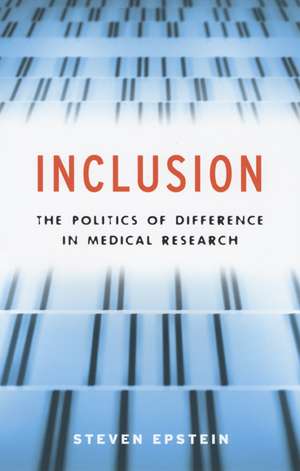
Inclusion: The Politics of Difference in Medical Research: Chicago Studies in Practices of Meaning
Autor Steven Epsteinen Limba Engleză Paperback – apr 2009
Găsim în Inclusion o analiză critică și profundă a modului în care sociologia și politica intersectează cercetarea medicală contemporană. Tema centrală nu este doar simpla reprezentare a minorităților, ci modul în care „politica diferenței” a remodelat protocoalele științifice începând cu anii '80. Notăm cu interes felul în care Steven Epstein demonstrează că, deși includerea femeilor și a minorităților în studiile clinice a fost o victorie a activismului, aceasta a generat o nouă paradigmă: „standardizarea de nișă”.
Ca și volumul Women and Health Research editat de Institute Of Medicine, această lucrare explorează etica reprezentării în medicină, dar Steven Epstein merge mai departe, aplicând o metodologie sociologică ce chestionează însăși validitatea categoriilor folosite. Dacă lucrările sale anterioare, precum Impure Science – Aids, Activism, & The Politics of Knowledge, analizau cum mișcările sociale au transformat cercetarea biomedicală, Inclusion extinde această perspectivă asupra întregului aparat de stat și academic.
Structura volumului este riguroasă, pornind de la o istorie a subiectului uman în cercetare și ajungând la concepte moderne precum „recrutamentologia” (știința recrutării subiecților) și monitorizarea conformității. Credem că această carte este esențială pentru a înțelege cum biopolitica modernă transformă cetățenia într-o chestiune de profilare biologică. Autorul nu se limitează la a descrie procesul, ci analizează critic consecințele acestor clasificări asupra modului în care percepem rasa și genul în laborator.
Din seria Chicago Studies in Practices of Meaning
-
 Preț: 286.52 lei
 -
 Preț: 355.06 lei
 -
 Preț: 228.95 lei
 -
 Preț: 238.11 lei
 -
 Preț: 219.10 lei
 -
 Preț: 250.21 lei
 -
 Preț: 261.94 lei
 -
 Preț: 259.83 lei
 -
 Preț: 292.62 lei
 -
 Preț: 253.36 lei
 -
 Preț: 243.00 lei
 -
 Preț: 309.23 lei
 -
 Preț: 238.72 lei
 -
 Preț: 333.68 lei
 -
 Preț: 387.68 lei
 - 27%
 Preț: 671.99 lei
 -
 Preț: 280.70 lei
 -
 Preț: 396.16 lei
 - 19%
 Preț: 200.81 lei
 - 14%
 Preț: 294.38 lei
 - 21%
 Preț: 172.43 lei
 - 16%
 Preț: 221.12 lei
 - 22%
 Preț: 183.33 lei
 - 31%
 Preț: 159.93 lei
 - 25%
 Preț: 446.21 lei
 - 32%
 Preț: 164.70 lei
Preț: 246.09 lei
Carte disponibilă
Livrare economică 17 noiembrie-01 decembrie
Livrare express 31 octombrie-06 noiembrie pentru 32.59 lei
Specificații
ISBN-10: 0226213102
Pagini: 432
Ilustrații: 2 line drawings
Dimensiuni: 152 x 229 x 28 mm
Greutate: 0.52 kg
Editura: University of Chicago Press
Colecția University of Chicago Press
Seria Chicago Studies in Practices of Meaning
V-ar putea interesa
-
 The Paramedic's Guide to Research: An IntroductionPauline Griffiths-33%Preț: 149.61 lei222.19 lei
 -
 Bayesian BiostatisticsEmmanuel Lesaffre-8%Preț: 547.71 lei595.34 lei
 -
 Applied Survival AnalysisDavid W Hosmer-5%Preț: 1009.30 lei1062.43 lei
 -
 BiometryRobert R. Sokal-11%Preț: 462.28 lei519.41 lei
 -
 -25%Preț: 88.90 lei118.53 lei
 -
 Research Handbook for Health Care ProfessionalsMary Hickson-5%Preț: 367.08 lei386.39 lei
 -
 Research Methods for Health Care PracticeFrances Griffiths-11%Preț: 373.38 lei419.54 lei
 -
 Kidnap for Ransom: Resolving the UnthinkableRichard P. Wright-18%Preț: 1114.04 lei1358.58 lei
De ce să citești această carte
Recomandăm această carte profesioniștilor din domeniul sănătății publice, bioeticii și sociologiei care doresc să înțeleagă mecanismele din spatele politicilor de diversitate. Cititorul va câștiga o perspectivă critică asupra modului în care cercetarea medicală este influențată de presiuni politice și sociale, învățând să distingă între incluziunea formală și echitatea reală în sănătate. Este o lectură fundamentală pentru cei care analizează impactul politicilor publice asupra științei.
Despre autor
Steven Epstein este profesor de istorie la University of Kansas, având o formație academică de prestigiu la instituții precum Swarthmore College, Cambridge și Harvard. Deși cariera sa timpurie s-a concentrat pe istoria socială și economică medievală, Epstein a devenit o voce autoritară în sociologia cunoașterii medicale. Lucrările sale, printre care The Quest for Sexual Health și Impure Science, explorează constant intersecția dintre știință, activism și identitate, analizând cum autoritatea medicală este construită și contestată în spațiul public.
Descriere scurtă
Formal concern with this issue, Epstein shows, is a fairly recent phenomenon. Until the mid-1980s, scientists often studied groups of white, middle-aged men—and assumed that conclusions drawn from studying them would apply to the rest of the population. But struggles involving advocacy groups, experts, and Congress led to reforms that forced researchers to diversify the population from which they drew for clinical research. While the prominence of these inclusive practices has offered hope to traditionally underserved groups, Epstein argues that it has drawn attention away from the tremendous inequalities in health that are rooted not in biology but in society.
“Epstein’s use of theory to demonstrate how public policies in the health profession are shaped makes this book relevant for many academic disciplines. . . . Highly recommended.”—Choice
“A masterful comprehensive overview of a wide terrain.”—Troy Duster, Biosocieties
Notă biografică
Cuprins
List of Abbreviations
Introduction: Health Research and the Remaking of Common Sense
1 How to Study a Biopolitical Paradigm
2 Histories of the Human Subject
3 The Rise of Resistance: Framing the Critique of the Standard Human
4 The Path to Reform: Aligning Categories, Targeting the State
5 Opposition to Reform: Controversy, Closure, and Boundary Work
6 Formalizing the New Regime
7 From the Standard Human to Niche Standardization
8 Counts and Consequences: Monitoring Compliance
9 The Science of Recruitmentology and the Politics of Trust
10 To Profile or Not to Profile: What Difference Does Race Make?
11 Sex Differences and the New Politics of Women’s Health
12 Whither the Paradigm?
Conclusion: Identity, Difference, Disparities, and Biopolitical Citizenship
Chronology
Interviews
Notes
Index
Recenzii
“This ‘recovering’ politician has many scars from fighting the National Institutes of Health (NIH) to get them to abandon their one size fits all/white males only research policy. Steven Epstein's book is a must read now that progressives won and inclusion is the new NIH research model. Inclusion has found many differences between people based on age, gender, race and other categories, but Epstein's book reminds us some of these differences could be caused by socioeconomic conditions. Citizens need to discern differences that are genetic and those driven by economic status, so politicians cannot use those differences to reinforce stereotypes they wish to create. Hurrah for a book that's not afraid to wade out there and clear the mines out of the field! That's what Epstein does.”