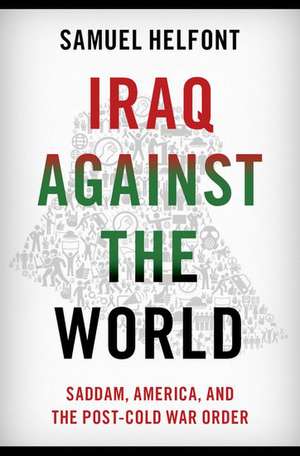
Iraq against the World: Saddam, America, and the Post-Cold War Order
Autor Samuel Helfonten Limba Engleză Hardback – 9 iun 2023
Preț: 217.29 lei
Preț vechi: 254.81 lei
-15%
Puncte Express: 326
Carte disponibilă
Livrare economică 13-18 noiembrie
Livrare express 29 octombrie-04 noiembrie pentru 70.88 lei
Livrare prin curier în România Termenul estimat este afișat lângă disponibilitate.
Transport gratuit de la 400.00 lei Plată online sau ramburs, în funcție de opțiunile comenzii.
Retur gratuit în 14 zile Comandă securizată și suport în română.
Specificații
ISBN-13: 9780197530153
ISBN-10: 019753015X
Pagini: 282
Dimensiuni: 162 x 243 x 24 mm
Greutate: 0.54 kg
Editura: Oxford University Press
Colecția OUP USA
Locul publicării:New York, United States
ISBN-10: 019753015X
Pagini: 282
Dimensiuni: 162 x 243 x 24 mm
Greutate: 0.54 kg
Editura: Oxford University Press
Colecția OUP USA
Locul publicării:New York, United States
Recenzii
Using the Iraqi archives for the first time, Helfont provides deep insights into how Saddam Hussein's Ba'thist regime sought to undermine America's post-Cold War order. Far from being a marginal actor on the global stage, Iraq's efforts inevitably placed it in the crosshairs of the George W. Bush administration and help explain why the disastrous invasion of Iraq became a White House obsession. The book successfully shifts our focus from great power politics to illustrate how relatively small countries can play important roles in world affairs. The focus on Iraq also helps explain wider transformations in international politics, and further emphasizes the central role of the Middle East over the last three decades.
Helfont has written the essential book about Iraqi influence operations abroad during the leadership tenure of Saddam Hussein. While most existing studies have focused on Iraq's domestic political scene, Helfont gives us a window into Iraqi activities abroad, including the conditions under which the regime succeeded or failed in achieving its foreign policy objectives.
Saddam Hussein's regime placed a high priority on undermining support for international sanctions on Iraq after 1991. Drawing on the vast archive of internal Ba'thist documents captured after the 2003 invasion, Samuel Helfont shows in gripping detail how the Iraqi regime sought to exploit global outrage over the humanitarian crisis. His account digs deep to document how Iraq attempted to manipulate well-intentioned civil society activists, journalists, politicians, and UN officials in a global campaign of information warfare and political manipulation.
Samuel Helfont, a brilliant Arabist with extensive experience on the ground, does indeed offer 'profound and unprecedented insights into Iraq's foreign policy.'ÂHis authoritative account reveals how the shrewd Âmaneuvers of Saddam Hussein's global Ba'thist network vexed the George H.W. Bush and Clinton administrations' efforts to forge a 'new world order' following the 1991 Gulf War. A chilling read.
This book deserves a wide readership among scholars of US foreign policy, global politics, and the Middle East. It is a landmark book not only of Iraq scholarship but global history...it is also a model of clear and concise historical writing.
Recommended. Undergraduates through faculty; general readers.
This book is a persuasive study for readers who are interested in understanding changes happening in the character of the UAE, specifically after the formal accession of Mohammed bin Zayed as head of the UAE in 2022.
The scope of Iraq against the World is impressive as it speaks to multiple audiences and literatures. Scholars of international relations, comparative politics, and diplomatic history would be interested in this book, as would policy-makers and journalists.
[A] fabulous account ... The fact is that the US's past politics in Iraq laid the foundation of the volatile Middle East one is witnessing today. Further, no other accounts on Iraq or US's geopolitical approach in the region in the decades of 1990s and 2000s have been so comprehensive and well-explained as is the case with this volume. The book is a must-read for those who are keen to grasp the essence of the past and present politics of Iraq along with the larger Middle East and how the US has been a catalyst in shaping today's Middle East.
[This book] forced me to reconceptualize the wars that have been the focus of my days and my nightmares for the past three decades.
Overall, this clear, well-researched book offers an important retelling of the post-Cold War era, highlighting Iraq's central role in the 1990s diplomatic efforts to establish a New World Order. By centering the Iraqi government's actions, Helfont restores an important balance in diplomatic history by underscoring the active role the Baʿth Party played in challenging the terms of sanctions.
Helfont has written the essential book about Iraqi influence operations abroad during the leadership tenure of Saddam Hussein. While most existing studies have focused on Iraq's domestic political scene, Helfont gives us a window into Iraqi activities abroad, including the conditions under which the regime succeeded or failed in achieving its foreign policy objectives.
Saddam Hussein's regime placed a high priority on undermining support for international sanctions on Iraq after 1991. Drawing on the vast archive of internal Ba'thist documents captured after the 2003 invasion, Samuel Helfont shows in gripping detail how the Iraqi regime sought to exploit global outrage over the humanitarian crisis. His account digs deep to document how Iraq attempted to manipulate well-intentioned civil society activists, journalists, politicians, and UN officials in a global campaign of information warfare and political manipulation.
Samuel Helfont, a brilliant Arabist with extensive experience on the ground, does indeed offer 'profound and unprecedented insights into Iraq's foreign policy.'ÂHis authoritative account reveals how the shrewd Âmaneuvers of Saddam Hussein's global Ba'thist network vexed the George H.W. Bush and Clinton administrations' efforts to forge a 'new world order' following the 1991 Gulf War. A chilling read.
This book deserves a wide readership among scholars of US foreign policy, global politics, and the Middle East. It is a landmark book not only of Iraq scholarship but global history...it is also a model of clear and concise historical writing.
Recommended. Undergraduates through faculty; general readers.
This book is a persuasive study for readers who are interested in understanding changes happening in the character of the UAE, specifically after the formal accession of Mohammed bin Zayed as head of the UAE in 2022.
The scope of Iraq against the World is impressive as it speaks to multiple audiences and literatures. Scholars of international relations, comparative politics, and diplomatic history would be interested in this book, as would policy-makers and journalists.
[A] fabulous account ... The fact is that the US's past politics in Iraq laid the foundation of the volatile Middle East one is witnessing today. Further, no other accounts on Iraq or US's geopolitical approach in the region in the decades of 1990s and 2000s have been so comprehensive and well-explained as is the case with this volume. The book is a must-read for those who are keen to grasp the essence of the past and present politics of Iraq along with the larger Middle East and how the US has been a catalyst in shaping today's Middle East.
[This book] forced me to reconceptualize the wars that have been the focus of my days and my nightmares for the past three decades.
Overall, this clear, well-researched book offers an important retelling of the post-Cold War era, highlighting Iraq's central role in the 1990s diplomatic efforts to establish a New World Order. By centering the Iraqi government's actions, Helfont restores an important balance in diplomatic history by underscoring the active role the Baʿth Party played in challenging the terms of sanctions.
Notă biografică
Samuel Helfont is Assistant Professor of Strategy and Policy in the Naval War College program at the Naval Postgraduate School in Monterey, California. His research focuses on international history and politics in the Middle East, especially Iraq and the Iraq Wars. He maintains affiliations with the Abbasi Program in Islamic Studies at Stanford University and the Foreign Policy Research Institute in Philadelphia. He is the author of Compulsion in Religion: Saddam Hussein, Islam, and the Roots of Insurgencies in Iraq (Oxford University Press, 2018). His work has also been published by Foreign Affairs, The International History Review, The Middle East Journal, Texas National Security Review, Orbis, The Washington Post, The New Republic, The American Interest, and War on the Rocks, among other outlets. Helfont served as an intelligence officer in the US Navy and Navy Reserve. An Iraq War veteran, he completed deployments both afloat and ashore in the Middle East. He also served onMiddle Eastern and counterterrorism missions at various American intelligence agencies.
Cuprins
- Preface and Acknowledgements
- Introduction
- Chapter One: Precursors
- Chapter Two: The Gulf Crisis and the New World Order
- Chapter Three: Triumph and Despair After the Gulf War
- Chapter Four: Building Networks in the West, 1991-1992
- Chapter Five: Toward Influencing Policy in the non-Western World, 1991-1992
- Chapter Six: Courting Clinton
- Chapter Seven: A Turning Point for the New World Order
- Chapter Eight: Breaking Isolation
- Chapter Nine: Normalization, 9/11, and the Road to War
- Conclusion and Afterword: Saddam's Iraq and 21st Century Disorder
- Bibliography