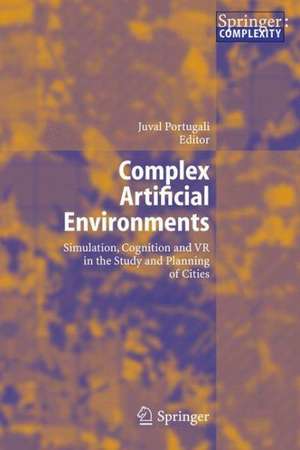
Complex Artificial Environments
Editat de Juval Portugalien Limba Engleză Paperback – 12 feb 2010
Subliniem importanța acestui volum pentru cercetătorii și profesioniștii care vizează acreditări avansate în urbanism și geografie umană, oferind o fundamentare teoretică solidă pentru utilizarea tehnologiilor geospațiale moderne. Complex Artificial Environments reprezintă o sinteză critică a modului în care teoriile auto-organizării pot fi aplicate orașelor secolului XXI prin intermediul simulărilor digitale și al realității virtuale.
Notăm cu interes modul în care editorul Juval Portugali reușește să medieze dialogul între rigoarea matematică a științelor exacte și interpretarea calitativă a mediilor urbane. Structura cărții ghidează cititorul de la fundamentele teoretice ale vizualizării spațiale către aplicații practice complexe, precum proiectul CityDev sau software-ul OBEUS, indicând o progresie clară de la concept la implementarea tehnică.
Acoperă aceeași arie tematică precum The City and Its Sciences, dar cu o abordare mai orientată către instrumentele digitale de simulare și cogniția spațială în medii VR. În contextul operei editorului, lucrarea se plasează ca o extensie tehnică a conceptelor din Self-Organization and the City, transformând teoria abstractă a sistemelor complexe în metodologii aplicabile de modelare urbană. Dacă în Information Adaptation autorul se concentra pe raportul dintre informația Shannon și cea semantică, aici el extinde această analiză la nivelul „agenților” urbani care interacționează în spații artificiale simulate. Putem afirma că volumul rămâne o resursă de referință pentru înțelegerea modului în care tehnologia VR și sistemele multi-agent pot prezice dinamica evoluției orașelor contemporane.
Preț: 911.19 lei
Preț vechi: 1111.20 lei
-18%
Carte tipărită la comandă
Livrare economică 29 iulie-12 august
Specificații
ISBN-10: 3642065295
Pagini: 340
Ilustrații: XVIII, 322 p.
Dimensiuni: 155 x 235 x 19 mm
Greutate: 0.52 kg
Ediția:Softcover reprint of hardcover 1st ed. 2006
Editura: Springer
Locul publicării:Berlin, Heidelberg, Germany
V-ar putea interesa
-
 Wild CitiesChris FitchPreț: 122.78 lei
 -
 The Nature of Our CitiesNadina GallePreț: 157.92 lei
 -
 City Planning: A Very Short IntroductionCarl Abbott-21%Preț: 49.84 lei63.16 lei
 -
 The Computable CityMichael BattyPreț: 349.73 lei
 -
 Inventing Future CitiesMichael Batty-23%Preț: 138.37 lei179.66 lei
 -
 The Image of the CityKevin LynchPreț: 242.73 lei
 -
 Virtual Reality: Architecture, Culture, and the BodyTatjana Crossley-9%Preț: 1199.39 lei1318.01 lei
 -
 Geodesign, Urban Digital Twins, and FuturesPaul CuretonPreț: 333.98 lei
 -
 -20%Preț: 357.83 lei447.29 lei
 -
 -16%Preț: 212.88 lei254.75 lei
 -
 Thinking through Archaeological ComplexityStefani A. CrabtreePreț: 363.24 lei
 -
 The Nature of Code: Simulating Natural Systems with JavaScriptDaniel Shiffman-35%Preț: 208.06 lei320.97 lei
 -
 The Homegrown CityMatias EchanovePreț: 150.24 lei
 -
 The Atomic HumanNeil D. LawrencePreț: 92.92 lei
 -
 The City and the WorldGregor HensPreț: 106.43 lei
 -
 -23%Preț: 682.99 lei887.01 lei
 -
 Reconnecting Cities, People, and NatureVictor Muñoz SanzPreț: 269.72 lei
 -
 Modeling Complex Processes Through Nature-Analogous MethodsChristina Klüver-13%Preț: 469.62 lei539.79 lei
 -
 Environments of Planetary UrbanizationNeil BrennerPreț: 306.53 lei
 -
 Flux CitiesGregor H. MewsPreț: 295.66 lei
Public țintă
ResearchDe ce să citești această carte
Această lucrare este esențială pentru doctoranzi și urbaniști care doresc să stăpânească fundamentele geosimulării și ale modelării multi-agent. Cititorul câștigă o perspectivă interdisciplinară rară, învățând cum să aplice teoriile complexității în planificarea urbană prin intermediul instrumentelor digitale. Este un motiv concret pentru a explora intersecția dintre știința cognitivă și arhitectura sistemelor artificiale de mari dimensiuni.
Cuprins
Recenzii
"The book represents the current state of thinking in the use of complex systems theory with geospatial technologies for understanding cities. It is organized into five coherent parts. … the book as a whole a unique reference source. In summary, Portugali’s book can be valuable for researchers who deal with the modeling of complex land-use change processes in urban and regional contexts. It can also be used for advanced seminar courses on topics in geosimulation." (Suzana Dragicevic, Journal of Regional Science, Vol. 48 (2), 2008)
Textul de pe ultima copertă
Descriere
Juval Portugali The notion of complex artificial environments (CAE) refers to theories of c- plexity and self-organization, as well as to artifacts in general, and to artificial - vironments, such as cities, in particular. The link between the two, however, is not trivial. For one thing, the theories of complexity and self-organization originated in the "hard" science and by reference to natural phenomena in physics and bi- ogy. The study of artifacts, per contra, has traditionally been the business of the "soft" disciplines in the humanities and social sciences. The notion of "complex artificial environments" thus implies the supposition that the theories of compl- ity and self-organization, together with the mathematical formalisms and meth- ologies developed for their study, apply beyond the domain of nature. Such a s- st position raises a whole set of questions relating to the nature of 21 century cities and urbanism, to philosophical issues regarding the natural versus the artificial, to the methodological legitimacy of interdisciplinary transfer of theories and me- odologies and to the implications that entail the use of sophisticated, state-of-t- art artifacts such as virtual reality (VR) cities and environments. The three-day workshop on the study of complex artificial environments that took place on the island of San Servolo, Venice, during April 1-3, 2004, was a gathering of scholars engaged in the study of the various aspects of CAE.