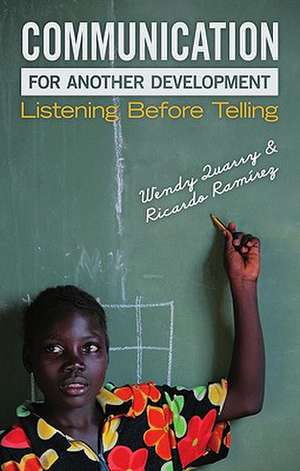
Communication for Another Development: Listening before Telling
Autor Wendy Quarry, Ricardo Ramirezen Limba Engleză Hardback – 13 aug 2009
Problema centrală pe care o rezolvă Communication for Another Development este eșecul sistemic al proiectelor de dezvoltare care ignoră contextul local în favoarea unor strategii rigide, impuse de la centru. Remarcăm o critică argumentată la adresa modelului tradițional în care comunicarea este văzută doar ca un instrument de diseminare a deciziilor deja luate, nu ca un proces participativ de ascultare. Subliniem că Wendy Quarry și Ricardo Ramirez nu scriu din turnul de fildeș al academiei, ci din experiența lor de decenii ca practicieni pe teren, oferind o perspectivă rară asupra a ceea ce ei numesc 'zona gri' a negocierii și implementării.
Pe linia teoretică a lucrării Communication for Development and Social Change, dar cu focus pe pragmatismul implementării la nivelul solului, această carte demonstrează că succesul oricărei inițiative depinde de capacitatea de a deveni un 'căutător' mai degrabă decât un 'planificator'. Structura textului este riguros organizată pentru a facilita progresia de la teorie la practică: după stabilirea scenei și definirea conceptului de 'altfel de dezvoltare' în prima parte, autorii trec în secțiunea a doua la lecții concrete învățate de la lideri de proiect care au reușit să schimbe paradigma. În final, partea a treia oferă un set de repere (touchstones) pentru formare și negociere, esențiale pentru oricine dorește să transforme comunicarea dintr-o funcție de PR într-un motor de schimbare socială. Stilul este lipsit de jargon, transformând concepte complexe în instrumente de lucru accesibile.
Preț: 547.72 lei
Preț vechi: 821.57 lei
-33%
Carte tipărită la comandă
Livrare economică 19 noiembrie-03 decembrie
Specificații
ISBN-10: 1848130082
Pagini: 168
Dimensiuni: 138 x 216 x 15 mm
Greutate: 0.32 kg
Editura: Bloomsbury Publishing
Colecția Zed Books
Locul publicării:London, United Kingdom
V-ar putea interesa
-
 Deep ListeningEmily KasrielPreț: 108.46 lei
 -
 AustraliaPhillip Knightley-20%Preț: 73.53 lei92.17 lei
 -
 Communication in Midwifery: Theory and PracticeTania Staras-30%Preț: 213.77 lei304.95 lei
 -
 Preț: 383.89 leiRecomandat
 -
 Stories in Health CommunicationGjyn O'Toole-33%Preț: 251.89 lei374.56 lei
 -
 Thinking Through CommunicationAdam RothPreț: 410.15 lei
 -
 Theories and Practices of DevelopmentKatie WillisPreț: 350.01 lei
 -
 -8%Preț: 454.66 lei494.19 lei
 -
 The Communication CodeJeremie KubicekPreț: 99.12 lei
 -
 The Companion to Development StudiesVandana Desai-8%Preț: 543.23 lei590.48 lei
 -
 Radical ListeningChristian van NieuwerburghPreț: 149.03 lei
 -
 Preț: 204.53 lei
 -
 -49%Preț: 34.60 lei67.75 lei
 -
 Preț: 63.69 lei
 -
 OracyNeil MercerPreț: 135.70 lei
 -
 Learning for DevelopmentDoctor Gordon Wilson-26%Preț: 148.67 lei199.61 lei
De ce să citești această carte
Această carte se adresează profesioniștilor din ONG-uri, decidenților politici și studenților la economie care doresc să înțeleagă de ce multe proiecte de dezvoltare eșuează în ciuda finanțărilor masive. Cititorul va câștiga un cadru metodologic clar pentru a implementa strategii participative reale. Este o resursă esențială pentru a învăța cum să asculți activ comunitățile înainte de a propune soluții tehnice.
Descriere
Free from jargon, and keeping a close look at how development is actually being implemented at ground level, this book is an important contribution to development studies not just for students but also for development practitioners and policy makers.
Cuprins
Introduction
About this book
1. Communication for development: Setting the scene
Part I: What We Know
2. The meaning of Another Development
3. Planners and searchers: Two ways of doing development
4. Why communicators can't communicate
Part II: What We Learned
5. Working in the grey zone
6. Early champions: Uncovering principles
7. New activists: Principles that travel
8. The forgotten context
Part III: What We Can Do Differently
9. Training and negotiating in the grey zone: A collection of touchstones
10. Searching and listening: Good development breeds good communication
Postscript: Cultivating common sense on the farm
References
Recenzii
Personal funny and entertaining, this book provides a better insight into the value, potential - and ultimately hugely frustrating practice - of using communication to listen rather than tell than any I've come across for a very long time. Anyone interested in development will learn much from this book. Those working or interested in using communication in development could usefully place it on their required reading list.
Quarry and Ramirez have written a highly readable, information-packed, lucid book on the challenges and successes of communication for international social change. Drawing from their extensive expertise, they patiently dissect the lessons from numerous programs showing how grassroots communication contributes to sustainable change.