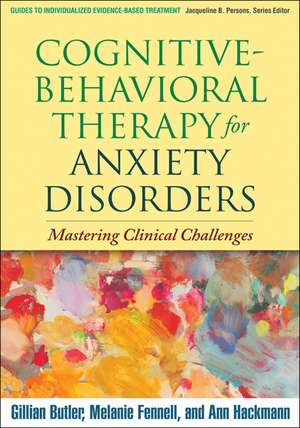
Cognitive-Behavioral Therapy for Anxiety Disorders: Mastering Clinical Challenges: Guides to Individualized Evidence-Based Treatment
Autor Gillian Butler, Melanie Fennell, Ann Hackmannen Limba Engleză Paperback – 9 iun 2010
În practica clinică, tranziția de la protocoalele standardizate la gestionarea cazurilor rezistente necesită un algoritm de lucru flexibil, dar riguros. Putem afirma că volumul Cognitive-Behavioral Therapy for Anxiety Disorders propune exact acest cadru, începând cu un protocol de investigare a evaluărilor cognitive (appraisals) în profunzime, esențial pentru a depăși impasurile terapeutice inițiale. Subliniem modul în care Gillian Butler și echipa sa reușesc să transforme complexitatea clinică într-o formulare de caz coerentă, facilitând obiectivitatea pacientului prin tehnici avansate de decentrare.
Remarcăm structura logică a lucrării, divizată în cinci părți ce oglindesc progresia naturală a terapiei: de la stabilirea cadrului și evaluare, la procesarea emoțională profundă prin experimente comportamentale, până la faza critică a încheierii tratamentului prin crearea unui „blue-print” terapeutic. Clinicienii care folosesc Treatment Resistant Anxiety Disorders ca referință vor găsi aici instrumentele necesare pentru a aborda specific obstacolele care blochează progresul, cum ar fi evitarea afectului sau frica paralizantă de incertitudine. Spre deosebire de manualele care se limitează la controlul simptomelor, această lucrare vizează schimbarea durabilă la nivelul structurilor cognitive profunde.
Această abordare clinică avansată continuă direcția stabilită de Gillian Butler în Oxford Guide to Behavioural Experiments in Cognitive Therapy, rafinând utilizarea experimentelor ca instrument de schimbare emoțională, nu doar cognitivă. Dacă în lucrările sale anterioare, precum Manage Your Mind, accentul cădea pe reziliența generală, volumul de față este o resursă strict specializată, dedicată profesioniștilor care doresc să stăpânească nuanțele fine ale psihoterapiei cognitiv-comportamentale aplicate tulburărilor de anxietate.

Preț: 291.45 lei
Preț vechi: 306.79 lei
-5%
Carte disponibilă
Livrare economică 03-17 august
Livrare express 17-23 iulie pentru 32.68 lei
Specificații
ISBN-10: 1606238698
Pagini: 224
Dimensiuni: 178 x 254 x 25 mm
Greutate: 0.44 kg
Ediția:1
Editura: Guilford Publications
Colecția Guilford Press
Seria Guides to Individualized Evidence-Based Treatment
V-ar putea interesa
-
 -27%Preț: 342.49 lei467.61 lei
 -
 Mastery of Your Anxiety and Panic: WorkbookDavid H. Barlow-18%Preț: 294.93 lei360.83 lei
 -
 Oxford Guide to Behavioural Experiments in Cognitive TherapyJames Bennett-Levy-22%Preț: 419.57 lei537.13 lei
 -
 -5%Preț: 271.33 lei285.60 lei
 -
 Cognitive Behavioral Group TherapyIngrid Sochting-23%Preț: 610.06 lei792.27 lei
 -
 The Wiley Handbook of Cognitive Behavioral Therapy, 3 Volume SetStefan G. Hofmann-26%Preț: 2549.95 lei3429.88 lei
 -
 Cognitive-Behavioral Treatment of PerfectionismSarah J. Egan-5%Preț: 303.88 lei319.88 lei
 -
 -5%Preț: 315.46 lei332.07 lei
 -
 Exposure Therapy for Anxiety, Second Edition: Principles and PracticeJonathan S. Abramowitz-5%Preț: 411.52 lei433.18 lei
 -
 Cognitive Behavior Therapy, Third Edition: Basics and BeyondJudith S. Beck-5%Preț: 481.93 lei507.29 lei
 -
 -5%Preț: 827.72 lei871.28 lei
 -
 -27%Preț: 67.70 lei92.75 lei
 -
 -28%Preț: 50.35 lei70.31 lei
 -
 An Introduction to Cognitive Behaviour TherapyHelen Kennerley-5%Preț: 340.17 lei358.07 lei
 -
 Cognitive-Behavioral Therapy in GroupsPeter J. Bieling-5%Preț: 365.18 lei384.40 lei
 -
 -5%Preț: 634.33 lei667.72 lei
 -
 Cognitive Therapy of Anxiety Disorders: Science and PracticeDavid A. Clark-5%Preț: 522.29 lei549.77 lei
 -
 The Anxiety and Phobia Workbook (8th Edition)Edmund J. Bourne-22%Preț: 122.21 lei156.49 lei
 -
 -27%Preț: 103.29 lei140.85 lei
 -
 The Anxiety and Phobia WorkbookEdmund J. BournePreț: 168.03 lei
Public țintă
Professional Practice & DevelopmentDe ce să citești această carte
Această lucrare este esențială pentru psihoterapeuții care caută soluții dincolo de protocoalele standard pentru anxietate. Cititorul câștigă o metodologie clară pentru conceptualizarea cazurilor dificile și instrumente practice (fișe reproductibile) pentru a aborda stima de sine scăzută și intoleranța la incertitudine. Este o resursă de perfecționare profesională ce transformă teoria în intervenții clinice de precizie.
Despre autor
Gillian Butler este psiholog clinician consultant și membru de onoare al British Psychological Society. Cu o carieră academică și clinică prodigioasă, aceasta profesează în cadrul Oxfordshire Mental Healthcare Trust. Expertiza sa în terapia cognitiv-comportamentală este recunoscută la nivel internațional, fiind co-autoarea unor lucrări fundamentale care au definit utilizarea experimentelor comportamentale în psihoterapie. Prin contribuțiile sale, Butler a modelat modul în care clinicienii abordează mecanismele de schimbare în tulburările de anxietate, combinând rigoarea cercetării cu empatia practicii clinice.
Descriere scurtă
Cuprins
I. Setting the Scene
1. Treating Anxiety Disorders: The State of the Art
II. Deepening Understanding and Securing Engagement
2. Assessment: Investigating Appraisals in Depth
3. Case Formulation: Making Sense of Complexity
4. Decentering from Thoughts: Achieving Objectivity
III. Facilitating Emotional Processing
5. Bringing About Lasting Change at the Deepest Level
6. The Role of Behavioral Experiments
IV. Overcoming Three Major Obstacles to Progress
7. Avoidance of Affect
8. Low Self-Esteem
9. Dealing with Uncertainty
V. Ending Treatment Productively
10. Creating a Therapy Blueprint
Notă biografică
Melanie Fennell, PhD, is Director of the University of Oxford Diploma/MSc in Advanced Cognitive Therapy Studies and is a research therapist in Oxford's Department of Psychiatry. She will also codirect a new Master of Studies in Mindfulness-Based Cognitive Therapy program. Dr. Fennell has contributed to the development of treatment protocols for depression and for a range of anxiety disorders, and has published widely on CBT for depression and low self-esteem. In 2002, she was voted "Most Influential Female UK Cognitive Therapist" by the membership of the British Association of Behavioural and Cognitive Psychotherapies.
Ann Hackmann, PhD, until her death in 2017, was a Consultant Clinical Psychologist at the Oxford Cognitive Therapy Centre and the Department of Psychiatry, University of Oxford. She has worked for over 20 years in a research group specializing in the development of cognitive therapy protocols for anxiety disorders. She was particularly interested in working with imagery in cognitive therapy, and published widely on this topic. Dr. Hackmann provided teaching and training in cognitive therapy in many national and international settings, and was a Founding Fellow of the Academy of Cognitive and Behavioral Therapies.
Recenzii
"This book must be read by all those who seek to help people suffering from anxiety disorders. It clearly and accessibly portrays the essence of effective CBT for anxiety while avoiding oversimplified prescriptions. The book is unique in helping clinicians to achieve the integration of clinical art and clinical science that characterizes excellent CBT. The reader will learn essential therapeutic skills for striking a balance in two key areas: between general and specific factors in anxiety disorders and their treatment, and between self-acceptance and recognizing and implementing the need for change. Read this book and use it!"--Paul Salkovskis, PhD, CPsychol, Institute of Psychiatry, King’s College, London, and Clinical Director, Centre for Anxiety Disorders and Trauma, South London and Maudsley NHS Foundation Trust