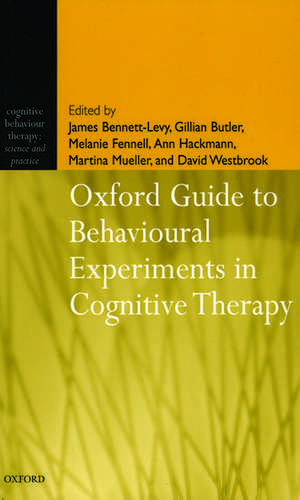
Oxford Guide to Behavioural Experiments in Cognitive Therapy: Cognitive Behaviour Therapy: Science and Practice
Editat de James Bennett-Levy, Gillian Butler, Melanie Fennell, Ann Hackmann, Martina Mueller, David Westbrook Autor Khadj Roufen Limba Engleză Paperback – 6 mai 2004
Preț: 440.67 lei
Preț vechi: 545.60 lei
-19%
Puncte Express: 661
Carte tipărită la comandă
Livrare economică 31 decembrie 26 - 06 ianuarie 27
Livrare express 21-27 noiembrie pentru 106.09 lei
Livrare prin curier în România Termenul estimat este afișat lângă disponibilitate.
Transport gratuit pentru acest produs Plată online sau ramburs, în funcție de opțiunile comenzii.
Retur gratuit în 14 zile Comandă securizată și suport în română.
Specificații
ISBN-13: 9780198529163
ISBN-10: 0198529163
Pagini: 496
Ilustrații: numerous tables and line drawings
Dimensiuni: 156 x 234 x 27 mm
Greutate: 0.74 kg
Editura: OUP OXFORD
Colecția OUP Oxford
Seria Cognitive Behaviour Therapy: Science and Practice
Locul publicării:Oxford, United Kingdom
ISBN-10: 0198529163
Pagini: 496
Ilustrații: numerous tables and line drawings
Dimensiuni: 156 x 234 x 27 mm
Greutate: 0.74 kg
Editura: OUP OXFORD
Colecția OUP Oxford
Seria Cognitive Behaviour Therapy: Science and Practice
Locul publicării:Oxford, United Kingdom
V-ar putea interesa
-
 Cognitive Therapy and the Emotional DisordersAaron T Beck-33%Preț: 62.43 lei93.33 lei
-
 The Wiley Handbook of Cognitive Behavioral Therapy, 3 Volume SetStefan G. Hofmann-23%Preț: 2668.78 lei3484.39 lei
-
 Preț: 431.99 lei
-
 -5%Preț: 461.07 lei485.34 lei
-
 -5%Preț: 530.52 lei558.44 lei
-
 -5%Preț: 314.36 lei330.91 lei
-
 -5%Preț: 320.42 lei337.28 lei
-
 Cognitive Behavior Therapy, Third Edition: Basics and BeyondJudith S. Beck-5%Preț: 501.31 lei527.69 lei
-
 -5%Preț: 877.11 lei923.28 lei
-
 Handbook of Cognitive-Behavioral Therapies, Fourth EditionKeith S. Dobson-5%Preț: 420.89 lei443.05 lei
-
 -26%Preț: 52.78 lei71.42 lei
-
 An Introduction to Cognitive Behaviour TherapyHelen Kennerley-5%Preț: 367.59 lei386.93 lei
-
 Cognitive-Behavioral Therapy for Bipolar Disorder, Second EditionMonica Ramirez Basco-5%Preț: 352.75 lei371.32 lei
-
 -5%Preț: 644.36 lei678.27 lei
-
 Cognitive Therapy of Anxiety Disorders: Science and PracticeDavid A. Clark-5%Preț: 530.52 lei558.44 lei
-
 -26%Preț: 93.55 lei126.43 lei
-
 A Practical Guide to CBTElaine Iljon Foreman-5%Preț: 68.39 lei71.98 lei
Recenzii
For anyone new coming into CBT, this book provides a wealth of learning and practical advice along with tried and trusted behavioural experiments for all the most common thinking distortions across all the major presenting problems common in everyday practice. Behavioural experiments are one of the mainstays and most powerful methods of intervention in cognitive therapy, so a book devoted to this one subject is well overdue and more than welcome.
Books like this are few and far between. It works as an accessible introduction to the practice of contemporary CBT, an overview of the most useful cognitive models of psychological disorders, and a unique reference book for finding out practical instructions and creative inspirations.
This new text... will attract interest both as a very valuable addition to the teaching and training resources in cognitive behaviour therapy (CBT), and is the first book to emerge from the Oxford Cognitive Therapy Centre subsequent to the departure of Professors Clark and Salkovskis to London. The volume is produced by the group of research clinicians who carried out the clinical trials and research work in developing cognitive therapy for anxiety disorders at Oxford... Both the wealth of clinical experience within a research framework and their teaching expertise are evident from this publication... In total, the book represents a considerable achievement and a tribute to the extent of CBT expertise within Oxford and the ability of this extended team to work together within a coherent framework.
Each chapter follows a systematic structure, making the book extremely accessible for the busy clinician who will find it easy to use as a resource in the clinic... It becomes apparent that in the hands of the Oxford group, the behavioural experiment becomes a very flexible tool, applicable to more open-ended enquiry as well as precise disconfirmation of predictions and capable of having impact upon all levels of cognition from the specific to the most general and abstract... The book has a much more clinical feel than many other CBT texts: the balance between theory and practice is much more weighted towards the latter; there is more acknowledgement of difficulties and complexities presented by patients in real life and therefore the attitude conveyed shows more humility in the face of such difficulties, making frequent references to therapists' needs for supervision, and so forth, while still conveying enthusiasm and optimism.
This book offers an excellent practical guide in how to carry out effective behavioural experiments... I am glad that I will have [it] on my bookshelf and I foresee using it with profit for the rest of my professional career. If you have only a limited budget for professional books, I would certainly recommend this one as a useful one to own.
An enjoyable and stimulating read with lots of useful insights.
This book is easy to read with clearly structured chapters set out in a consistent format that will appeal to new and experienced therapists alike, and will be invaluable in both the practice of CT and the delivery of training in it.
Cuprins
- Foreword
- 1: James Bennett-Levy, David Westbrook, Melanie Fennell, Myra Cooper, Khadj Rouf and Ann Hackmann: Behavioural experiments: historical and conceptual underpinnings
- 2: Khadj Rouf, Melanie Fennell, David Westbrook, Myra Cooper and James Bennett-Levy: Devising effective behavioural experiments
- 3: Ann Hackmann: Panic disorder and agoraphobia
- 4: Amy Silver, Diana Sanders, Norma Morrison and Carolyn Cowie,: Health anxiety
- 5: Norma Morrison and David Westbrook: Obsessive-compulsive disorder
- 6: Gillian Butler and Khadj Rouf: Generalised anxiety disorder
- 7: Gillian Butler and Ann Hackmann: Social anxiety
- 8: Joan Kirk and Khadj Rouf: Specific phobias
- 9: Martina Mueller, Ann Hackmann and Alison Croft: Post Traumatic Stress Disorder
- 10: Melanie Fennell, James Bennett-Levy and David Westbrook: Depression
- 11: June Dent, Helen Close and Joanne Ryder: Bipolar affective disorders
- 12: Helen Close and Stefan Schuller: Psychotic symptoms
- 13: Myra Cooper, Linette Whitehead and Nicky Boughton: Eating disorders
- 14: Melissa Ree and Allison Harvey: Insomnia
- 15: Amy Silver, Christina Surawy and Diana Sanders: Physical illness and disability
- 16: Joanna McGrath and Nigel King: Acquired brain injury
- 17: Gillian Butler and Christina Surawy: Avoidance of affect
- 18: Helen Kennerley: Self-injurious behaviour
- 19: Paul Flecknoe and Diana Sanders: Interpersonal difficulties
- 20: Melanie Fennell and Helen Jenkins: Low self-esteem
- 21: Christine Padesky: Behavioural experiments: at the crossroads