
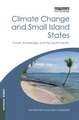
Climate Change and Small Island States: Power, Knowledge and the South Pacific: Earthscan Climate
Autor Jon Barnett, John Campbellen Limba Engleză Hardback – 31 mar 2010
| Toate formatele și edițiile | Preț | Express |
|---|---|---|
| Paperback (1) | 448.71 lei 6-8 săpt. | |
| Taylor & Francis – 9 iun 2015 | 448.71 lei 6-8 săpt. | |
| Hardback (1) | 1015.27 lei 6-8 săpt. | |
| Taylor & Francis – 31 mar 2010 | 1015.27 lei 6-8 săpt. |
Preț: 1015.27 lei
Preț vechi: 1238.14 lei
-18% Nou
Puncte Express: 1523
Preț estimativ în valută:
179.66€ • 210.67$ • 157.78£
179.66€ • 210.67$ • 157.78£
Carte tipărită la comandă
Livrare economică 04-18 februarie 26
Preluare comenzi: 021 569.72.76
Specificații
ISBN-13: 9781844074945
ISBN-10: 1844074943
Pagini: 232
Dimensiuni: 156 x 234 x 23 mm
Greutate: 0.5 kg
Ediția:1
Editura: Taylor & Francis
Colecția Routledge
Seria Earthscan Climate
Locul publicării:Oxford, United Kingdom
ISBN-10: 1844074943
Pagini: 232
Dimensiuni: 156 x 234 x 23 mm
Greutate: 0.5 kg
Ediția:1
Editura: Taylor & Francis
Colecția Routledge
Seria Earthscan Climate
Locul publicării:Oxford, United Kingdom
V-ar putea interesa
-
 Preț: 83.95 lei
 -
 Turnaround Challenge: Business and the City of the FutureMichael Blowfield-10%Preț: 284.50 lei317.57 lei
 -
 -27%Preț: 906.87 lei1242.21 lei
 -
 -34%Preț: 754.86 lei1137.77 lei
 -
 New Directions for Smallholder AgriculturePeter B. R. Hazell-17%Preț: 330.66 lei397.96 lei
 -
 Elements of Ecological EconomicsJan Otto Andersson-15%Preț: 475.24 lei559.10 lei
 -
 Permit Trading in Different ApplicationsBernd Hansjürgens-18%Preț: 1073.64 lei1309.31 lei
 -
 Land Use Problems and Conflicts: Causes, Consequences and SolutionsJohn C. BergstromPreț: 422.71 lei
 -
 Ending Dirty Energy Policy: Prelude to Climate ChangeJoseph P. TomainPreț: 241.39 lei
 -
 Campbell, J: F. E. SmithJohn CampbellPreț: 260.95 lei
 -
 CastingsJohn CampbellPreț: 490.05 lei
 -
 Preț: 232.67 lei
 -
 Preț: 100.24 lei
 -
 Preț: 341.82 lei
 -
 The HittiesDegrande, DonnaPreț: 178.06 lei
 -
 -18%Preț: 1575.58 lei1921.44 lei
 -
 Green Economics: An Introduction to Theory, Policy and PracticeMolly Scott CatoPreț: 397.66 lei
 -
 Ecological Economics from the Ground UpHali HealyPreț: 468.10 lei
 -
 Corporate Environmental Management 1: Systems and strategiesRichard Welford-18%Preț: 1019.05 lei1242.74 lei
 -
 The Meaning of Environmental SecurityJon Barnett-18%Preț: 242.45 lei293.89 lei
 -
 -41%Preț: 75.81 lei127.54 lei
Cuprins
1. The Trouble with Climate Change2. Environment and Development in Pacific Islands3. The History and Architecture of Climate Science4. Pacific Science Initiatives5. The Architecture of Climate Change Policy6. Doing Climate Change in the Pacific7. Investing in Uncertainty and Vulnerability8. Discourses of Danger9. Conclusions
Notă biografică
Dr Jon Barnett has a PhD in Resource Management and Environmental Science from the Australian National University and is currently an Australian Research Council Fellow at the University of Melbourne. John Campbell has a PhD in Geography from the University of Hawaii and is currently Associate Professor at the Department of Geography, University of Waikato, New Zealand.
Recenzii
'This is a courageous and provocative book. It challenges the prevailing views and assumptions about the science and policy of climate change. The focus is on Pacific small island states, but the questions raised apply worldwide. This is a timely check on established paradigms and their effectiveness (or otherwise) in contributing to practical adaptation to climate change in vulnerable regions.'Barry Smit, Canada Research Chair in Global Environmental Change, University of Guelph, Canada'Climate Change and Small Island States is a timely and most welcome book. It shows the value of using powerful social science insights to enrich what are often bland and superficial accounts of climate change impacts. Barnett and Campbell's book will contribute to the slowly growing critical literature which challenges the climate change science-and-policy orthodoxy, an orthodoxy which has narrowed our thinking and failed our people. This book is about enabling and trusting the people to take back control of their lives.' Mike Hulme, Tyndall Centre for Climate Change Research'This is a fascinating book about small South Pacific islands and climate change that takes care to highlight the differences between the islands, gives agency to their residents, and shows the significance of history and political economy. Using critical perspectives on power and knowledge, the authors show how science and other discursive formations have represented the vulnerability of small island states and the ways in which these have overlooked the nuances of local experience, structured international debate, and limited the success of adaptation to date. The innovative theoretical perspective gives the book considerable resonance beyond the region.' Diana Liverman, University of Arizona