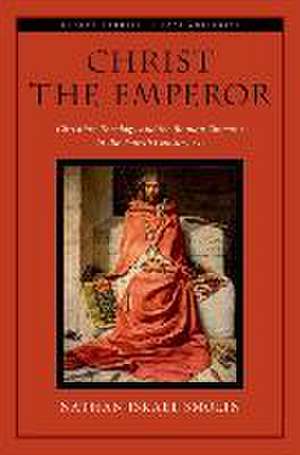
Christ the Emperor: Christian Theology and the Roman Emperor in the Fourth Century AD: Oxford Studies in Late Antiquity
Autor Nathan Israel Smolinen Limba Engleză Hardback – 29 aug 2024
Din seria Oxford Studies in Late Antiquity
- 32%
 Preț: 677.84 lei
 - 32%
 Preț: 544.93 lei
 - 23%
 Preț: 764.30 lei
 - 31%
 Preț: 539.38 lei
 - 31%
 Preț: 757.50 lei
 - 28%
 Preț: 463.39 lei
 - 31%
 Preț: 726.02 lei
 - 31%
 Preț: 724.70 lei
 - 31%
 Preț: 661.29 lei
 - 34%
 Preț: 731.03 lei
 - 31%
 Preț: 920.48 lei
 - 31%
 Preț: 747.27 lei
 -
 Preț: 273.58 lei
 - 35%
 Preț: 541.32 lei
 - 31%
 Preț: 727.80 lei
 - 31%
 Preț: 716.19 lei
 - 34%
 Preț: 645.95 lei
 - 31%
 Preț: 711.64 lei
 - 12%
 Preț: 600.88 lei
 - 31%
 Preț: 531.40 lei
 - 30%
 Preț: 573.61 lei
 - 29%
 Preț: 538.95 lei
Preț: 536.16 lei
Preț vechi: 790.30 lei
-32%
Puncte Express: 804
Carte disponibilă
Livrare economică 06-11 noiembrie
Livrare prin curier în România Termenul estimat este afișat lângă disponibilitate.
Transport gratuit pentru acest produs Plată online sau ramburs, în funcție de opțiunile comenzii.
Retur gratuit în 14 zile Comandă securizată și suport în română.
Specificații
ISBN-13: 9780197689547
ISBN-10: 019768954X
Pagini: 392
Dimensiuni: 164 x 235 x 30 mm
Greutate: 0.7 kg
Editura: Oxford University Press
Colecția OUP USA
Seria Oxford Studies in Late Antiquity
Locul publicării:New York, United States
ISBN-10: 019768954X
Pagini: 392
Dimensiuni: 164 x 235 x 30 mm
Greutate: 0.7 kg
Editura: Oxford University Press
Colecția OUP USA
Seria Oxford Studies in Late Antiquity
Locul publicării:New York, United States
Recenzii
A brilliant book. Smolin's premise is original, and highly interesting: as a usurper, Constantine needed to justify his rule, and after casting his lot with the formerly oppressed Christians, he developed a theology in which he became the 'cosmic emperor,' playing the same role on earth that the Christian god played in the universe.
[Smolin] contributes to scholarship that has tried to elucidate the complex relationship between the Constantinian dynasty and the Christian Church. By considering a variety of sources, he provides helpful insights into how the emperor's status and self-image, as well as the perception of cosmic dominion, are reflected in contemporary theological sources and thus offers some new ideas to 'political theology' in the fourth century.
By considering a variety of sources, he provides helpful insights into how the emperor's status and self-image, as well as the perception of cosmic dominion, are reflected in contemporary theological sources and thus offers some new ideas to 'political theology' in the fourth century.
To make such a topic understandable would have been accomplishment enough; to have made it both readable and even relevant is worthy of high praise, indeed.
When reading Smolin, the sense of his absolute command of the scholarship is constantly present, supported by the author's exceptional facility for explaining the complex relationship of 4th century theology and politics. To make such a topic understandable would have been accomplishment enough; to have made it both readable and even relevant is worthy of high praise.
In his work, Smolin focuses on theological texts as vehicles for political theory, thereby making a substantial contribution to research into late antique political theology. Anyone wishing to explore political theory and theology in the 4th century will gain an insightful overview thanks to Smolin's engaging work.
Smolin reminds us that power is not only exercised but imagined; not only enacted, but narrated; not only political, but theological. In so doing, he has written a book that deserves to be widely read, carefully studied, and deeply considered.
[Smolin] contributes to scholarship that has tried to elucidate the complex relationship between the Constantinian dynasty and the Christian Church. By considering a variety of sources, he provides helpful insights into how the emperor's status and self-image, as well as the perception of cosmic dominion, are reflected in contemporary theological sources and thus offers some new ideas to 'political theology' in the fourth century.
By considering a variety of sources, he provides helpful insights into how the emperor's status and self-image, as well as the perception of cosmic dominion, are reflected in contemporary theological sources and thus offers some new ideas to 'political theology' in the fourth century.
To make such a topic understandable would have been accomplishment enough; to have made it both readable and even relevant is worthy of high praise, indeed.
When reading Smolin, the sense of his absolute command of the scholarship is constantly present, supported by the author's exceptional facility for explaining the complex relationship of 4th century theology and politics. To make such a topic understandable would have been accomplishment enough; to have made it both readable and even relevant is worthy of high praise.
In his work, Smolin focuses on theological texts as vehicles for political theory, thereby making a substantial contribution to research into late antique political theology. Anyone wishing to explore political theory and theology in the 4th century will gain an insightful overview thanks to Smolin's engaging work.
Smolin reminds us that power is not only exercised but imagined; not only enacted, but narrated; not only political, but theological. In so doing, he has written a book that deserves to be widely read, carefully studied, and deeply considered.
Notă biografică
Nathan Israel Smolin, an independent scholar, completed his PhD in Classics at the University of North Carolina at Chapel Hill.
Cuprins
- Introduction
- Chapter One: Usurpation and the Church
- Chapter Two: The Theology of Constantine
- Chapter Three: Constantius II and the Failure of the Constantinian Settlement
- Chapter Four: The Eternal Emperor
- Chapter Five: Lucifer of Cagliari and the Eternal Emperor
- Chapter Six: Hilary of Poitiers and the Cosmic Unity of the Episcopate
- Epilogue: Jovian, the Valentiniani, and the Theodosian Settlement
- Appendix A: Dating of Key Texts
- Bibliography