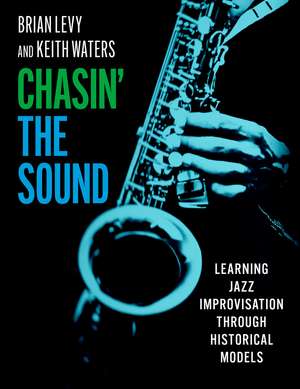
Chasin' the Sound: Learning Jazz Improvisation through Historical Models
Autor Brian Levy, Keith Watersen Limba Engleză Hardback – 7 iul 2025
Preț: 607.74 lei
Preț vechi: 806.87 lei
-25%
Puncte Express: 912
Carte tipărită la comandă
Livrare economică 20-25 noiembrie
Livrare prin curier în România Termenul estimat este afișat lângă disponibilitate.
Transport gratuit pentru acest produs Plată online sau ramburs, în funcție de opțiunile comenzii.
Retur gratuit în 14 zile Comandă securizată și suport în română.
Specificații
ISBN-13: 9780197643532
ISBN-10: 0197643531
Pagini: 306
Ilustrații: 379 annotated music examples
Dimensiuni: 216 x 19 x 279 mm
Greutate: 0.89 kg
Editura: Oxford University Press
Colecția OUP USA
Locul publicării:New York, United States
ISBN-10: 0197643531
Pagini: 306
Ilustrații: 379 annotated music examples
Dimensiuni: 216 x 19 x 279 mm
Greutate: 0.89 kg
Editura: Oxford University Press
Colecția OUP USA
Locul publicării:New York, United States
V-ar putea interesa
-
 The Classroom Guide to Jazz ImprovisationJohn McNeil-15%Preț: 146.73 lei173.37 lei
 -
 -11%Preț: 322.08 lei363.29 lei
 -
 A Listener's Guide to Free ImprovisationJohn CorbettPreț: 136.55 lei
 -
 Jazz Improvisation Using Simple Melodic EmbellishmentMike Titlebaum-8%Preț: 470.44 lei511.34 lei
 -
 How to Listen to JazzTed Gioia-27%Preț: 102.15 lei140.56 lei
 -
 Hear Me Talkin' to YANat ShapiroPreț: 106.76 lei
 -
 Preț: 196.77 lei
 -
 Preț: 155.90 lei
 -
 Preț: 174.37 lei
 -
 The Philosophy of JazzKevin Le Gendre-5%Preț: 87.37 lei91.50 lei
 -
 Berklee Jazz PianoRay SantisiPreț: 141.45 lei
 -
 Preț: 193.61 lei
 -
 Jazz Vocal ImprovisationMili BermejoPreț: 164.62 lei
 -
 The Jazz Bass Book: Technique and TraditionJohn GoldsbyPreț: 178.93 lei
 -
 The Piano Improvisation HandbookCarl Humphries-35%Preț: 191.82 lei294.03 lei
 -
 Playing ChangesNate ChinenPreț: 98.01 lei
 -
 Listen to Jazz!: Exploring a Musical GenreMelissa Ursula Dawn Goldsmith-44%Preț: 298.48 lei533.33 lei
 -
 -19%Preț: 197.05 lei243.29 lei
 -
 The Jazz Theory BookMark LevinePreț: 407.40 lei
 -
 Ready, Aim, Improvise!Hal CrookPreț: 235.68 lei
Recenzii
What sets jazz apart from other music is its rhythm and feel. This book does such a masterful job at showcasing the elements that are essential to this music. The detail and explanations make it accessible to all who want to improvise. The relationship between soloist and rhythm section is highlighted in the transcriptions that are in the book. This book is a knockout!!!
Brian Levy and Keith Waters have accomplished something remarkable in Chasin' the Sound, creating a thorough and practical guide for students interested in learning the language of jazz, the melodic and rhythmic vocabulary at the heart of the music that often gets overlooked by teachers of jazz improvisation who never get beyond setting up the palette of scales and chords that jazz players can draw from.
In Chasin' the Sound, Brian Levy and Keith Waters have managed to synthesize the seemingly intangible qualities of jazz feel, rhythmic phrasing, and group interaction into a comprehensive text that can prove valuable to musicians of all skill levels. The emphasis placed on the historical model is so often left out of pedagogical texts on jazz, but is arguably the most important way for improvisers to build upon the shared language of the music. As someone who felt held back by overly intellectual approaches to jazz education, Levy's teaching materials gave me the tools necessary to shape my voice within the idiom.
Frankly, the book already has me reimagining my approach to teaching and practicing jazz improvisation. It focuses on identifying, deconstructing, and then reconstructing jazz language, especially from bebop and hard bop traditions. The fact that most exercises are derived directly from performances of jazz masters is a clear strength (and a must!). The text also includes written, aural, and performing exercises, a beneficial mix which provides different vantage points from which to understand jazz music.
This book is an excellent resource for any music student looking to improve and deepen their improvisational skill set. Featuring examples of iconic solos by legends such as Louis Armstrong and Charlie Parker, this book emphasizes the importance of understanding the playing styles and techniques of these icons as a foundation for expanding your musical vocabulary. I highly recommend this book as an essential step in improvisation education.
In Chasin' the Sound, Keith Waters and Brian Levy bring their extensive backgrounds as jazz players, analysts, historians, and teachers to a new approach to teaching and learning improvisation, based on the rhythmic and melodic content of carefully selected historic solos by Louis Armstrong, Lester Young, Charlie Parker, Miles Davis, and others, explored through transcription, listening, and structured practice exercises. This is, in a sense, a new application of a traditional approach: learning from the language of past masters and innovators. It proposes a complement and corrective to the frequent overemphasis on simply identifying the 'right' notes and scales at each moment in jazz improvisation pedagogy.
Brian Levy and Keith Waters have accomplished something remarkable in Chasin' the Sound, creating a thorough and practical guide for students interested in learning the language of jazz, the melodic and rhythmic vocabulary at the heart of the music that often gets overlooked by teachers of jazz improvisation who never get beyond setting up the palette of scales and chords that jazz players can draw from.
In Chasin' the Sound, Brian Levy and Keith Waters have managed to synthesize the seemingly intangible qualities of jazz feel, rhythmic phrasing, and group interaction into a comprehensive text that can prove valuable to musicians of all skill levels. The emphasis placed on the historical model is so often left out of pedagogical texts on jazz, but is arguably the most important way for improvisers to build upon the shared language of the music. As someone who felt held back by overly intellectual approaches to jazz education, Levy's teaching materials gave me the tools necessary to shape my voice within the idiom.
Frankly, the book already has me reimagining my approach to teaching and practicing jazz improvisation. It focuses on identifying, deconstructing, and then reconstructing jazz language, especially from bebop and hard bop traditions. The fact that most exercises are derived directly from performances of jazz masters is a clear strength (and a must!). The text also includes written, aural, and performing exercises, a beneficial mix which provides different vantage points from which to understand jazz music.
This book is an excellent resource for any music student looking to improve and deepen their improvisational skill set. Featuring examples of iconic solos by legends such as Louis Armstrong and Charlie Parker, this book emphasizes the importance of understanding the playing styles and techniques of these icons as a foundation for expanding your musical vocabulary. I highly recommend this book as an essential step in improvisation education.
In Chasin' the Sound, Keith Waters and Brian Levy bring their extensive backgrounds as jazz players, analysts, historians, and teachers to a new approach to teaching and learning improvisation, based on the rhythmic and melodic content of carefully selected historic solos by Louis Armstrong, Lester Young, Charlie Parker, Miles Davis, and others, explored through transcription, listening, and structured practice exercises. This is, in a sense, a new application of a traditional approach: learning from the language of past masters and innovators. It proposes a complement and corrective to the frequent overemphasis on simply identifying the 'right' notes and scales at each moment in jazz improvisation pedagogy.
Notă biografică
Brian Levy is Director and Associate Professor of Jazz Studies at San Diego State University (SDSU). Prior to this role, he was a full-time member of the faculty at The New England Conservatory of Music (NEC) from 2013-23, where he held joint appointments in the Department of Jazz Studies and the Department of Music History and Musicology. In 2021, he received the prestigious Louis Krasner Teaching Award. As a saxophonist, Levy performs regularly in the US and Europe.Keith Waters is Professor of Music at the University of Colorado Boulder. As a professional jazz pianist, he has recorded and performed with jazz artists such as James Moody, Bobby Hutcherson, Eddie Harris, Dave Liebman, Janis Siegel, and many others. As an author, Waters is the author of The Studio Recordings of the Miles Davis Quintet, 1965-68; Postbop Jazz in the 1960s: The Compositions of Wayne Shorter; Herbie Hancock and Chick Corea; and Jazz: The First Hundred Years (with co-author Henry Martin).
Cuprins
- How to Use this Book
- About the Companion Website
- Preface
- Acknowledgements
- Introduction
- Chapter 1: Pulse and Syncopation
- Chapter 2: Horizontal and Vertical Approaches to Improvisation
- Chapter 3: Introduction to Charlie Parker: Rhythm and Pitch
- Chapter 4: Rhythmic Shapes
- Chapter 5: "Groovin' High": The Upsurge
- Chapter 6: Descending Pathways and Underlying Thirds
- Chapter 7: Techniques for Connecting and Expanding Melodies
- Chapter 8: Cross Rhythms
- Chapter 9: "Klaunstance" and "Ko Ko": the Vocabulary of Bebop
- Chapter 10: Vertical Approaches: Harmonic Spaces
- Chapter 11: Flexibility of Harmonic Rhythm
- Chapter 12: Hard Bop Approaches
- Chapter 13: Soloing with Comping Rhythms
- Chapter 14 (Online): Practical Applications
- Chapter 15 (Online): Learning Tunes, Harmonic Progressions, and Lines in 12 Transpositions
- Chapter 16 (Online): Other Bop Players
- Chapter 17 (Online): Rhythm Changes Routines
- Chapter 18 (Online): John Coltrane and Harmonic Third Relations
- Index