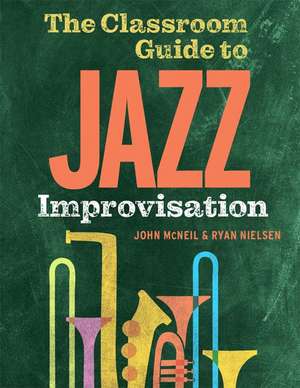
The Classroom Guide to Jazz Improvisation
Autor John McNeil, Ryan Nielsenen Limba Engleză Paperback – 29 aug 2024
Preț: 146.73 lei
Preț vechi: 173.37 lei
-15%
Puncte Express: 220
Carte disponibilă
Livrare economică 30 octombrie-04 noiembrie
Livrare express 15-21 octombrie pentru 55.15 lei
Livrare prin curier în România Termenul estimat este afișat lângă disponibilitate.
Transport gratuit de la 400.00 lei Plată online sau ramburs, în funcție de opțiunile comenzii.
Retur gratuit în 14 zile Comandă securizată și suport în română.
Specificații
ISBN-13: 9780197614655
ISBN-10: 0197614655
Pagini: 168
Ilustrații: 400 musical examples
Dimensiuni: 218 x 287 x 13 mm
Greutate: 0.43 kg
Editura: Oxford University Press
Colecția OUP USA
Locul publicării:New York, United States
ISBN-10: 0197614655
Pagini: 168
Ilustrații: 400 musical examples
Dimensiuni: 218 x 287 x 13 mm
Greutate: 0.43 kg
Editura: Oxford University Press
Colecția OUP USA
Locul publicării:New York, United States
V-ar putea interesa
-
 -21%Preț: 147.30 lei185.54 lei
 -
 -15%Preț: 194.49 lei228.32 lei
 -
 -11%Preț: 322.08 lei363.29 lei
 -
 A Listener's Guide to Free ImprovisationJohn CorbettPreț: 136.55 lei
 -
 Jazz Improvisation Using Simple Melodic EmbellishmentMike Titlebaum-8%Preț: 470.44 lei511.34 lei
 -
 How to Listen to JazzTed Gioia-27%Preț: 102.48 lei140.56 lei
 -
 Preț: 193.24 lei
 -
 Improve your teaching! Teaching BeginnersPaul HarrisPreț: 97.22 lei
 -
 The Essential Handbook for Musicians Who TeachDiane WiddisonPreț: 109.39 lei
 -
 Preț: 196.77 lei
 -
 Preț: 155.90 lei
 -
 Preț: 80.80 lei
 -
 Preț: 105.43 lei
 -
 Preț: 190.02 lei
 -
 Berklee Jazz PianoRay SantisiPreț: 141.45 lei
 -
 Bloomsbury Curriculum Basics: Teaching Primary MusicJimmy Rotheram-42%Preț: 97.38 lei167.78 lei
 -
 Middle School General Music: The Best Part of Your DayElizabeth Ann McAnally-25%Preț: 218.37 lei291.60 lei
 -
 Preț: 70.17 lei
Notă biografică
John McNeil is a jazz trumpet player living in Brooklyn, New York. He has played with Horace Silver, Gerry Mulligan, the Thad Jones-Mel Lewis Orchestra, and many others. He is also an active writer/producer on the New York jazz scene and is the author of The Art of Jazz Trumpet and Flexus: Trumpet Calisthenics for the Modern Improvisor. John recently retired from the faculty of the New England Conservatory of Music, where he taught for nearly 40 years.Ryan Nielsen is the trumpeter in the Kobie Watkins Grouptet. Their first album, Movement, was released to international critical acclaim and was named one of the ten best albums of 2018 by Howard Reich, former member of the Pulitzer Music Jury. Ryan has performed and/or recorded with Ra Kalam Bob Moses, Delfeayo Marsalis, and the Summit Brass. He is currently Associate Professor of Trumpet at Utah Valley University.
Cuprins
- Chapter 1 Getting Started
- Everyone Can Improvise
- Training the Subconscious to Make Choices
- Beyond Rote Memory
- How to Use This Book
- Tips for Getting Started
- Reconsidering Beginning with the Blues
- Chapter 2 Basic Concepts: The Root Triad and Jazz Rhythms
- Chord Versus Scale
- Reading Jazz Chord Symbols
- Lesson Plan 1: Improvising on the Root Triad
- Rhythm Section Tips
- Lesson Plan 2: Adding Rhythm
- Teacher's Notes
- Why Start with the Root Triad?
- Choosing Chords to Begin With
- Adjusting Range
- Designing Rhythm
- Rhythm Section
- General Tips
- Piano: Basic Voicings
- Guitar: Basic Voicings
- Bass: Walking Bass Lines with Triad Pitches
- Drums: Basic Ride Cymbal Technique, Hi-Hat Usage, and Kicks
- Chapter 3 Adding the 2nd (1-2-3-5)
- Lesson Plan 3: Adding the 2nd Degree
- Lesson Plan 4: Building Longer 8th-Note Lines
- Teachers' Notes
- Other Possibilities on 1-2-3-5
- Moving from Chord to Chord
- The Metronome in Rehearsal
- Tunes to Begin With
- More Advanced Rhythms (3/4 + 2/4)
- Chapter 4: Approaching Chord Tones from Below
- Lesson Plan 5: Approach Tones (Half-Step-Below)
- Teacher's Notes
- Upbeats and Anticipation
- Different Chord Qualities (Major)
- Rhythm Section
- Drums: Lightly Kicking the Upbeats
- Piano/Guitar: Approaching 3, 5
- 7, 9 Voicings from Below
- Chapter 5 Approaching Chord Tones from Above
- Lesson Plan 6: Approaching Chord Tones from a Scale Step Above
- Lesson Plan 7: 8th-Note Lines with Approach Tones
- Teacher's Notes
- Rhythm Section
- Bass: Adding Approach Tones to Bass Lines
- Chapter 6: Approaching Chord Tones by Two Notes
- Lesson Plan 8: Two-Note Approach Tones (Above/Below)
- Lesson Plan 9: Approaching Chord Tones from Two Notes Above or Two Notes Below
- Chapter 7: Approaching Chord Tones by Three or More Notes
- Lesson Plan 10: Approaching with Three Notes (Part 1)
- Lesson Plan 11: Approaching with Three Notes (Part 2)
- Lesson Plan 12: Approaching the 7th
- Teacher's Notes
- Approaching with Four or Five Notes
- Simplifying Three Note Approaches for Less Experienced Students
- Chapter 8: Improvising on the Entire Chord/Scale (Part 1)
- Lesson Plan 13: Diatonic Thirds
- Teacher's Notes
- Singing Tetrachords
- Adding Syncopation to Diatonic Thirds
- More Advanced Use of Thirds
- Descending Lines
- Rhythm Section
- Bass: Using Diatonic Thirds in Bass Lines
- Piano: Using Diatonic Thirds in Comping
- Chapter 9 Improvising on the Entire Chord/Scale (Part 2): Longer Lines and Harmonic Changes
- Lesson Plan 14: Creating Longer Lines with Thirds
- Lesson Plan 15: Moving from One Chord/Scale to Another
- Chapter 10 General Scale Skills: Triads, 7th Chords, and Other Intervals
- Lesson Plan 16: Triads and Other Structures
- Lesson Plan 17: Mixing It Up
- Teacher's Notes
- Organizing Other Structures in the Chord/Scale (7th-Chords, Intervals)
- Combining Lessons
- Chapter 11: Understanding Chord Symbols and Respelling Chords
- First, Chord Symbols
- What Is Respelling?
- How to Respell
- Examples of Respelling
- Extra Credit: Parallel Structures
- Teacher's Notes
- Respelling the Dominant
- Respelling the Altered Dominant
- Respelling the Half-Diminished Chord
- Respelling Lydian
- Rhythm Section
- Bass: Only Respell When Soloing
- Piano/Guitar: Voicing the Altered Dominant, When to Respell
- Chapter 12: The II-7
- V7
- Id7 (Part 1) - Using
7 to 3 to Move from Chord to Chord - Lesson Plan 18: Hearing
7 to 3 on the II-7 - V7
- Id7
- Lesson Plan 19: Using
7 to 3 to Improvise on a II-7 - V7
- Lesson Plan 20: Using
7 to 3 to Improvise on a V7 - Id7
- Lesson Plan 21: Using
7 to 3 to Improvise on a II-7 - V7
- Id7
- Teacher's Notes
- Singing Backgrounds
- Tips for Building 8th-Note Lines
- Rhythm Section
- Piano/Guitar: Using Stepwise Motion
- Chapter 13 II-7
- V7
- I (Part 2): Melodic Arpeggios and Dominant Cycles
- Lesson Plan 22: Towards Improvising on a II-7
- V7
- Id7
- Lesson Plan 23: Introducing
9 and 9 on the V7 Chord - Lesson Plan 24: Dominant Cycles (Part 1) - 1-2-3-5 and 1-5-3-5
- Lesson Plan 25: Dominant Cycles (Part 2) - 3-5-7-9 Arpeggios
- Lesson Plan 26: Dominant Cycles (Part 3) - Adding and Dropping Beats
- Lesson Plan 27: 3-5-7-9 + Approach Tones - Dropping and Adding Beats
- on a II-7
- V7
- Id7
- Chapter 14: Playing the Blues (Part 1)
- Why We Didn't Start with the Blues
- What the Blues Means to Us
- Lesson Plan 28: Using Approach Tones to Hear the Harmonic Form of the Blues (Less Advanced)
- Lesson Plan 29: 1-2-3-5 on the Blues (Less Advanced)
- Teacher's Notes
- Harmonic Options on the Blues
- The Turnaround
- Rhythm Section
- Piano: An Example of Comping on the Blues
- Chapter 15: The Vocal Form of the Blues
- Lesson Plan 30: Introducing the Vocal Form of the Blues (Less Advanced)
- Lesson Plan 31: Instrumental Blues (Part 1 - Less Advanced)
- Lesson Plan 32: Instrumental Blues (Part 2 - Less Advanced)
- Lesson Plan 33: Instrumental Blues (Part 3 - More Advanced)
- List of Blues Tunes
- Teacher's Notes
- Rhythm Section
- Recommended Blues Tracks for Piano
- Chapter 16: A Guide to Transcribing (Learning by Ear)
- Getting Started
- Make It Their Own
- A Few Examples of Creative Practice Inspired by Transcribing
- Chapter 17: The Benefits of Play - Why We Teach Jazz
- A Word About a Word: Play
- The Effects of Jazz: Talking Points for Admin and Parents
- Appendix: Chord Symbols
- Index