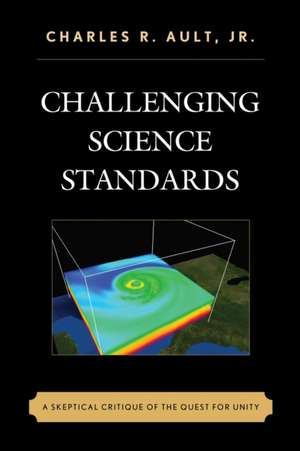
Challenging Science Standards: A Skeptical Critique of the Quest for Unity
Autor Charles R. Ault Jr.en Limba Engleză Paperback – 13 aug 2015
Preț: 284.39 lei
Preț vechi: 370.52 lei
-23%
Puncte Express: 427
Carte tipărită la comandă
Livrare economică 20 noiembrie-04 decembrie
Livrare prin curier în România Termenul estimat este afișat lângă disponibilitate.
Transport gratuit de la 400.00 lei Plată online sau ramburs, în funcție de opțiunile comenzii.
Retur gratuit în 14 zile Comandă securizată și suport în română.
Specificații
ISBN-13: 9781475818482
ISBN-10: 1475818483
Pagini: 218
Ilustrații: 1 BW Illustration, 1 Table
Dimensiuni: 154 x 227 x 16 mm
Greutate: 0.32 kg
Editura: Bloomsbury Publishing
Colecția Rowman & Littlefield
Locul publicării:New York, United States
ISBN-10: 1475818483
Pagini: 218
Ilustrații: 1 BW Illustration, 1 Table
Dimensiuni: 154 x 227 x 16 mm
Greutate: 0.32 kg
Editura: Bloomsbury Publishing
Colecția Rowman & Littlefield
Locul publicării:New York, United States
V-ar putea interesa
-
 -18%Preț: 1290.94 lei1574.32 lei
 -
 Music 3-5Susan YoungPreț: 253.98 lei
 -
 Introducing Applied Linguistics: Concepts and SkillsSusan HunstonPreț: 419.65 lei
 -
 The Handbook to Literary ResearchDelia da Sousa CorreaPreț: 380.12 lei
 -
 The Really Useful Elementary Science BookJeffrey W. Bloom-15%Preț: 440.90 lei518.71 lei
 -
 Listening in the Language ClassroomJohn Field-8%Preț: 361.17 lei392.57 lei
 -
 Preț: 218.91 lei
 -
 Inspirational Ideas: PSHE and Citizenship 9-11Molly Potter-43%Preț: 94.91 lei166.23 lei
 -
 Handbook of Reading Research, Volume IVMichael L. Kamil-18%Preț: 1093.69 lei1333.78 lei
 -
 The ABCs of LiteracyCynthia DollinsPreț: 104.17 lei
 -
 Preț: 63.37 lei
 -
 Tangram Tales: Story Theater Using the Ancient Chinese PuzzleDianne de Las Casas-26%Preț: 214.07 lei288.26 lei
Cuprins
Contents
Foreword by John L. Rudolph
Introduction: Halting the Quest
Part I: The Nature of the Problem
Chapter 1: Unity v. Diversity
Chapter 2: The Scientific Method from Cradle to Grave
Chapter 3: Old Wine in New Bottles
Chapter 4: The "Alphabets" from NSF
Chapter 5: Abstract Liabilities
Chapter 6: Cataclysms Outside the Classroom
Chapter 7: The Downward Spiral
Part II: Diversity's Starting Points
Chapter 8: The Second Style
Chapter 9: Geological Reasoning
Chapter 10: Metaphor and Analogy
Part III: Prospective Solutions
Chapter 11: The Twin Pillars of Thinking and Doing
Chapter 12: The Promising Idea of Core Progressions
Chapter 13:The Elbow and Ankle Tour of the Zoo
Chapter 14: Cracks in Unity's Armor
Chapter 15: The Promise of Place
Conclusion: A New Coherence
Foreword by John L. Rudolph
Introduction: Halting the Quest
Part I: The Nature of the Problem
Chapter 1: Unity v. Diversity
Chapter 2: The Scientific Method from Cradle to Grave
Chapter 3: Old Wine in New Bottles
Chapter 4: The "Alphabets" from NSF
Chapter 5: Abstract Liabilities
Chapter 6: Cataclysms Outside the Classroom
Chapter 7: The Downward Spiral
Part II: Diversity's Starting Points
Chapter 8: The Second Style
Chapter 9: Geological Reasoning
Chapter 10: Metaphor and Analogy
Part III: Prospective Solutions
Chapter 11: The Twin Pillars of Thinking and Doing
Chapter 12: The Promising Idea of Core Progressions
Chapter 13:The Elbow and Ankle Tour of the Zoo
Chapter 14: Cracks in Unity's Armor
Chapter 15: The Promise of Place
Conclusion: A New Coherence
Recenzii
Kip's book is a creative path to a new paradigm of science teaching and learning. His book is an amazing journey of stories and experiences in classrooms that will be familiar to you. The international science education community has embraced the importance of qualitative research. Descriptions of people, events and situations are hallmarks of qualitative methods. Kip has filled his book with playful, aesthetic, meaningful, and compelling stories about learning in which context and the needs of students reigns. Kip's book is a qualitative treasure chest of new paradigm learning examples.
Fascinating, as used by Mr. Spock of Star Trek fame to indicate unexpected encounters, is an appropriate word to describe Ault's book. Many of us who think we have a strong background in the development of science standards will quickly learn to see conventional ideas in a new light. Charles R. Ault, Jr. has provided a courageous examination of science standards in the twenty-first Century.
The many methods employed to create new knowledge in the many fields of science and mathematics cannot be described by a simple set of procedures. Over the years, numerous curriculum attempts to do so result more in obfuscation than clarification of the complex nature of creating new understandings, and they do little to assist students in pursuing their own inquiries. Charles Ault has presented this argument with numerous examples in a way that will fascinate the reader.
Lumping all disciplines under the single banner "school science" imperils contemporary science education. To the questions 'what science should be taught?' and 'how is science done?' this book refreshingly and recursively poses a better question: 'which science?' Ault promotes an appreciation for the rich diversity of scientific knowledge, techniques and perspectives. This makes for a valuable text for aspiring and practicing science teachers - and those who work with them.
In an era when standards have become the preeminent metric for assessing educational quality, Charles Ault's Challenging Science Standards demonstrates a level of intellectual courage unfortunately rare in academic circles. He argues that the quest for educational standards mirrors the bureaucratic quest for order, measurement, and accountability, a pursuit that with forests destroys biological diversity and reduces a woodland's bounty to only a few products. He suggests that the same thing happens in schools when a false unity is imposed upon the methodological and conceptual diversity of the scientific disciplines. Rather than seeking curricular coherence through the invention of a collection of fictional scientific universals, Ault argues that coherence can be better achieved by inviting students to enact the complexity of the different disciplines in the places where they live. The unity sought by curriculum designers can then be achieved through story, lived experience, and real-life contexts. This is a recipe for enlivening interest, value, and meaning-a recipe that seem more likely to engender powerful learning than complex grids of behavioral objectives.
At last we have an engaging, accessible book that challenges how reforms in education that seek unity and standardization within their fields and across all learners have been inconsistent with what we know about children's learning and natural investigations of the world, as well as with the diversity of methods and structures within the sciences. While Ault's engaging stories from his own teaching and research and from his students' observations and experience focus on science, educators of all disciplines will find this a fascinating journey. He honors what children can teach us about the methods of science and the importance of bridging disciplinary structures with personal experience and a sense of wonder about the world.
Beware, conformists. Science educator, historian and author Ault will make you think, and think hard about what conformity does to the motivation of learning. As a fellow educator, parent and student who had the honor of working for and alongside Charles Ault, I find his insights and demand for intelligent education for our children leaving me both breathless and cheering. Management demands may drive the design of education, but Challenging Science Standards: A Skeptical Quest for Unity will surely cause the reader to examine the notion that standardization does not best serve the interests of our children, our families, schools and society.
In this important and timely book, Charles Ault leads us on a journey that thoughtfully questions the current focus on supposed "commonalities" across the different science disciplines. His work reveals the lamentable loss of both the rich context and the unique content particular to individual science disciplines when a unified (and simplified) approach to science is adopted. Numerous classroom and field based examples (e.g., Pillbug Projects) presented in the book highlight the significance of disciplinary science and will prove useful to educators and teacher educators as they embark on a "promising pathway towards understanding scientific expertise in valued contexts."
Fascinating, as used by Mr. Spock of Star Trek fame to indicate unexpected encounters, is an appropriate word to describe Ault's book. Many of us who think we have a strong background in the development of science standards will quickly learn to see conventional ideas in a new light. Charles R. Ault, Jr. has provided a courageous examination of science standards in the twenty-first Century.
The many methods employed to create new knowledge in the many fields of science and mathematics cannot be described by a simple set of procedures. Over the years, numerous curriculum attempts to do so result more in obfuscation than clarification of the complex nature of creating new understandings, and they do little to assist students in pursuing their own inquiries. Charles Ault has presented this argument with numerous examples in a way that will fascinate the reader.
Lumping all disciplines under the single banner "school science" imperils contemporary science education. To the questions 'what science should be taught?' and 'how is science done?' this book refreshingly and recursively poses a better question: 'which science?' Ault promotes an appreciation for the rich diversity of scientific knowledge, techniques and perspectives. This makes for a valuable text for aspiring and practicing science teachers - and those who work with them.
In an era when standards have become the preeminent metric for assessing educational quality, Charles Ault's Challenging Science Standards demonstrates a level of intellectual courage unfortunately rare in academic circles. He argues that the quest for educational standards mirrors the bureaucratic quest for order, measurement, and accountability, a pursuit that with forests destroys biological diversity and reduces a woodland's bounty to only a few products. He suggests that the same thing happens in schools when a false unity is imposed upon the methodological and conceptual diversity of the scientific disciplines. Rather than seeking curricular coherence through the invention of a collection of fictional scientific universals, Ault argues that coherence can be better achieved by inviting students to enact the complexity of the different disciplines in the places where they live. The unity sought by curriculum designers can then be achieved through story, lived experience, and real-life contexts. This is a recipe for enlivening interest, value, and meaning-a recipe that seem more likely to engender powerful learning than complex grids of behavioral objectives.
At last we have an engaging, accessible book that challenges how reforms in education that seek unity and standardization within their fields and across all learners have been inconsistent with what we know about children's learning and natural investigations of the world, as well as with the diversity of methods and structures within the sciences. While Ault's engaging stories from his own teaching and research and from his students' observations and experience focus on science, educators of all disciplines will find this a fascinating journey. He honors what children can teach us about the methods of science and the importance of bridging disciplinary structures with personal experience and a sense of wonder about the world.
Beware, conformists. Science educator, historian and author Ault will make you think, and think hard about what conformity does to the motivation of learning. As a fellow educator, parent and student who had the honor of working for and alongside Charles Ault, I find his insights and demand for intelligent education for our children leaving me both breathless and cheering. Management demands may drive the design of education, but Challenging Science Standards: A Skeptical Quest for Unity will surely cause the reader to examine the notion that standardization does not best serve the interests of our children, our families, schools and society.
In this important and timely book, Charles Ault leads us on a journey that thoughtfully questions the current focus on supposed "commonalities" across the different science disciplines. His work reveals the lamentable loss of both the rich context and the unique content particular to individual science disciplines when a unified (and simplified) approach to science is adopted. Numerous classroom and field based examples (e.g., Pillbug Projects) presented in the book highlight the significance of disciplinary science and will prove useful to educators and teacher educators as they embark on a "promising pathway towards understanding scientific expertise in valued contexts."