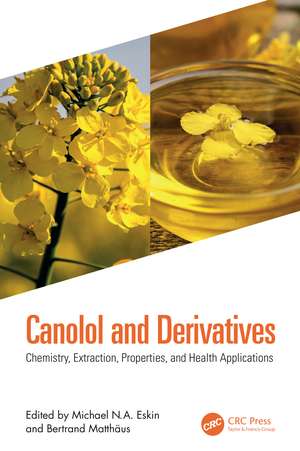
Canolol and Derivatives: Chemistry, Extraction, Properties and Application in Food
Editat de Michael N.A. Eskin, Bertrand Matthausen Limba Engleză Hardback – 27 apr 2026
KEY FEATURES:
- Canolol’s unique chemistry and formation during oilseed processing
- Advanced extraction technologies, including green and sustainable methods
- Its role as a natural alternative to synthetic antioxidants like BHA and BHT
- Applications in food preservation, nutraceuticals, and therapeutic uses
Preț: 961.47 lei
Preț vechi: 1172.53 lei
-18%
Puncte Express: 1442
Carte tipărită la comandă
Livrare economică 07-21 decembrie
Livrare prin curier în România Termenul estimat este afișat lângă disponibilitate.
Transport gratuit pentru acest produs Plată online sau ramburs, în funcție de opțiunile comenzii.
Retur gratuit în 14 zile Comandă securizată și suport în română.
Specificații
ISBN-13: 9781032250342
ISBN-10: 1032250348
Pagini: 144
Ilustrații: 56
Dimensiuni: 156 x 234 mm
Greutate: 0.38 kg
Ediția:1
Editura: CRC Press
Colecția CRC Press
ISBN-10: 1032250348
Pagini: 144
Ilustrații: 56
Dimensiuni: 156 x 234 mm
Greutate: 0.38 kg
Ediția:1
Editura: CRC Press
Colecția CRC Press
V-ar putea interesa
-
 Adventures in FermentationJohnny DrainPreț: 166.76 lei
 -
 -27%Preț: 1488.37 lei2035.63 lei
 -
 Studies in Natural Products ChemistryAtta-Ur-Rahman-31%Preț: 1488.37 lei2167.02 lei
 -
 Natural Food Flavors and ColorantsMathew Attokaran-23%Preț: 1229.97 lei1597.37 lei
 -
 Oregano: Properties, Uses and Health BenefitsGema Nieto Martínez-26%Preț: 1278.71 lei1739.30 lei
 -
 Natural Products: Structure, Bioactivity & ApplicationsRamiro E Goncalves-27%Preț: 1251.03 lei1703.54 lei
 -
 Bioactive Molecules in Plant FoodsFlorence Ojiugo Uruakpa-27%Preț: 833.39 lei1134.53 lei
 -
 -27%Preț: 1635.25 lei2228.59 lei
 -
 -27%Preț: 1523.32 lei2075.91 lei
 -
 Advances in Food Analysis ResearchAnita Haynes-27%Preț: 1633.93 lei2227.74 lei
 -
 Handbook of Research on Food Science and Technology: Volume 2: Food Biotechnology and MicrobiologyMonica Lizeth Chavez-Gonzalez-15%Preț: 581.47 lei684.09 lei
 -
 FermentTim Spector-5%Preț: 149.00 lei156.83 lei
 -
 CannabisSimon JarrettPreț: 94.86 lei
 -
 Handbook of Food Bioactive IngredientsSeid Mahdi Jafari-18%Preț: 4911.44 lei5989.56 lei
 -
 Biotechnology of Natural ProductsWilfried Schwab-18%Preț: 1158.14 lei1412.36 lei
 -
 -14%Preț: 1767.25 lei2054.94 lei
Public țintă
Professional ReferenceCuprins
1. Canolol: Introduction 2. Extraction and production of canolol: Application of green technology 3. Analysis of canolol (4-vinylsyringol) and its derivatives in rapeseed oil and sidestreams 4. Canolol production from a renewable feedstock via an engineered sinapic acid decarboxylase 5. Antioxidant properties of canolol 6. Anti-cancer properties of canolol 7. Application of canolol in foods
Notă biografică
Dr. Michael N. A. Eskin, a former Chair and Associate Dean, is a Distinguished Professor in the Department of Food and Human Nutritional Sciences in the Faculty of Agricultural and Food Sciences at the University of Manitoba, Winnipeg, Canada. He is the author and co-author of 20 books, 80 chapters, and over 170 papers. Dr. Eskin is the recipient of many prestigious awards for his lipid research, including the Stephen S. Chang Award and the Lifetime Achievement Award in Honor of Nicolas Appert by the Institute of Food Technologists; the Supelco AOCS Research Award, Stephen S. Chang Award, Alton E. Bailey Medal, Herbert J. Dutton Award, Timothy L. Mounts Award and Distinguished Service Award by the American Oil Chemists’ Society; and the William J. Eva Award by the Canadian Institute of Food Science and Technology. In 2016, Dr. Eskin was awarded the Order of Canada for his significant contributions to the success of the Canadian canola oil industry and recently inducted into the Canadian Agricultural Hall of Fame.
Dr. Bertrand Matthäus, heads since 2021 the Department of Safety and Quality of Cereals at the Max Rubner-Institut, Federal Research Institute of Nutrition and Food of the German Federal Ministry of Agriculture, Nutrition, and Regional Identity. During his career he has been responsible for research regarding improvements in the quality of fats and oils, especially canola oil. His work focused on the investigation of frying processes but included also contaminants such as 3-MCPD ester, acrylamide or 4-hydroxy-2-trans-nonenal, and the investigation of oxidation processes of edible oils and fats. He has published over 200 articles, scientific papers, and book chapters. In the last 25 years he has organized and co-organized several symposia and workshops on fats and oils given for official laboratories, private institutions, and industry. He is vice-president of the German Society for Fat Science, and he has been awarded the prestigious Wilhelm Normann Medal in 2019 for his work on edible fats and oils. In 2024, he was awarded the "Bianzhong Award" of the Hubei Provincial Government. He is the co-author with Dr. Michael N. A. Eskin and the late Dr. Usha Thiyam-Hollander of Canola and Rapeseed: Production, Processing, Food Quality, and Nutrition.
Dr. Bertrand Matthäus, heads since 2021 the Department of Safety and Quality of Cereals at the Max Rubner-Institut, Federal Research Institute of Nutrition and Food of the German Federal Ministry of Agriculture, Nutrition, and Regional Identity. During his career he has been responsible for research regarding improvements in the quality of fats and oils, especially canola oil. His work focused on the investigation of frying processes but included also contaminants such as 3-MCPD ester, acrylamide or 4-hydroxy-2-trans-nonenal, and the investigation of oxidation processes of edible oils and fats. He has published over 200 articles, scientific papers, and book chapters. In the last 25 years he has organized and co-organized several symposia and workshops on fats and oils given for official laboratories, private institutions, and industry. He is vice-president of the German Society for Fat Science, and he has been awarded the prestigious Wilhelm Normann Medal in 2019 for his work on edible fats and oils. In 2024, he was awarded the "Bianzhong Award" of the Hubei Provincial Government. He is the co-author with Dr. Michael N. A. Eskin and the late Dr. Usha Thiyam-Hollander of Canola and Rapeseed: Production, Processing, Food Quality, and Nutrition.
Descriere
As the demand for natural and sustainable solutions grows, Canolol and Derivatives: Chemistry, Extraction, Properties and Application in Food explores the science and potential of canolol, a powerful antioxidant derived from oilseed products like canola and mustard.