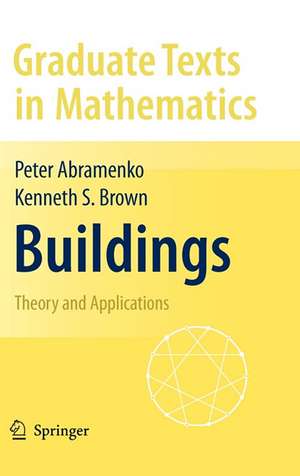
Buildings
Autor Peter Abramenko, Kenneth S Brownen Limba Engleză Hardback – 28 aug 2008
Reținem cu interes apariția volumului Buildings, o lucrare monumentală care vine să completeze o lacună serioasă în literatura academică: absența unei tratări enciclopedice și unitare a teoriei clădirilor. Deși subiectul este central în geometria grupurilor, cercetătorii au fost nevoiți mult timp să consulte surse fragmentate. Această ediție din 2008, semnată de Peter Abramenko și Kenneth S Brown, transformă un text introductiv anterior într-un tratat de referință de peste 700 de pagini, esențial pentru nivelul de cercetare. Notăm integrarea a două perspective metodologice fundamentale. Pe de o parte, autorii păstrează abordarea „clasică”, vizuală, în care o clădire este văzută ca un complex simplicial. Pe de altă parte, introduc riguros abordarea „modernă” prin spații W-metrice, devenită indispensabilă în aplicațiile actuale. Această dualitate metodologică completează perspectiva oferită de Lectures on Buildings de Mark Ronan, adăugând o profunzime tehnică superioară și o tratare exhaustivă a proprietății Moufang, care ocupă două capitole dense. Structura volumului reflectă o progresie logică impecabilă, pornind de la fundamentele grupurilor de reflexie finite și grupurilor Coxeter, trecând prin clasificarea clădirilor sferice și ajungând la clădiri euclidiene și hiperbolice. Finalul este dedicat aplicațiilor în coomologia grupurilor, ancorând teoria pură în probleme matematice concrete. Față de lucrarea anterioară a lui Peter Abramenko, Twin Buildings and Applications to S-Arithmetic Groups, care presupunea deja cunoștințe solide, volumul de față este mai generos, oferind secțiuni opționale pentru începători și un set vast de exerciții cu soluții, facilitând tranziția de la studiul graduat la cercetarea avansată.
Preț: 523.92 lei
Carte tipărită la comandă
Livrare economică 05-19 decembrie
Specificații
ISBN-10: 0387788344
Pagini: 754
Ilustrații: XXII, 754 p. 100 illus.
Dimensiuni: 167 x 244 x 43 mm
Greutate: 1.19 kg
Ediția:2008 edition
Editura: Springer
Locul publicării:New York, NY, United States
V-ar putea interesa
-
 Schaum's Outline of Group TheoryB. Baumslag-33%Preț: 166.49 lei250.18 lei
 -
 Collected PapersBertram Kostant-18%Preț: 1427.92 lei1741.36 lei
 -
 Collected PapersBertram Kostant-18%Preț: 1142.81 lei1393.67 lei
 -
 Compact Lie GroupsMark R. SepanskiPreț: 508.85 lei
 -
 Topological Methods in Group TheoryRoss Geoghegan-15%Preț: 616.02 lei724.73 lei
 -
 Linear Representations of Finite GroupsJean Pierre Serre-15%Preț: 458.56 lei539.48 lei
 -
 Cohomology of GroupsKenneth S. Brown-15%Preț: 554.07 lei651.85 lei
 -
 The Geometry of Discrete GroupsAlan F. Beardon-15%Preț: 611.24 lei719.11 lei
 -
 Groups and RepresentationsJ.L. AlperinPreț: 464.49 lei
 -
 -18%Preț: 985.08 lei1201.32 lei
 -
 Groups and SymmetryMark A. ArmstrongPreț: 401.95 lei
 -
 Notes on Lie AlgebrasHans SamelsonPreț: 365.61 lei
 -
 Weyl TransformsM. W. WongPreț: 365.38 lei
 -
 BuildingsKenneth S. Brown-15%Preț: 665.89 lei783.39 lei
 -
 -27%Preț: 782.44 lei1071.84 lei
 -
 Personality in the Social ProcessJ. Aronoff-5%Preț: 1047.80 lei1102.94 lei
 -
 Preț: 116.82 lei
 -
 The Mathieu GroupsA. A. Ivanov-14%Preț: 908.60 lei1056.51 lei
 -
 Sets Relations and Groups Ibh Topic 8 (2nd Edition)Steven ClarkePreț: 116.46 lei
 -
 Twin Buildings and Applications to S-Arithmetic GroupsPeter AbramenkoPreț: 275.57 lei
 -
 INVERSE SEMIGROUPSLawson Mark V-18%Preț: 906.99 lei1106.08 lei
 -
 Classical Artinian Rings and Related TopicsYoshitomo Baba-15%Preț: 671.34 lei789.81 lei
 -
 FUNCTIONAL EQUATIONS ON GROUPSStetkaer Henrik-18%Preț: 838.28 lei1022.30 lei
 -
 SYMMETRIES AND GROUPS IN CONTEMPORARY PHYSICSBai Chengming-18%Preț: 1399.78 lei1707.05 lei
Public țintă
ResearchDe ce să citești această carte
Recomandăm acest volum oricărui matematician care dorește o stăpânire completă a structurilor geometrice ce reprezintă grupurile de tip Lie. Cititorul câștigă acces la prima sinteză enciclopedică a domeniului, beneficiind de un aparat pedagogic revizuit, cu numeroase ilustrații și exerciții. Este resursa definitivă care unifică viziunea geometrică și cea metrică asupra clădirilor, fiind utilă atât ca manual de studiu, cât și ca lucrare de referință în cercetare.
Despre autor
Kenneth S Brown este profesor la Universitatea Cornell din 1971, fiind un nume de referință în topologie și algebră, cu un doctorat obținut la MIT. Lucrarea sa timpurie despre clădiri din 1989 a pus bazele pedagogice ale domeniului. Peter Abramenko, profesor la University of Virginia, este specialist în grupuri sferice și aritmetice, fiind cunoscut pentru contribuțiile sale în seria Lecture Notes in Mathematics cu titlul Twin Buildings and Applications to S-Arithmetic Groups. Colaborarea lor reunește experiența didactică de lungă durată cu rigoarea cercetării moderne de vârf.
Descriere scurtă
Cuprins
Recenzii
American Mathematical Society Mathematical Reviews MR2439729:
"The book under review ... is the first encyclopedic treatment of buildings made available in the literature, so that with writing this book the authors manage to close a serious gap in the mathematical literature: the non-existence of an easily accessible reference for buildings beyond an introduction.
In their introduction the authors state that it is their ``goal in this book to treat buildings from all three ... points of view [via the simplicial, the combinatorial, and the metric approach]. The various approaches complement one another and are useful. On the other hand, [the authors] recognize that some readers may prefer one particular viewpoint. [The authors] have therefore tried to create more than one path through the book so that, for example, the reader interested only in the combinatorial approach can learn the basics without having to spend too much time studying buildings as simplicial complexes.'' In the reviewer's opinion, the authors perfectly reach this goal and, moreover, manage to show that the theory of buildings and their applications are active, thriving, exciting and beautiful areas of mathematics. This book is very well written. The reviewer is sure that it will become a standard reference for buildings and remain one for a very long time.
... The main advantages of the combinatorial approach to buildings are that it is elementary and abstract and, hence, easily accessible. Since the simplicial and combinatorial approaches are equivalent..., one can always work with the one which is more suitable for one's own problems or more appealing to one's own taste. It is indeed one of the great achievements of this book to introduce both concepts simultaneously and to combine them in a natural way.
... Chapter 8 is extremely valuable for students and researchers interested in the theory of twin buildings, as it makes the theory... easily accessible. It is particularly important for the mathematical community that the folklore Theorem 8.27 has finally been recorded.
... Altogether, the book under review is a wonderful piece of work that will have many enthusiastic readers."
“This book is the first one which presents all of the different approaches to buildings alongside one another, and it does so in an accessible yet thorough manner which should prove extremely useful to anyone wishing to learn more about this interesting area of mathematics. The goal of presenting this introductory material in one place would be laudable enough. … this book is an extremely valuable addition to the mathematical literature. … it should also be an essential resource for experts in the area.” (Michael Bate, Zentralblatt MATH, Vol. 1214, 2011)
Notă biografică
Peter Abramenko received his Ph.D. in 1987 from the University of Frankfurt, Germany. He held various academic positions afterwards, including a Heisenberg fellowship from 1998 until 2001. Since 2001, he is Associate Professor at the University of Virginia in Charlottesville. He has previously published Twin Buildings and Applications to S-Arithmetic Groups for the Lecture Notes in Mathematics series for Springer (1996).
Textul de pe ultima copertă
There are several paths through the book, so that readers may choose to concentrate onone particular approach. The pace is gentle in the elementary parts of the book, and the style is friendly throughout. All concepts are well motivated. There are thorough treatments of advanced topics such as the Moufang property, with arguments that are much more detailed than those that have previously appeared in the literature.
This book is suitable as a textbook, with many exercises, and it may also be used for self-study.