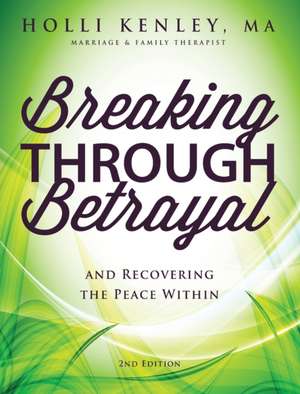
Breaking Through Betrayal
Autor Holli Kenleyen Limba Engleză Hardback – 2019
We are living in a time where betrayal abounds. Tragically, most of know or know of someone who has been scarred by the betrayal bandit. In whatever form it takes (financial, political, personal, social, legal, environmental, cultural, etc.), no one is immune from the infectious waves of betrayal moving through our society. Breaking Through Betrayal: And Recovering the Peace Within is for any individual who has experienced or is experiencing betrayal, who carries the wounds or scars of betrayal injury, and who is struggling to break through its bonds. Betrayal has known us far longer than we have known it; it is time to change that. Readers of this book will be challenged to:
- Explore the different kinds of betrayal while connecting with the experiences of others.
- Unravel the emotions and behaviors that accompany betrayal injury and explore the factors which contribute to the intensity and duration of symptoms.
- Empower yourself by embracing an interactive healing process tailored specifically for recovery from betrayal injury.
- Revive and restore your mind, body, and spirit through a series of activities, exercises, and self-assessments which provide tools for renewal, as well as working through relapse or re-injury.
- Reclaim your rightful sense of self.
Therapists Praise Breaking Through Betrayal
"Useful for anyone caught in self-blame, shame or repeated victimization. Though almost the antithesis of my inner-transformation approach, this empowering 'in-control' approach can help readers take charge, assess injury, gauge healing and find excellent strategies to protect themselves from future trauma when relating to one's betrayer."
--Beth Hedva, Ph.D. author of award-winning Betrayal, Trust and Forgiveness
"This volume deals with the subject of betrayal, and is appropriate as a self-help aid for clients. It also contains useful suggestions for therapists dealing with those who have experienced betrayal of trust of several kinds: interpersonal, familial, sexual, and financial. The steps in the healing process are well outlined and make clear that relapse is to be expected. Overlap with loss and the grief process is also well discussed."
--Lucy R. Ferguson, Ph.D., Member, AFTNC
Faculty Member and Dean Emerita, CSPP, Alliant University
About the Author
Holli Kenley is a Licensed Marriage and Family Therapist in the state ofCalifornia. She holds a Masters Degree in Psychology with an emphasis onMarriage, Family, and Child Counseling. For over a decade (both as an intern and a licensed clinician), Holli has worked in a variety of settings: a women's shelter and transitional housing, a counseling center, and in private practice.
Learn more at www.HolliKenley.com
From the New Horizons in Therapy Series at Loving Healing Press www.LovingHealing.com
Self-Help : Abuse - Psychological
Family & Relationships : Dysfunctional Families
Psychology : Cognitive Therapy
| Toate formatele și edițiile | Preț | Express |
|---|---|---|
| Paperback (2) | 106.77 lei 3-5 săpt. | |
| Loving Healing Press – 14 dec 2009 | 106.77 lei 3-5 săpt. | |
| Loving Healing Press – 17 ian 2016 | 119.25 lei 3-5 săpt. | |
| Hardback (1) | 228.02 lei 3-5 săpt. | |
| Loving Healing Press – 2019 | 228.02 lei 3-5 săpt. |
Preț: 228.02 lei
Puncte Express: 342
Preț estimativ în valută:
40.31€ • 47.92$ • 34.98£
40.31€ • 47.92$ • 34.98£
Carte disponibilă
Livrare economică 19 februarie-05 martie
Specificații
ISBN-13: 9781615994281
ISBN-10: 1615994289
Pagini: 242
Dimensiuni: 208 x 260 x 18 mm
Greutate: 0.73 kg
Editura: Loving Healing Press
ISBN-10: 1615994289
Pagini: 242
Dimensiuni: 208 x 260 x 18 mm
Greutate: 0.73 kg
Editura: Loving Healing Press
V-ar putea interesa
-
 Preț: 103.59 lei
 -
 Pathological AltruismBarbara Oakley-27%Preț: 545.81 lei750.33 lei
 -
 -29%Preț: 512.04 lei717.29 lei
 -
 What to Say to Get Your WayJohn BoswellPreț: 186.54 lei
 -
 OutliersMalcolm GladwellPreț: 113.28 lei
 -
 Telling LiesPaul EkmanPreț: 96.66 lei
 -
 The SelfJonathon BrownPreț: 321.43 lei
 -
 The Expansion of ConsciousnessRalph MetznerPreț: 97.88 lei
 -
 The Science of Subjective Well-BeingMichael Eid-15%Preț: 444.39 lei522.81 lei
 -
 RevolutionBill LucasPreț: 109.08 lei
 -
 Fifty Tales for a Wet Weekend in TighnabruaichThomas F. CarberyPreț: 126.27 lei
 -
 The Individual in a Social WorldStanley Milgram-34%Preț: 187.93 lei283.88 lei
Notă biografică
Typically, I am an author of clinical works writing to bring healing and hope to others. Of course, there is always a piece of me and of my experiences in them as well. When I sat down and started writing Mountain Air, I did so solely for my own recovering. Writing is a significant tool that I utilize in my healing process. It wasn't until after I finished the very rough and rambling first draft that I felt it may be of benefit to others. Even then, I wasn't sure. It took many more rewrites, time away from the drafts, and the integration of a stronger, more powerful voice into my being which ultimately fueled my desire to share my narrative with you. Mountain Air, as you have read, is a unique perspective into the topic of relapse and recovering from it. As you know now, I based this work on my own debilitating decline into emotional relapse. I shared with you how returning to my betrayal environment of my youth precipitated the relapse, and I described how the myriad of triggers within those surroundings exacerbated my struggle. I also disclosed the unearthing of a deeply embedded injury from my childhood-a sexual assault-which was at the core of my descent into relapse. Throughout the writing of Mountain Air, it was always my intention to make this book about the emotional and psychological challenges that accompany any kind of relapse-shame, self-blame, guilt-after sustaining a period of wellness, of sobriety, or of integrity to one's way of being. At the same time, I am guessing that there are many readers who are wondering why I did not fully disclose the details of the abuse I endured. I want to explain why. There are two explanations; both are extremely important to me. First, it is my belief that individuals, even those who share common abuse experiences, heal differently and uniquely. For many, it is extremely helpful and healing to share their experiences in a very public forum and to include the details of their injuries or injustices. Indeed, there are many celebrities as well as non-celebrities who have shared their most private and painful stories on television as well as through other media venues. Their narratives reach out and help many people; they educate and inform others; and hopefully, most importantly, the survivors themselves experience additional healing each time they reveal their histories. For me, and many others like myself, this is not the case. My healing came in the trusting of two therapists and in the process that it took to peel off the layers of injury-a little at a time and over a lengthy period of time. In the safe harbor of experienced, nurturing therapists, I was able to disclose all the intimacies of my pain. However, in the retelling of the abuse, I do relive it and thus, I re-traumatize myself. I also feel as though I give my power over to the betrayers and that I diminish my "voice" in doing so. Therefore, I must value my healing truth. I choose to keep my experiences contained because in doing so, I am respecting myself and my choices, and I am honoring my betrayal experiences with the dignity and grace that serve me well. Secondly, and as importantly, I do not want to be remembered as a survivor of abuse who endured a litany of injustices. I want my legacy to be one of renewal and of refinement. In my last book, Breaking Through Betrayal: And Recovering The Peace Within, I talk about the difference of being "defined by our betrayal experience" or of being "refined by it". It is paramount that my recovering message to you be one of "moving beyond being defined by our survival identity and embracing the opportunity to become a more effective being and to be more elegant in the process". I want others to remember how I taught them to seek ways to enhance and cultivate new ways of being, and that I encouraged and motivated them to act upon those choices. Visit my website www.HolliKenley.com
Descriere
Descriere de la o altă ediție sau format:
"This volume deals with the subject of betrayal, and is appropriate as a self-help aid for clients. It also contains useful suggestions for therapists dealing with those who have experienced betrayal of trust."--Lucy R. Ferguson, Ph.D., member, AFTNC Faculty Member and Dean Emerita, CSPP, Alliant University.
"This volume deals with the subject of betrayal, and is appropriate as a self-help aid for clients. It also contains useful suggestions for therapists dealing with those who have experienced betrayal of trust."--Lucy R. Ferguson, Ph.D., member, AFTNC Faculty Member and Dean Emerita, CSPP, Alliant University.