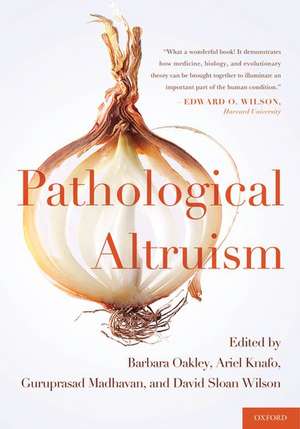
Pathological Altruism
Editat de Barbara Oakley, Ariel Knafo, Guruprasad Madhavan, David Wilsonen Limba Engleză Hardback – 4 ian 2011
Preț: 604.77 lei
Preț vechi: 888.36 lei
-32%
Puncte Express: 907
Carte tipărită la comandă
Livrare economică 27 noiembrie-08 decembrie
Livrare prin curier în România Termenul estimat este afișat lângă disponibilitate.
Transport gratuit pentru acest produs Plată online sau ramburs, în funcție de opțiunile comenzii.
Retur gratuit în 14 zile Comandă securizată și suport în română.
Specificații
ISBN-13: 9780199738571
ISBN-10: 0199738572
Pagini: 496
Dimensiuni: 175 x 257 x 28 mm
Greutate: 0.98 kg
Ediția:New.
Editura: Oxford University Press
Colecția OUP USA
Locul publicării:New York, United States
ISBN-10: 0199738572
Pagini: 496
Dimensiuni: 175 x 257 x 28 mm
Greutate: 0.98 kg
Ediția:New.
Editura: Oxford University Press
Colecția OUP USA
Locul publicării:New York, United States
V-ar putea interesa
-
 The Joyless Economy: The Psychology of Human SatisfactionTibor Scitovsky-16%Preț: 188.11 lei223.93 lei
 -
 Trust: A Very Short IntroductionKatherine Hawley-20%Preț: 56.65 lei70.82 lei
 -
 QuietSusan CainPreț: 106.89 lei
 -
 TraumaJeffrey C AlexanderPreț: 205.06 lei
 -
 Develop Your AssertivenessSue BishopPreț: 105.11 lei
 -
 Hunting EvilDavid Wilson-28%Preț: 56.42 lei77.98 lei
 -
 -27%Preț: 68.18 lei93.03 lei
 -
 Preț: 104.99 lei
 -
 Preț: 85.57 lei
 -
 -18%Preț: 1337.77 lei1631.42 lei
 -
 Preț: 417.04 lei
 -
 Mary Ann CottonDavid WilsonPreț: 172.58 lei
 -
 Intimate TreasonClaudia Black-5%Preț: 104.67 lei110.18 lei
Recenzii
Scholarly yet surprisingly sprightly volume
I recommend this book to health professionals looking for a deeper understanding of altruism and its motivation. The arguments are clear and scholarly, and supported by a wealth of references.
By showing the mix of good intentions with themes such as hording, self-righteousness, and addictions that are taken to extremes, authors provide readers with a strong understanding of how people alleviate their own personal distress by trying to help others. Specific chapters offer varied insights into how altruism affects self-care, relationships, and civic engagement. Taken as a whole, the book helps readers better imagine how they might participate in civil discourse.
I recommend this book to health professionals looking for a deeper understanding of altruism and its motivation. The arguments are clear and scholarly, and supported by a wealth of references.
By showing the mix of good intentions with themes such as hording, self-righteousness, and addictions that are taken to extremes, authors provide readers with a strong understanding of how people alleviate their own personal distress by trying to help others. Specific chapters offer varied insights into how altruism affects self-care, relationships, and civic engagement. Taken as a whole, the book helps readers better imagine how they might participate in civil discourse.
Notă biografică
Barbara Oakley is an associate professor of engineering at Oakland University in Michigan. Her work focuses on the complex relationship between social behavior and neuroscience. Her books include Cold-Blooded Kindness (Prometheus Books, 2011) and Evil Genes (Prometheus Books, 2007).Ariel Knafo is a senior lecturer in psychology at the Hebrew University of Jerusalem. His research deals with the genetic and environmental contributions to empathy and altruism and how children's genetics affect their behavior and the way parents react to them.Guruprasad Madhavan, a bioengineer, is a program officer in policy and global affairs at the National Academy of Sciences, National Academy of Engineering, Institute of Medicine, and the National Research Council - collectively called the National Academies - in Washington, DC. He is senior co-editor of Career Development in Bioengineering and Biotechnology (Springer, 2008).David Sloan Wilson is SUNY Distinguished Professor of Biology and Anthropology at Binghamton University. His books include The Neighborhood Project (Little, Brown, 2011), Evolution for Everyone (Delacorte, 2007), Darwin's Cathedral (Chicago, 2002), and Unto Others (Harvard,1998).