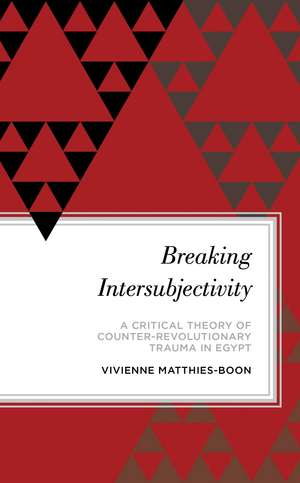
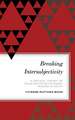
Breaking Intersubjectivity: A Critical Theory of Counter-Revolutionary Trauma in Egypt: Radical Subjects in International Politics
Autor Vivienne Matthies-Boonen Limba Engleză Hardback – 27 dec 2022
Rooted in Frankfurt School critical theory, this book thus urges us to rethink the concept of trauma: trauma should not be understood as impaired subjectivity but rather as broken intersubjectivity. Hence, it not only presents a critique of the notion 'PTSD', but - drawing on the philosophies of Jurgen Habermas, Nancy Fraser, Rahel Jaeggi and Heideggerian trauma theory in particular - it argues that trauma entails the violent imposition of traumatic status subordination. In traumatic status subordination, intersubjective parity (the counterfactual presupposition of being treated as an equal human being) is so violently betrayed that the symbolic realm of the lifeworld collapses. As the lifeworld collapses, one suffers an atomized state of speechless disorientation, wherein the potential of creative collective becoming is destroyed. In this sense, human induced trauma should thus be understood as a political tool par excellence.
As this monograph indicates, traumatic status subordination was a tool which the Egyptian counter-revolutionary actors (consisting of the Egyptian military, and its temporary subsidiary the Muslim Brotherhood) used unsparingly as they attempted to put the revolutionary genie back into the bottle. Importantly, the Egyptian military not only sought to destroy the object of revolutionary politics, but rather the underlying existential structures of the possibility of its very existence as such. And thus, in the violent instrumental pursuit of economic and political power, the counter-revolution inflicted multileveled status subordination. It did so through a consistent tripartite structural mechanism: the infliction of grave (deadly) violence, the procedural colonisation and repressive juridification of the public sphere, and the acceleration of neoliberal economic rationalism. This not only accumulated in Sisi's prisonification of society and his politics of death, but rather also threw activists ever deeper into an atomized state of demoralized silence as it destroyed the very potential of revolutionary and transformative becoming.





Preț: 630.61 lei
Preț vechi: 960.64 lei
-34%
Puncte Express: 946
Carte tipărită la comandă
Livrare economică 08-22 decembrie
Livrare prin curier în România Termenul estimat este afișat lângă disponibilitate.
Transport gratuit pentru acest produs Plată online sau ramburs, în funcție de opțiunile comenzii.
Retur gratuit în 14 zile Comandă securizată și suport în română.
Specificații
ISBN-13: 9781786610324
ISBN-10: 1786610329
Pagini: 352
Dimensiuni: 156 x 236 x 26 mm
Greutate: 0.69 kg
Editura: Bloomsbury Publishing
Colecția Rowman & Littlefield
Seria Radical Subjects in International Politics
Locul publicării:New York, United States
ISBN-10: 1786610329
Pagini: 352
Dimensiuni: 156 x 236 x 26 mm
Greutate: 0.69 kg
Editura: Bloomsbury Publishing
Colecția Rowman & Littlefield
Seria Radical Subjects in International Politics
Locul publicării:New York, United States
Cuprins
Acknowledgements
INTRODUCTION
Structure of the Book
Further Remarks
PART 1. TOWARDS A CRITICAL THEORY OF TRAUMA AS BROKEN SUBJECTIVITY
Introduction
Chapter 1. Trauma Studies and the Philosophy of the Subject
Towards Intersubjectivity: Habermas' Critique of the Philosophy of the Subject
The Positivist Revolution and the Emergence of PTSD
Cognitive Trauma Theory: Intersubjectivity Within
Lazarus Never Dies: Anti-Mimeticism in Post-structural and Political Trauma
Chapter 2. Towards a Critical Trauma Studies: Trauma as Intersubjective Alienation
On Heideggerian Trauma Theory: Struggles of Intersubjectivity
Traumatic Status Subordination: Nany Fraser
Traumatic Alienation: Rahel Jaeggi
Traumatic Instrumentality: Jurgen Habermas
Conclusion
PART 2. COUNTER-REVOLUTIONARY TRAUMA IN EGYPT: INFLICTING TRAUMATIC STATUS SUBORDINATION
Introduction: Political Trauma in Egypt
Chapter 3. A Legacy of Traumatic Status Subordination in Egypt: From Nasser to Mubarak
Maldistribution: Neoliberal Economics
Misrec
INTRODUCTION
Structure of the Book
Further Remarks
PART 1. TOWARDS A CRITICAL THEORY OF TRAUMA AS BROKEN SUBJECTIVITY
Introduction
Chapter 1. Trauma Studies and the Philosophy of the Subject
Towards Intersubjectivity: Habermas' Critique of the Philosophy of the Subject
The Positivist Revolution and the Emergence of PTSD
Cognitive Trauma Theory: Intersubjectivity Within
Lazarus Never Dies: Anti-Mimeticism in Post-structural and Political Trauma
Chapter 2. Towards a Critical Trauma Studies: Trauma as Intersubjective Alienation
On Heideggerian Trauma Theory: Struggles of Intersubjectivity
Traumatic Status Subordination: Nany Fraser
Traumatic Alienation: Rahel Jaeggi
Traumatic Instrumentality: Jurgen Habermas
Conclusion
PART 2. COUNTER-REVOLUTIONARY TRAUMA IN EGYPT: INFLICTING TRAUMATIC STATUS SUBORDINATION
Introduction: Political Trauma in Egypt
Chapter 3. A Legacy of Traumatic Status Subordination in Egypt: From Nasser to Mubarak
Maldistribution: Neoliberal Economics
Misrec
Recenzii
Matthies-Boon's compelling retheorization of trauma offers a deeper understanding of the existential realities of an Egyptian society saturated in repressive violence following the revolution of 2011. By attending to different modes of subordination that have profoundly devastated the vital human capability to imagine alternate ways of becoming in the world, she movingly bears witness to the unjust suffering of Egyptian activists and incisively demonstrates their prospects for recreating politically meaningful lives.
Dr. Matthies-Boon has given us a path-breaking book on Egyptian activists and how they experience physical, emotional, and mental traumatic swings of political revolutionary atmospheres and counter-revolutionary repression. Political activists are usually portrayed as the heroes of political organizing and dissent. Rarely does the literature reflect on what happens to activists and citizens when a new group of elites coalesce and try to create a new political (dis)order through violent repression. The toll such crackdowns have on activists' lives leave emotional wreckage, and a range of disorders like alienation, depression, and despair. Matthies-Boon shines a bright spotlight on these dark and depressing matters that are usually rendered invisible in academic works on activism. The research forces the reader to come to grips with the trauma vicious governments - trying to survive - inflict on society in an attempt to maintain or extend their rule. All this is done with careful, empathetic writing and rigorous and unrelenting evidence. This book advances what our field knows. It is a must-read for students of Egypt and the politics of dissent.
This book is a rare and precious combination of things: impassionate, powerful and moving, and at the same time theoretically path-breaking. It is critical theory according to its original promise by developing and utilizing philosophical and social scientific tools for understanding contemporary forms and causes of injustice and suffering. A must read for anyone interested in a thorough comprehension of trauma in general and counter-revolutionary trauma in particular.
Pain and suffering always involve an assault on meaning, and regaining meaning is always at stake when it comes to recovery. This is a missing dimension in our current, PTSD-centred, discourse on trauma. In this powerful, moving and scholarly exploration of pain, suffering and politics in Egypt, Matthies-Boon puts meaning at centre-stage. She demonstrates how we completely fail to understand trauma if we ignore its impact on our being-in-the-world.
Dr. Matthies-Boon has given us a path-breaking book on Egyptian activists and how they experience physical, emotional, and mental traumatic swings of political revolutionary atmospheres and counter-revolutionary repression. Political activists are usually portrayed as the heroes of political organizing and dissent. Rarely does the literature reflect on what happens to activists and citizens when a new group of elites coalesce and try to create a new political (dis)order through violent repression. The toll such crackdowns have on activists' lives leave emotional wreckage, and a range of disorders like alienation, depression, and despair. Matthies-Boon shines a bright spotlight on these dark and depressing matters that are usually rendered invisible in academic works on activism. The research forces the reader to come to grips with the trauma vicious governments - trying to survive - inflict on society in an attempt to maintain or extend their rule. All this is done with careful, empathetic writing and rigorous and unrelenting evidence. This book advances what our field knows. It is a must-read for students of Egypt and the politics of dissent.
This book is a rare and precious combination of things: impassionate, powerful and moving, and at the same time theoretically path-breaking. It is critical theory according to its original promise by developing and utilizing philosophical and social scientific tools for understanding contemporary forms and causes of injustice and suffering. A must read for anyone interested in a thorough comprehension of trauma in general and counter-revolutionary trauma in particular.
Pain and suffering always involve an assault on meaning, and regaining meaning is always at stake when it comes to recovery. This is a missing dimension in our current, PTSD-centred, discourse on trauma. In this powerful, moving and scholarly exploration of pain, suffering and politics in Egypt, Matthies-Boon puts meaning at centre-stage. She demonstrates how we completely fail to understand trauma if we ignore its impact on our being-in-the-world.