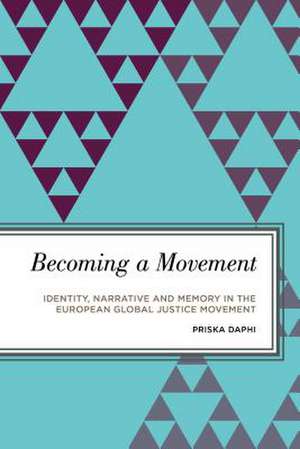
Becoming a Movement: Identity, Narrative and Memory in the European Global Justice Movement: Radical Subjects in International Politics
Autor Priska Daphien Limba Engleză Paperback – 18 dec 2018





Preț: 304.89 lei
Preț vechi: 406.14 lei
-25%
Puncte Express: 457
Carte tipărită la comandă
Livrare economică 28 noiembrie-12 decembrie
Livrare prin curier în România Termenul estimat este afișat lângă disponibilitate.
Transport gratuit de la 400.00 lei Plată online sau ramburs, în funcție de opțiunile comenzii.
Retur gratuit în 14 zile Comandă securizată și suport în română.
Specificații
ISBN-13: 9781786603807
ISBN-10: 1786603802
Pagini: 164
Ilustrații: 6 Charts, 3 Tables
Dimensiuni: 151 x 221 x 12 mm
Greutate: 0.25 kg
Editura: Bloomsbury Publishing
Colecția Rowman & Littlefield
Seria Radical Subjects in International Politics
Locul publicării:New York, United States
ISBN-10: 1786603802
Pagini: 164
Ilustrații: 6 Charts, 3 Tables
Dimensiuni: 151 x 221 x 12 mm
Greutate: 0.25 kg
Editura: Bloomsbury Publishing
Colecția Rowman & Littlefield
Seria Radical Subjects in International Politics
Locul publicării:New York, United States
V-ar putea interesa
-
 The Closing of the American BorderEdward AldenPreț: 93.45 lei
 -
 The Environment Between Theory and PracticeAvner De-Shalit-28%Preț: 365.38 lei510.00 lei
 -
 A Liberal Theory of International JusticeAndrew Altman-14%Preț: 295.39 lei343.41 lei
 -
 Going to Extremes: How Like Minds Unite and DivideCass Sunstein-20%Preț: 89.29 lei111.83 lei
 -
 The Holocaust Is Over; We Must Rise from Its AshesAvraham BurgPreț: 151.15 lei
 -
 Why Arendt MattersElisabeth Young-BruehlPreț: 239.19 lei
 -
 Rules for RadicalsSaul AlinskyPreț: 109.10 lei
 -
 Preț: 231.18 lei
 -
 Hannah Arendt: A Critical IntroductionFinn BowringPreț: 259.30 lei
 -
 Political IslamKhaled HroubPreț: 130.00 lei
 -
 European UniversalismImmanuel WallersteinPreț: 100.38 lei
 -
 Hashim, A: The Caliphate at WarAhmed S. Hashim-22%Preț: 166.21 lei213.49 lei
Descriere
Social movement scholars have become increasingly interested in the role of stories in contentious politics. Stories may facilitate the mobilization of activists and strengthen the resonance of their claims within public discourse and institutional politics. This open access book explores the role of narratives in building collective identity - a vital element in activists' continued commitment. While often claimed important, the connection between narratives and movement identity remains understudied. Drawing on a rich pool of original data, the book's analysis focusses on the Global Justice Movement (GJM), a movement known for its diversity of political perspectives. Based on a comparison of different national constellations of the GJM in Europe, the book demonstrates the centrality of activists' narratives in forming and maintaining movement identity and in making the GJM more enduring.
The ebook editions of this book are available open access under a CC BY-NC-ND 4.0 licence on bloomsburycollections.com. Open access was funded by Goethe University Frankfurt am Main
The ebook editions of this book are available open access under a CC BY-NC-ND 4.0 licence on bloomsburycollections.com. Open access was funded by Goethe University Frankfurt am Main
Cuprins
List of Abbreviations/ List of Figures and Tables/ Introduction: Narrating the Global Justice Movement in Europe/ 1. Movement Identity, Narrative and Memory/ 2. Differences in Narrating the GJM/ 3. The Shared GJM Narrative/ 4. The GJM Narrative and Movement Identity/ Conclusion: Narrative Identity and Movement Continuity/ Acknowledgments/ Appendix A: Interviews and Focus Groups with GJM Activists/ Appendix B: Selection of GJM Documents/ Bibliography/ Cited GJM Documents
Recenzii
In this deeply researched and compellingly theorized book, Priska Daphi shows that becoming part of a movement is learning to tell the movement's story. Daphi demonstrates how the Global Justice Movement was able to forge solidarity across strikingly different national contexts by recounting the movement's own history. Synthesizing theories of collective identity, narrative and group memory, Becoming a Movement contributes powerfully to our understanding of the cultural dimensions of mobilization.
Priska Daphi shows how narratives help define activists' realities. Her engaging book offers a deep understanding of identity construction by comparing movement stories in several national contexts. This thoughtful analysis provides penetrating insights into a core movement mechanism: Collective Identity Construction. This book is a groundbreaking study that will be welcomed by all engaged researchers pondering the role of narratives, identity and the cultural realities of activism.
In this important contribution to the literature, Priska Daphi draws on original and rich cross-national data to explore the relationship between memory, narratives and collective identity in one of the most influential movements of recent years, the Global Justice Movement. Full of nuanced insights on collective meaning making and narratives of becoming and belonging, Becoming a Movement is a compelling read.
Comparing activists' narratives across countries, movement sectors and time this book provides a persuasive answer to how heterogeneous socio-cultural backgrounds and political traditions have been bridged in the Global Justice Movement. Filling a gap in social movement studies, Daphi's excellent research reveals how cognitive, relational and emotional components of narratives shape processes of collective identity formation.
Daphi's volume makes an important empirical contribution to a more complex understanding of the role of narrative in the formation and maintenance of movement identity, which is interesting beyond social movement and narrative studies.
Becoming a Movement is an important and innovative contribution to the
field of social movement studies. An indispensable book for the scholars of movement
identity and the GJM alike.
The book is particularly strong in revealing how cognitive, relational and emotional factors came together in the formation of a powerful movement narrative that had the ability of constructing a collective identity even though the activists did not share the same political perspectives. Daphi concludes by arguing that movement narratives are particularly successful if they combine the idea of shared experience with a plurality of diverse perspectives uniting in common agency. Overall, her book very successfully underlines the importance of memories for social movements.
Priska Daphi shows how narratives help define activists' realities. Her engaging book offers a deep understanding of identity construction by comparing movement stories in several national contexts. This thoughtful analysis provides penetrating insights into a core movement mechanism: Collective Identity Construction. This book is a groundbreaking study that will be welcomed by all engaged researchers pondering the role of narratives, identity and the cultural realities of activism.
In this important contribution to the literature, Priska Daphi draws on original and rich cross-national data to explore the relationship between memory, narratives and collective identity in one of the most influential movements of recent years, the Global Justice Movement. Full of nuanced insights on collective meaning making and narratives of becoming and belonging, Becoming a Movement is a compelling read.
Comparing activists' narratives across countries, movement sectors and time this book provides a persuasive answer to how heterogeneous socio-cultural backgrounds and political traditions have been bridged in the Global Justice Movement. Filling a gap in social movement studies, Daphi's excellent research reveals how cognitive, relational and emotional components of narratives shape processes of collective identity formation.
Daphi's volume makes an important empirical contribution to a more complex understanding of the role of narrative in the formation and maintenance of movement identity, which is interesting beyond social movement and narrative studies.
Becoming a Movement is an important and innovative contribution to the
field of social movement studies. An indispensable book for the scholars of movement
identity and the GJM alike.
The book is particularly strong in revealing how cognitive, relational and emotional factors came together in the formation of a powerful movement narrative that had the ability of constructing a collective identity even though the activists did not share the same political perspectives. Daphi concludes by arguing that movement narratives are particularly successful if they combine the idea of shared experience with a plurality of diverse perspectives uniting in common agency. Overall, her book very successfully underlines the importance of memories for social movements.
Notă biografică
Priska Daphi is Head of Research Group Conflict & Social Movements, Peace Research Institute Frankfurt (PRIF) and Research Fellow at Goethe University Frankfurt