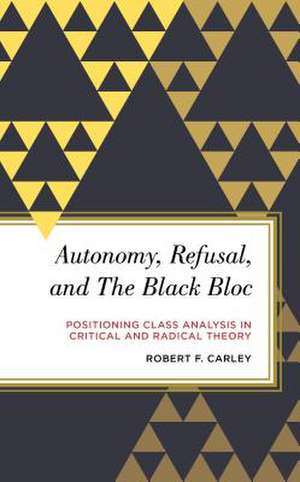
Autonomy, Refusal, and the Black Bloc: Positioning Class Analysis in Critical and Radical Theory: Radical Subjects in International Politics
Autor Robert F. Carleyen Limba Engleză Hardback – 11 iul 2019






Preț: 725.40 lei
Preț vechi: 1092.75 lei
-34%
Puncte Express: 1088
Carte tipărită la comandă
Livrare economică 08-22 decembrie
Livrare prin curier în România Termenul estimat este afișat lângă disponibilitate.
Transport gratuit pentru acest produs Plată online sau ramburs, în funcție de opțiunile comenzii.
Retur gratuit în 14 zile Comandă securizată și suport în română.
Specificații
ISBN-13: 9781786608802
ISBN-10: 1786608804
Pagini: 128
Dimensiuni: 161 x 237 x 15 mm
Greutate: 0.35 kg
Editura: Bloomsbury Publishing
Colecția Rowman & Littlefield
Seria Radical Subjects in International Politics
Locul publicării:New York, United States
ISBN-10: 1786608804
Pagini: 128
Dimensiuni: 161 x 237 x 15 mm
Greutate: 0.35 kg
Editura: Bloomsbury Publishing
Colecția Rowman & Littlefield
Seria Radical Subjects in International Politics
Locul publicării:New York, United States
Cuprins
Preface
1. Introduction: Marxism, Critical, and Radical Theory
2. Class, Organicity, and Autonomy: A Critique of Post-Autonomist Conceptions of Hegemony and Political Practice
3. Marcuse and Social Protest: Disruption and Continuance of the Radical Tradition in Critical Theory
4. An Analysis of the Black Bloc Tactic: Tactics as a Cultural Practice
5. References
About the Author
1. Introduction: Marxism, Critical, and Radical Theory
2. Class, Organicity, and Autonomy: A Critique of Post-Autonomist Conceptions of Hegemony and Political Practice
3. Marcuse and Social Protest: Disruption and Continuance of the Radical Tradition in Critical Theory
4. An Analysis of the Black Bloc Tactic: Tactics as a Cultural Practice
5. References
About the Author
Recenzii
These are fighting words. Part genealogy of critical theory's strongest sinews, part corrective to the distortions of posers, Carley's mastery of the literature is bested only by his contempt for those who fake it. Every theory must find its limit situation, and Carley makes plain that, at its threshold, "autonomy" demands the repolarization of our one-dimensional world. Read at your own risk!
Contra Antonio Negri's criticism of the black bloc movement as "solitary" and "individual," Carley argues powerfully and lucidly that the black bloc movement involves not merely isolated incidents of revolt, but an "affirmative and active" practice of progressive and constructive reconfigurations of social relations. This is an important contribution for anyone attempting to theorize, and support, contemporary social movements, and particularly the urgent issue of their organization or lack thereof.
Carley's work is short and dense, wasting no time in diving into the complexities of radical and critical theory, as well as the tactical dimensions of social movement organizing. This is not a weakness, as it lends a clarity of purpose and significance to Carley's arguments. As such, it is of interest to scholars concerned with contemporary forms of social protest, as well as activists and organizers doing that work. Given the growing prominence of groups using Black Bloc tactics and those adjacent to them-various antifa groups, as well as the gilet jaunes in France-the number of those interested in such questions is bound to grow.
Contra Antonio Negri's criticism of the black bloc movement as "solitary" and "individual," Carley argues powerfully and lucidly that the black bloc movement involves not merely isolated incidents of revolt, but an "affirmative and active" practice of progressive and constructive reconfigurations of social relations. This is an important contribution for anyone attempting to theorize, and support, contemporary social movements, and particularly the urgent issue of their organization or lack thereof.
Carley's work is short and dense, wasting no time in diving into the complexities of radical and critical theory, as well as the tactical dimensions of social movement organizing. This is not a weakness, as it lends a clarity of purpose and significance to Carley's arguments. As such, it is of interest to scholars concerned with contemporary forms of social protest, as well as activists and organizers doing that work. Given the growing prominence of groups using Black Bloc tactics and those adjacent to them-various antifa groups, as well as the gilet jaunes in France-the number of those interested in such questions is bound to grow.