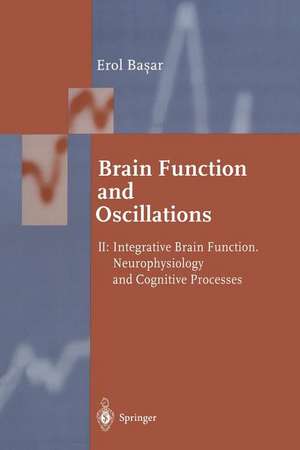
Brain Function and Oscillations: Springer Series in Synergetics
Autor Erol Ba¿aren Limba Engleză Paperback – 22 sep 2011
Din seria Springer Series in Synergetics
- 15%
 Preț: 677.02 lei
 -
 Preț: 403.04 lei
 -
 Preț: 411.78 lei
 -
 Preț: 409.71 lei
 - 18%
 Preț: 755.23 lei
 - 18%
 Preț: 766.57 lei
 -
 Preț: 386.04 lei
 -
 Preț: 393.24 lei
 -
 Preț: 384.12 lei
 -
 Preț: 401.21 lei
 - 15%
 Preț: 670.48 lei
 -
 Preț: 414.85 lei
 - 15%
 Preț: 515.66 lei
 -
 Preț: 422.88 lei
 - 15%
 Preț: 619.84 lei
 - 18%
 Preț: 1008.14 lei
 - 15%
 Preț: 645.63 lei
 -
 Preț: 411.51 lei
 -
 Preț: 375.29 lei
 - 15%
 Preț: 516.28 lei
 -
 Preț: 380.99 lei
 -
 Preț: 389.23 lei
 -
 Preț: 377.64 lei
 - 8%
 Preț: 594.60 lei
 - 15%
 Preț: 616.51 lei
 - 20%
 Preț: 466.68 lei
 -
 Preț: 412.31 lei
 - 18%
 Preț: 1121.34 lei
 - 18%
 Preț: 765.91 lei
 - 15%
 Preț: 647.87 lei
 -
 Preț: 375.08 lei
 -
 Preț: 393.95 lei
Preț: 655.47 lei
Preț vechi: 771.14 lei
-15%
Puncte Express: 983
Carte tipărită la comandă
Livrare economică 30 noiembrie-14 decembrie
Livrare prin curier în România Termenul estimat este afișat lângă disponibilitate.
Transport gratuit pentru acest produs Plată online sau ramburs, în funcție de opțiunile comenzii.
Retur gratuit în 14 zile Comandă securizată și suport în română.
Specificații
ISBN-13: 9783642641701
ISBN-10: 3642641709
Pagini: 520
Ilustrații: XXXIX, 476 p.
Dimensiuni: 155 x 235 x 28 mm
Greutate: 0.78 kg
Ediția:Softcover reprint of the original 1st ed. 1999
Editura: Springer
Colecția Springer Series in Synergetics
Seria Springer Series in Synergetics
Locul publicării:Berlin, Heidelberg, Germany
ISBN-10: 3642641709
Pagini: 520
Ilustrații: XXXIX, 476 p.
Dimensiuni: 155 x 235 x 28 mm
Greutate: 0.78 kg
Ediția:Softcover reprint of the original 1st ed. 1999
Editura: Springer
Colecția Springer Series in Synergetics
Seria Springer Series in Synergetics
Locul publicării:Berlin, Heidelberg, Germany
V-ar putea interesa
-
 Energy for Animal LifeR. McNeill Alexander-29%Preț: 376.73 lei527.52 lei
 -
 Electricity and Magnetism in Biological SystemsDonald Edmonds-28%Preț: 439.40 lei613.09 lei
 -
 Molecular Theory of SolutionsArieh Ben-Naim-32%Preț: 667.93 lei985.92 lei
 -
 Introducing Biological Energetics: How Energy and Information Control the Living WorldNorman W. H. Cheetham-20%Preț: 454.38 lei570.73 lei
 -
 -31%Preț: 932.22 lei1355.39 lei
 -
 -23%Preț: 686.29 lei891.29 lei
 -
 Chemical BiophysicsDaniel A. BeardPreț: 511.37 lei
 -
 Biological Physics of the Developing EmbryoGabor Forgacs-23%Preț: 745.68 lei968.41 lei
 -
 Physics in Molecular BiologyKim Sneppen-23%Preț: 779.32 lei1012.11 lei
 -
 Statistical Mechanics of Cellular Systems and ProcessesMuhammad H. Zaman-11%Preț: 609.30 lei684.60 lei
 -
 Random Walks in BiologyHoward C BergPreț: 341.45 lei
 -
 The Physics of Living ProcessesThomas Andrew Waigh-15%Preț: 689.52 lei811.20 lei
 -
 Biophysics For DummiesKen VosPreț: 126.26 lei
 -
 Biomechanics For DummiesSteve MccawPreț: 135.04 lei
 -
 Fundamentals of BiophysicsAndrey B Rubin-9%Preț: 1250.81 lei1374.52 lei
 -
 -23%Preț: 619.66 lei804.75 lei
 -
 Single-Channel RecordingBert Sakmann-18%Preț: 2069.92 lei2524.28 lei
 -
 Ecological MicrocosmsRobert J. BeyersPreț: 408.37 lei
 -
 Continuum Mechanics of Anisotropic MaterialsStephen C. CowinPreț: 418.25 lei
 -
 -11%Preț: 430.95 lei484.20 lei
 -
 Design in Nature: Learning from TreesClaus Mattheck-18%Preț: 859.03 lei1047.60 lei
Public țintă
Professional/practitionerCuprins
I. Dynamics of Electrical Signals in the Animal Brain.- 1. Dynamics of Potentials in the Visual and Auditory Pathway, Hippocampus, and Reticular Formation of the Cat Brain.- 2. Cross-Modality Experiments on the Cat Brain.- 3. Selectively Distributed Gamma-Band Responses Studied in Cortex, Reticular Formation, Hippocampus, and Cerebellum.- 4. Highest Frequency Range in Reticular Formation and Inferior Colliculus (100–1000 Hz).- 5. The Brain of the Sleeping Cat: Dynamics of Electrical Signals.- 6. Dynamics of Potentials from Invertebrate Brains.- 7. Dynamics of Potentials from the Brain of Anamniotes (Vertebrates).- 8. Frequency Response of the Cat Brain Is Influenced by Pharmacological Agents.- II. The Human Brain: Dynamics of EEG, Evoked Potentials, and MEG.- 9. Evoked Alpha and Theta Responses in Humans to Auditory and Visual Stimuli.- 10. “Cross-Modality” Experiments in Humans.- 11. The Bisensory Evoked Theta Response - A Correlate of Supramodal Association?.- 12. Evoked Delta Oscillations on the Hearing Threshold.- 13. Evoked Oscillations in Magnetoencephalography.- III. Cognitive Processes.- 14. Selective Attention and Memory: Neurophysiology and Cognitive Psychology.- 15. Memory Templates in Event-Related Oscillations, P300, MMN.- 16. Dynamics of Compound Potentials (P300) in Freely Moving Cats.- 17. The Compound P300–40Hz Response of the Cat Hippocampus.- 18. Event-Related Potentials During States of High Expectancy: Results on the Cat Hippocampus, Cortex, and Reticular Formation.- 19. Event-Related Potentials During States of High Expectancy and Attention in Human Subjects.- 20. Topological Distribution of Oddball “P300” Responses.- 21. Wavelet Analysis of Oddball P300.- 22. Dynamic Memory Manifested by Induced Alpha.- 23. Event-Related Oscillationsas a Strategy in Cognition Research.- IV. Integrative Systems in Brain Function.- 24. Functional Alphas Selectively Distributed in the Brain - A Theory.- 25. Theta Rhythms in Integrative Brain Function.- 26. Gamma-Band Responses in the Brain: Functional Significance.- 27. Structures, Brain Waves, and Their Functions.- 28. Brain Functioning: Integrative Models.- 29. EEG and Event-Related Oscillations as Brain Alphabet.- 30. Event-Related Oscillations in Brain Function.- V. Conclusion.- 31. An Integrative Neurophysiology Based on Brain Oscillations.- 32. A “Neurons-Brain” Doctrine: New Thoughts.- 33. Epilogue: EEG Oscillations in Integrative-Cognitive Neurophysiology.- References.- Author Index.
Recenzii
From the reviews
"These books are very-well written and provide a strong background for explaining neural oscillations ... We strongly believe that the contents of these two volumes will be very useful for those neurophysiologists, biomedical engineers, clinical researchers, physicians, and graduate students who are working in all areas of brain research." (M. Akay & P. Bonetto, IEEE Engineering in Medicine and Biology, 1999)
"This book contains a wealth of new experimental findings, techniques for analysis and theoretical conceptions. Anyone interested in brain oscillations and cortical information processing in general will enjoy reading this book." (W. Klimesch, Trends in Cognitive Science, 1999)
"One's response to this pair of volumes will inevitably depend of what kind of explanation one finds 'satisfying' .... Nevertheless, this is a landmark publication which may have an inspirational effect on other workers on the field." (S. Jones, Clinical Neurophysiology, 1999)
"These books are very-well written and provide a strong background for explaining neural oscillations ... We strongly believe that the contents of these two volumes will be very useful for those neurophysiologists, biomedical engineers, clinical researchers, physicians, and graduate students who are working in all areas of brain research." (M. Akay & P. Bonetto, IEEE Engineering in Medicine and Biology, 1999)
"This book contains a wealth of new experimental findings, techniques for analysis and theoretical conceptions. Anyone interested in brain oscillations and cortical information processing in general will enjoy reading this book." (W. Klimesch, Trends in Cognitive Science, 1999)
"One's response to this pair of volumes will inevitably depend of what kind of explanation one finds 'satisfying' .... Nevertheless, this is a landmark publication which may have an inspirational effect on other workers on the field." (S. Jones, Clinical Neurophysiology, 1999)
Textul de pe ultima copertă
This book establishes a brain theory based on neural oscillations with a temporal relation to a well-defined event. New findings about oscillations at the cellular level show striking parallels with EEG and MEG measurements. The authors embrace both the level of single neurons and that of the brain as a whole, showing how this approach advances our knowledge about the functional significance of the brain's electrical activity. They are related to sensory and cognitive tasks, leading towards an "integrative neurophysiology". The book will appeal to scientists and graduate students.
This two-volume treatise has the special features that:
- powerful mathematical algorithms are used;
- concepts of synergetics, synchronization of cell assemblies provide a new theory of evoked potentials;
- the EEG frequencies are considered as a type of alphabet of brain function;
- based on the results described, brain oscillations are correlated with multiple functions, including sensory registration, perception, movement and cognitive processes related to attention,learning and memory;
- the superposition principle of event-related oscillations and brain Feynmann diagrams are introduced as metaphors from quantum theory.
This two-volume treatise has the special features that:
- powerful mathematical algorithms are used;
- concepts of synergetics, synchronization of cell assemblies provide a new theory of evoked potentials;
- the EEG frequencies are considered as a type of alphabet of brain function;
- based on the results described, brain oscillations are correlated with multiple functions, including sensory registration, perception, movement and cognitive processes related to attention,learning and memory;
- the superposition principle of event-related oscillations and brain Feynmann diagrams are introduced as metaphors from quantum theory.
Caracteristici
This book not only covers exhaustively EEG and MEG measurements, but it is unique in also offering a detailed analysis of integrative neurophysiology based on the physics of dynamical systems.