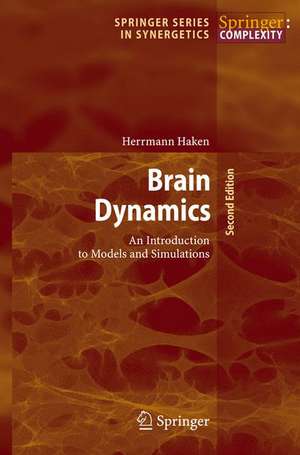
Brain Dynamics: Springer Series in Synergetics
Autor Hermann Hakenen Limba Engleză Hardback – 4 ian 2008
The second edition has been thoroughly updated and augmented by two extensive chapters that discuss the interplay between pattern recognition and synchronization. Further, to enhance the usefulness as textbook and for self-study, the detailed solutions for all 34 exercises throughout the text have been added.
Din seria Springer Series in Synergetics
- 15%
 Preț: 677.02 lei
 -
 Preț: 403.04 lei
 -
 Preț: 411.78 lei
 -
 Preț: 409.71 lei
 - 18%
 Preț: 755.23 lei
 - 18%
 Preț: 766.57 lei
 -
 Preț: 386.04 lei
 -
 Preț: 393.24 lei
 -
 Preț: 384.12 lei
 -
 Preț: 401.21 lei
 - 15%
 Preț: 670.48 lei
 -
 Preț: 414.85 lei
 - 15%
 Preț: 515.66 lei
 -
 Preț: 422.88 lei
 - 15%
 Preț: 619.84 lei
 - 18%
 Preț: 1008.14 lei
 - 15%
 Preț: 645.63 lei
 -
 Preț: 411.51 lei
 -
 Preț: 375.29 lei
 - 15%
 Preț: 516.28 lei
 -
 Preț: 380.99 lei
 -
 Preț: 389.23 lei
 -
 Preț: 377.64 lei
 - 8%
 Preț: 594.60 lei
 - 15%
 Preț: 616.51 lei
 - 20%
 Preț: 466.68 lei
 - 18%
 Preț: 1121.34 lei
 - 18%
 Preț: 765.91 lei
 - 15%
 Preț: 647.87 lei
 -
 Preț: 375.08 lei
 - 15%
 Preț: 655.47 lei
 -
 Preț: 393.95 lei
Preț: 412.31 lei
Puncte Express: 618
Carte tipărită la comandă
Livrare economică 26 noiembrie-10 decembrie
Livrare prin curier în România Termenul estimat este afișat lângă disponibilitate.
Transport gratuit pentru acest produs Plată online sau ramburs, în funcție de opțiunile comenzii.
Retur gratuit în 14 zile Comandă securizată și suport în română.
Specificații
ISBN-13: 9783540752363
ISBN-10: 3540752366
Pagini: 348
Ilustrații: XIV, 333 p. 85 illus.
Dimensiuni: 160 x 241 x 25 mm
Greutate: 0.64 kg
Ediția:Second Edition 2008
Editura: Springer
Colecția Springer Series in Synergetics
Seria Springer Series in Synergetics
Locul publicării:Berlin, Heidelberg, Germany
ISBN-10: 3540752366
Pagini: 348
Ilustrații: XIV, 333 p. 85 illus.
Dimensiuni: 160 x 241 x 25 mm
Greutate: 0.64 kg
Ediția:Second Edition 2008
Editura: Springer
Colecția Springer Series in Synergetics
Seria Springer Series in Synergetics
Locul publicării:Berlin, Heidelberg, Germany
V-ar putea interesa
-
 Energy for Animal LifeR. McNeill Alexander-29%Preț: 376.73 lei527.52 lei
 -
 Electricity and Magnetism in Biological SystemsDonald Edmonds-28%Preț: 439.40 lei613.09 lei
 -
 Molecular Theory of SolutionsArieh Ben-Naim-32%Preț: 667.93 lei985.92 lei
 -
 BiophysicsCotterill-23%Preț: 665.06 lei863.71 lei
 -
 Biological Physics of the Developing EmbryoGabor Forgacs-23%Preț: 745.68 lei968.41 lei
 -
 Physics in Molecular BiologyKim Sneppen-23%Preț: 779.32 lei1012.11 lei
 -
 Statistical Mechanics of Cellular Systems and ProcessesMuhammad H. Zaman-11%Preț: 609.30 lei684.60 lei
 -
 Random Walks in BiologyHoward C BergPreț: 336.82 lei
 -
 -23%Preț: 619.66 lei804.75 lei
 -
 Single-Channel RecordingBert Sakmann-18%Preț: 2069.92 lei2524.28 lei
 -
 Ecological MicrocosmsRobert J. BeyersPreț: 408.37 lei
 -
 Continuum Mechanics of Anisotropic MaterialsStephen C. CowinPreț: 418.25 lei
 -
 Design in Nature: Learning from TreesClaus Mattheck-18%Preț: 859.03 lei1047.60 lei
Public țintă
ResearchCuprins
Basic Experimental Facts and Theoretical Tools.- The Neuron – Building Block of the Brain.- Neuronal Cooperativity.- Spikes, Phases, Noise: How to Describe Them Mathematically? We Learn a Few Tricks and Some Important Concepts.- Spiking in Neural Nets.- The Lighthouse Model. Two Coupled Neurons.- The Lighthouse Model. Many Coupled Neurons.- Integrate and Fire Models (IFM).- Many Neurons, General Case, Connection with Integrate and Fire Model.- Pattern Recognition Versus Synchronization: Pattern Recognition.- Pattern Recognition Versus Synchronization: Synchronization and Phase Locking.- Phase Locking, Coordination and Spatio-Temporal Patterns.- Phase Locking via Sinusoidal Couplings.- Pulse-Averaged Equations.- Conclusion.- The Single Neuron.- Conclusion and Outlook.- Solutions to Exercises.
Textul de pe ultima copertă
Brain Dynamics serves to introduce graduate students and nonspecialists from various backgrounds to the field of mathematical and computational neurosciences. Some of the advanced chapters will also be of interest to the specialists. The book approaches the subject through pulse-coupled neural networks, with at their core the lighthouse and integrate-and-fire models, which allow for the highly flexible modelling of realistic synaptic activity, synchronization and spatio-temporal pattern formation. Topics also include pulse-averaged equations and their application to movement coordination. The book closes with a short analysis of models versus the real neurophysiological system.
The second edition has been thoroughly updated and augmented by two extensive chapters that discuss the interplay between pattern recognition and synchronization. Further, to enhance the usefulness as textbook and for self-study, the detailed solutions for all 34 exercises throughout the text have been added.
The second edition has been thoroughly updated and augmented by two extensive chapters that discuss the interplay between pattern recognition and synchronization. Further, to enhance the usefulness as textbook and for self-study, the detailed solutions for all 34 exercises throughout the text have been added.
Notă biografică
Prof. Dr. Dr. h.c. mult. Hermann Haken arbeitet an Anwendungen der
Synergetik auf Gehirnvorgänge. Prof. emer.
Dr. Peter J. Plath war an der Universität Bremen und ist Gastprofessor am
Fritz-Haber-Institut. Prof. emer. Dr.
Werner Ebeling war an der Humboldt-Universität Berlin und ist Gründer des
heutigen Bereiches Statistische Physik und nichtlineare Dynamik. Prof. Dr. Yuri M. Romanovsky ist in
Lehre und Forschung an der Physikalischen Fakultät der Moskauer Staatlichen
Lomonossov-Universität tätig.