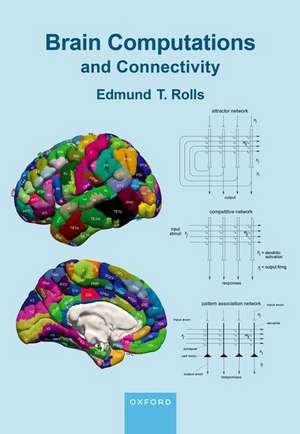
Brain Computations and Connectivity
Autor Edmund T. Rollsen Limba Engleză Hardback – 11 iul 2023
Ne-a atras atenția în mod deosebit profunzimea tehnică a acestui volum, care se poziționează pe linia practică a lucrării An Introduction to Natural Computation, dar cu un focus mult mai accentuat pe sistemele de conectivitate specifice creierului uman. Suntem de părere că această ediție extinsă reușește să depășească limitele teoretice obișnuite, oferind o analiză riguroasă a ceea ce se calculează în diferite regiuni cerebrale și, mai ales, a modului în care aceste procese sunt implementate biologic.
Subliniem faptul că Brain Computations and Connectivity reprezintă o evoluție naturală în cadrul operei autorului. Dacă în Cerebral Cortex accentul era pus pe principiile de funcționare ale cortexului, iar în Emotion and Decision-making Explained autorul explora mecanismele valorice ale deciziilor, aici Edmund T. Rolls integrează aceste teme într-un cadru computațional unificat. Față de volumul precedent Brain Computations, această lucrare aduce un volum impresionant de date noi privind conectivitatea, esențiale pentru oricine dorește să înțeleagă arhitectura informațională a minții.
Structura narativă a textului este una tehnică și sistematică, culminând cu prezentarea a 13 principii fundamentale de codificare în rețelele neurale. Autorul folosește un limbaj științific precis pentru a explica fenomene complexe, făcând puntea necesară între neurofiziologie și [Machine learning / Deep learning](category). Este o resursă vastă, de peste 1000 de pagini, care nu se mulțumește doar cu descrierea structurilor, ci propune modele matematice și computaționale aplicabile atât în medicină, cât și în dezvoltarea unei inteligențe artificiale inspirate de biologie.
Preț: 808.77 lei
Preț vechi: 1299.03 lei
-38%
Carte disponibilă
Livrare economică 09-15 iulie
Specificații
ISBN-10: 0198887914
Pagini: 1174
Dimensiuni: 175 x 252 x 46 mm
Greutate: 1.8 kg
Ediția:2
Editura: OUP OXFORD
Colecția OUP Oxford
Locul publicării:Oxford, United Kingdom
V-ar putea interesa
-
 Brain and BehaviorDavid Eagleman-27%Preț: 932.19 lei1276.97 lei
 -
 The Brain: A Very Short IntroductionMichael O'Shea-33%Preț: 46.81 lei70.00 lei
 -
 Brain ComputationsEdmund T. Rolls-5%Preț: 779.91 lei820.96 lei
 -
 Natural NeuroscienceNachum Ulanovsky-14%Preț: 432.81 lei503.27 lei
 -
 Theoretical NeuroscienceLaurence F. Abbott-18%Preț: 527.45 lei641.32 lei
 -
 The Computer and the BrainJohn Von NeumannPreț: 111.06 lei
 -
 Inside Your BrainLucy Ann Unwin-18%Preț: 86.54 lei106.17 lei
 -
 The Importance of Being EducableLeslie ValiantPreț: 160.08 lei
 -
 The Self-Assembling BrainPeter Robin HiesingerPreț: 176.72 lei
 -
 How to Create a MindRay Kurzweil-36%Preț: 62.85 lei97.85 lei
 -
 Theoretical Neuroscience: Understanding CognitionXiao-Jing Wang-9%Preț: 766.06 lei841.82 lei
 -
 Machine Learning For DummiesJohn Paul Mueller-20%Preț: 147.53 lei184.42 lei
 -
 The Essential Book of AIAnne Rooney-20%Preț: 71.24 lei89.04 lei
 -
 Preț: 120.16 lei
 -
 50 Human Brain Ideas You Really Need to KnowMoheb Costandi-29%Preț: 50.03 lei70.11 lei
 -
 Computational IntelligenceAlexandru Floares-41%Preț: 917.84 lei1564.38 lei
 -
 -27%Preț: 1259.12 lei1733.90 lei
 -
 The Brain CodeYossi ChalamishPreț: 142.46 lei
 -
 The Brain at RestJoseph JebelliPreț: 84.25 lei
De ce să citești această carte
Recomandăm această carte cercetătorilor și inginerilor din domeniul inteligenței artificiale care doresc să depășească modelele abstracte și să înțeleagă arhitectura reală a procesării informației în creier. Cititorul câștigă acces la o sinteză monumentală a neuroștiinței computaționale moderne, oferind instrumente concrete pentru a modela conectivitatea neurală în aplicații practice de machine learning sau neuropsihiatrie.
Despre autor
Edmund T. Rolls este profesor de psihologie experimentală la Universitatea din Oxford și un cercetător de renume în neuroștiințe. Cu o pregătire medicală inițială la Cambridge, Rolls și-a dedicat cariera studierii legăturilor dintre neurofiziologie, neuroimagistică funcțională și modelele computaționale. Activitatea sa academică este marcată de o abordare interdisciplinară, reușind să conecteze studiul emoțiilor și al deciziilor cu arhitectura rețelelor neurale, fiind autorul unor lucrări de referință precum Neural Networks and Brain Function.
Descriere
Recenzii
This "bottom-up" approach to data-driven neuroscientific discovery serves as the perfect primer for those who study brain sciences, cognitive sciences, artificial intelligence, neuro-engineering, neuropsychology, and empirically oriented philosophy.
Brain Computations is the first complete attempt to summarize our current knowledge about computation in the brain, at a level a graduate can understand. ... This is a biologically grounded, full systems neuroscience textbook-which makes it one of a kind. ... Hippocampal memories, action selection in the striatum, orbitofrontal reward representations, emotion in the limbic system, cerebellar motor control, parietal spatial coordinate transforms, place fields, and posterior visual object recognition-all these can emerge from relatively simple rules. This is Rolls' unspoken but substantial grand unifying theory. (full review https://doi.org/10.1093/brain/awab477)
He concludes with 13 principles about how information in encoded in neural networks. This is almost the Holy Grail of neuroscience, the language of neurons, what makes us what we are. Yet, these ideas are presented in a simple unassuming scientific language ...