Cantitate/Preț
Produs

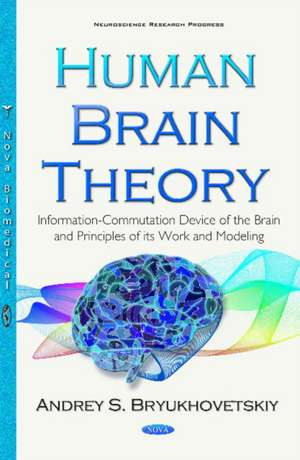
Human Brain Theory: Information-Commutation Device of the Brain & Principles of its Work & Modeling

Autor Andrey S Bryukhovetskiy
en Limba Engleză Hardback – apr 2016

Această monografie științifică semnată de Andrey S Bryukhovetskiy reprezintă o tentativă ambițioasă de a depăși impasul teoretic în care se află neuroștiința contemporană. Autorul propune o schimbare de paradigmă, trecând de la viziunea dogmatică a secolului al XIX-lea asupra structurilor anatomice către o teorie informațional-comutațională. Descoperim aici o critică severă a eficienței scăzute în terapia neurologică și a incapacității modelelor matematice actuale de a concura cu creierul uman, fenomene puse pe seama unei metodologii învechite.

Structura lucrării este riguros organizată, pornind de la analiza conceptelor actuale de organizare a creierului și evaluarea avantajelor și dezavantajelor abordării sistemice, până la prezentarea noii metodologii pentru dezvoltarea simulărilor 3D. Apreciem în mod deosebit modul în care autorul, în calitate de clinician și profesor de neurologie, își ancorează conceptele teoretice în exemple clinice și cercetări asupra genomului și proteomului, încercând să integreze datele moleculare cu cele cognitive într-un spațiu informațional unitar.

Human Brain Theory acoperă aceeași arie tematică precum Neural Assemblies de Günther Palm, dar cu o abordare care prioritizează logistica transferului de date în detrimentul structurii de rețea propriu-zise. În timp ce Towards a Theoretical Neuroscience: from Cell Chemistry to Cognition de L Andrew Coward utilizează ierarhii de procesare inspirate din sistemele electronice complexe, lucrarea de față se concentrează pe inductivitatea țesutului și pe erorile de sistem ale neurologiei teoretice. Textul oferă un cadru conceptual provocator, invitând la o reevaluare a modului în care înțelegem funcționarea morfologică a creierului în era simulărilor digitale.

Citește tot Restrânge

Preț: 124923 lei

Preț vechi: 167791 lei
-26%

Puncte Express: 1874

Carte disponibilă

Livrare economică 27 mai-10 iunie


Specificații

ISBN-13: 9781634847414
ISBN-10: 1634847415
Pagini: 160
Dimensiuni: 155 x 230 x 19 mm
Greutate: 0.59 kg
Editura: Nova Science Publishers Inc
Colecția Nova Science Publishers Inc
Locul publicării:United States

De ce să citești această carte

Recomandăm această carte cercetătorilor din neuroștiințe și specialiștilor în inteligență artificială care caută o perspectivă alternativă asupra arhitecturii cerebrale. Cititorul va câștiga o înțelegere a principiilor de comutație informațională și a limitărilor modelelor matematice actuale. Este o lectură esențială pentru cei care doresc să exploreze noi metodologii de modelare 3D a creierului, dincolo de clișeele rețelelor neuronale clasice.


Descriere

The book was written as an attempt to find the solution to one of the most complex and unsolved issues of the human anatomy: the understanding of the human brain and the principles according to which it operates. Currently, it is important to look at the challenge in an alternatively non-standard, yet still systemic way, paying less attention to details and outlining the ways out of this crisis of neuroscience. The purpose of this monograph is to describe the author's theory about the brain's architecture and operation to the medical and scientific community. Accompanied with extensive clinical, research and training experience, the author's theoretical concepts of the brain synthesized with scientific evidence brought about the conclusion that low efficiency in neurologic therapy and mental diseases; the inability to work out mathematical models and simulations that could compete with the human brain; an academic dead end in the development of artificial intelligence; as well as high energy consumption of the computing innovations were conditioned by the inaccurate methodology and outdated anatomical and physiological views of the neurologists and neuroscientists on information processing in the brain, registration of memories and basic functions of the key morphological structures of the brain. The morphological structure and physiological functions of all known anatomical formations of the brain were defined in the late nineteenth century. Since then, these functions have been accepted as dogmatic. The book shows that present day multi-level neuroresearch relies on the foundation of systemic, morphofunctional and neuroanatomic knowledge about the brain structure. It looks for correlations between genome and post-genome data of molecular research in the brain tissue, as well as with neuropsychological and cognitive data; that is, the book intends to integrate the non-integrable into unified information space. The systemic approach in neuroresearch has become outdated by now and interferes with scientific development. The information approach in the author's research of the genome, transcriptome, proteome in health and in disease permitted the analysis of the inductivity and magnetization of the nervous tissue. It also provided the explanation for targeted movement of the data in the module of the nervous tissue. The author came to the conclusion that gene, protein and neural networks "confused and chained" the pathways of scientific thought. Neural networks are only logistic constructions to provide data transfer in the brain between different modules of the nervous tissue. The author presumes that the funds invested in the development of brain simulations and artificial intelligence will hardly result in the expected advantages. If we are unable to step over the stereotypes of the systemic, morphofunctional research of the previous century, no progress shall come about. The author's theoretical survey resulted in the unique information-commutation theory of the brain and formulation of the key principles of brain operation. As a clinician and professor of neurology, the author underpins his theory with clinical examples. This book presents the framework of the ideas that require experimental research and proof.

Cuprins

Introduction; Neurology & Neural Research in the Early 21st Century; Contemporary Scientific Concepts of the Human Brain Operation & Organization; Current Global Research of Brain: Theoretical, Methodological & Technological Bases for the Discoveries, Inventions & Innovations in Contemporary Neuroscience; A System Approach as the Basic Methodology of Contemporary Neuroresearch: Its Advantages & Disadvantages; An Information Approach to the Fundamental & Theoretical Research of the Brain; The Theory of the Information-Commutation Organization of Human Brain & Its Operations Principles; The Methodology & Technologies of Developing 3D Virtual Models of the Brain; Methodological Errors & Systemic Errors of Theoretical Neurology in the Development of 3D Virtual Models of Brain; The Methodology to Develop a 3D Simulation of the Brain Using the Information Approach; The Future of Theoretical Neurology in Clinical Medicine, the Mathematical Modeling of the Brain & the Development of a Brain-Computer Interface; Conclusion; References; Index.