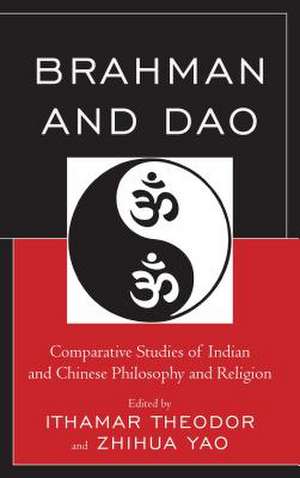
Brahman and Dao: Comparative Studies of Indian and Chinese Philosophy and Religion: Studies in Comparative Philosophy and Religion
Editat de Ithamar Theodor, Zhihua Yao Contribuţii de Ram Nath Jha, Sophia Katz, Friederike Assandri, Nicholas F. Gier, Alexus McLeod, Timothy Connolly, Yong Huang, Livia Kohn, Wei Zhang, Joshua Capitanio, Guang Xing, Bill M. Mak, John M. Thompson, Carl Olson, Gad C. Isayen Limba Engleză Paperback – 16 oct 2015
Din seria Studies in Comparative Philosophy and Religion
- 22%
 Preț: 332.98 lei
 - 35%
 Preț: 747.03 lei
 - 23%
 Preț: 323.68 lei
 - 22%
 Preț: 325.83 lei
 - 23%
 Preț: 327.44 lei
 - 23%
 Preț: 312.23 lei
 - 34%
 Preț: 567.78 lei
 - 34%
 Preț: 633.31 lei
 - 23%
 Preț: 326.92 lei
 - 18%
 Preț: 692.10 lei
 - 29%
 Preț: 345.71 lei
 - 26%
 Preț: 359.68 lei
 - 33%
 Preț: 549.46 lei
 - 27%
 Preț: 271.41 lei
 - 32%
 Preț: 599.73 lei
 - 30%
 Preț: 535.13 lei
 - 36%
 Preț: 525.10 lei
 - 33%
 Preț: 583.16 lei
 - 32%
 Preț: 563.27 lei
 - 26%
 Preț: 272.03 lei
 - 33%
 Preț: 517.62 lei
 - 32%
 Preț: 616.03 lei
 - 27%
 Preț: 284.48 lei
 - 36%
 Preț: 526.58 lei
 - 32%
 Preț: 566.51 lei
 - 33%
 Preț: 518.63 lei
 - 34%
 Preț: 631.23 lei
 - 35%
 Preț: 623.32 lei
 - 33%
 Preț: 578.43 lei
 - 32%
 Preț: 560.57 lei
 - 30%
 Preț: 537.80 lei
 - 32%
 Preț: 551.24 lei
 - nou
 Preț: 563.44 lei
 - nou
 Preț: 563.78 lei
Preț: 380.47 lei
Preț vechi: 579.30 lei
-34%
Puncte Express: 571
Carte tipărită la comandă
Livrare economică 30 noiembrie-14 decembrie
Livrare prin curier în România Termenul estimat este afișat lângă disponibilitate.
Transport gratuit de la 400.00 lei Plată online sau ramburs, în funcție de opțiunile comenzii.
Retur gratuit în 14 zile Comandă securizată și suport în română.
Specificații
ISBN-13: 9781498525916
ISBN-10: 1498525911
Pagini: 308
Ilustrații: 13 b/w photos; 7 tables;
Dimensiuni: 150 x 228 x 20 mm
Greutate: 0.48 kg
Editura: Bloomsbury Publishing
Colecția Lexington Books
Seria Studies in Comparative Philosophy and Religion
Locul publicării:New York, United States
ISBN-10: 1498525911
Pagini: 308
Ilustrații: 13 b/w photos; 7 tables;
Dimensiuni: 150 x 228 x 20 mm
Greutate: 0.48 kg
Editura: Bloomsbury Publishing
Colecția Lexington Books
Seria Studies in Comparative Philosophy and Religion
Locul publicării:New York, United States
Descriere
The present geopolitical rise of India and China evokes much interest in the comparative study of these two ancient Asian cultures. There are various studies comparing Western and Indian philosophies and religions, and there are similar works comparing Chinese and Western philosophy and religion. However, so far there is no systemic comparative study of Chinese and Indian philosophies and religions. Therefore there is a need to fill this gap. As such, Brahman and Dao: Comparative Studies of Indian and Chinese Philosophy and Religion is a pioneering volume in that it highlights possible bridges between these two great cultures and complex systems of thought, with seventeen chapters on various Indo-Chinese comparative topics. The book focuses on four themes: metaphysics and soteriology; ethics; body, health and spirituality; and language and culture.
Cuprins
Acknowledgments
List of Contributors
Introduction
Part One: Metaphysics and Soteriology
Chapter 1: One, Water, and Cosmogony: Reflections on the Rgveda X.129 and the Taiyi sheng shui
Chapter Two: Exploring Parallels between the Philosophy of Upanisads and Daoism
Chapter Three: The Way of silent Realization: Ineffability and Rationality in the Philosophical Mysticisms of Sa?kara and Zhan Ruoshui
Chapter Four: Impermanence and Immortality: The concept of pañca-skandha in Buddhism and in Twofold Mystery Daoism
Section Two: Ethics
Chapter Five: Li and Dharma: Gandhi, Confucius and Virtue Aesthetics
Chapter Six: Ethics and Metaphysics in the Bhagavadgita and Classical Chinese Thought
Chapter Seven: Communal Moral Personhood and Moral Responsibility in the Analects and the Bhagavadgita
Chapter Eight: Ethics of Compassion: Buddhist Karu?a and Confucian Ren
Chapter Nine: Why "Besire" Is Not Bizarre: Moral Knowledge in Confucianism and Hinduism
Section Three: Body, Health and Spirituality
Chapter Te
List of Contributors
Introduction
Part One: Metaphysics and Soteriology
Chapter 1: One, Water, and Cosmogony: Reflections on the Rgveda X.129 and the Taiyi sheng shui
Chapter Two: Exploring Parallels between the Philosophy of Upanisads and Daoism
Chapter Three: The Way of silent Realization: Ineffability and Rationality in the Philosophical Mysticisms of Sa?kara and Zhan Ruoshui
Chapter Four: Impermanence and Immortality: The concept of pañca-skandha in Buddhism and in Twofold Mystery Daoism
Section Two: Ethics
Chapter Five: Li and Dharma: Gandhi, Confucius and Virtue Aesthetics
Chapter Six: Ethics and Metaphysics in the Bhagavadgita and Classical Chinese Thought
Chapter Seven: Communal Moral Personhood and Moral Responsibility in the Analects and the Bhagavadgita
Chapter Eight: Ethics of Compassion: Buddhist Karu?a and Confucian Ren
Chapter Nine: Why "Besire" Is Not Bizarre: Moral Knowledge in Confucianism and Hinduism
Section Three: Body, Health and Spirituality
Chapter Te
Recenzii
This volume will contribute to broadening the horizons of comparative philosophy and religion, and for that reason I highly recommend it to scholars of Indian and Chinese traditions and anyone who is interested in what can be learned from cross-cultural explorations.
The editors who dreamt up this volume of essays on Brahman and Dao were walking in the right direction.
China and India have the richest and most influential spiritual and philosophic traditions in Asia and have been in contact with each other for two millennia, yet comparative studies of these two civilizations and their relationship with each other have been few. The fine essays in this volume bridge this gap by exploring the similarities and dissimilarities between the two traditions in the areas of metaphysics, ethics, medicine, spirituality, language, and culture. Theodor and Yao are to be commended for providing us with such an insightful and multi-dimensional understanding of the complex spiritual traditions of these two enormously influential cultures.
This is a thoughtful and bold collection of essays that seeks genuinely to engage across Indian and Chinese traditions on a wide variety of issues. It represents the emerging field of comparativist study of Indian and Chinese materials that will surely be a significant area of twenty-first century global philosophy. This book offers a scholarly yet accessible presentation of illuminating comparisons between Indian and Chinese sources.
The editors who dreamt up this volume of essays on Brahman and Dao were walking in the right direction.
China and India have the richest and most influential spiritual and philosophic traditions in Asia and have been in contact with each other for two millennia, yet comparative studies of these two civilizations and their relationship with each other have been few. The fine essays in this volume bridge this gap by exploring the similarities and dissimilarities between the two traditions in the areas of metaphysics, ethics, medicine, spirituality, language, and culture. Theodor and Yao are to be commended for providing us with such an insightful and multi-dimensional understanding of the complex spiritual traditions of these two enormously influential cultures.
This is a thoughtful and bold collection of essays that seeks genuinely to engage across Indian and Chinese traditions on a wide variety of issues. It represents the emerging field of comparativist study of Indian and Chinese materials that will surely be a significant area of twenty-first century global philosophy. This book offers a scholarly yet accessible presentation of illuminating comparisons between Indian and Chinese sources.