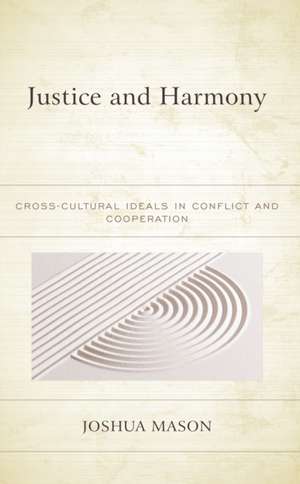
Justice and Harmony: Cross-Cultural Ideals in Conflict and Cooperation: Studies in Comparative Philosophy and Religion
Autor Joshua Masonen Limba Engleză Hardback – 16 aug 2022
Din seria Studies in Comparative Philosophy and Religion
- 22%
 Preț: 332.98 lei
 - 35%
 Preț: 747.03 lei
 - 23%
 Preț: 323.68 lei
 - 22%
 Preț: 325.83 lei
 - 23%
 Preț: 327.44 lei
 - 23%
 Preț: 312.23 lei
 - 34%
 Preț: 567.78 lei
 - 34%
 Preț: 633.31 lei
 - 23%
 Preț: 326.92 lei
 - 18%
 Preț: 692.10 lei
 - 34%
 Preț: 380.47 lei
 - 29%
 Preț: 345.71 lei
 - 26%
 Preț: 359.68 lei
 - 33%
 Preț: 549.46 lei
 - 27%
 Preț: 271.41 lei
 - 32%
 Preț: 585.45 lei
 - 30%
 Preț: 535.13 lei
 - 36%
 Preț: 525.10 lei
 - 33%
 Preț: 583.16 lei
 - 33%
 Preț: 550.17 lei
 - 26%
 Preț: 272.03 lei
 - 33%
 Preț: 517.62 lei
 - 32%
 Preț: 616.03 lei
 - 27%
 Preț: 284.48 lei
 - 36%
 Preț: 526.58 lei
 - 32%
 Preț: 553.52 lei
 - 33%
 Preț: 518.63 lei
 - 34%
 Preț: 631.23 lei
 - 35%
 Preț: 623.32 lei
 - 32%
 Preț: 560.57 lei
 - 30%
 Preț: 537.80 lei
 - 32%
 Preț: 551.24 lei
 - nou
 Preț: 551.54 lei
Preț: 578.43 lei
Preț vechi: 864.92 lei
-33%
Puncte Express: 868
Carte tipărită la comandă
Livrare economică 19 noiembrie-03 decembrie
Livrare prin curier în România Termenul estimat este afișat lângă disponibilitate.
Transport gratuit pentru acest produs Plată online sau ramburs, în funcție de opțiunile comenzii.
Retur gratuit în 14 zile Comandă securizată și suport în română.
Specificații
ISBN-13: 9781793654977
ISBN-10: 1793654972
Pagini: 292
Ilustrații: 3 tables;
Dimensiuni: 158 x 237 x 23 mm
Greutate: 0.6 kg
Editura: Bloomsbury Publishing
Colecția Lexington Books
Seria Studies in Comparative Philosophy and Religion
Locul publicării:New York, United States
ISBN-10: 1793654972
Pagini: 292
Ilustrații: 3 tables;
Dimensiuni: 158 x 237 x 23 mm
Greutate: 0.6 kg
Editura: Bloomsbury Publishing
Colecția Lexington Books
Seria Studies in Comparative Philosophy and Religion
Locul publicării:New York, United States
Cuprins
Acknowledgments
Introduction: Justice and Harmony from Metaphysics to Geopolitics
Chapter 1: The Right and the Good, Liberals and Communitarians, Justice and Harmony
Chapter 2: Traditions of Harmony
Chapter 3: Traditions of Justice
Chapter 4: A Pattern of Three Interrelated Concerns
Chapter 5: Root Harmony, Harmonic Justice, Just Harmony
Conclusion
Bibliography
About the Author
Introduction: Justice and Harmony from Metaphysics to Geopolitics
Chapter 1: The Right and the Good, Liberals and Communitarians, Justice and Harmony
Chapter 2: Traditions of Harmony
Chapter 3: Traditions of Justice
Chapter 4: A Pattern of Three Interrelated Concerns
Chapter 5: Root Harmony, Harmonic Justice, Just Harmony
Conclusion
Bibliography
About the Author
Recenzii
Mason's work is a refreshing and successful stab at a large, high-level topic ... a formidable contribution to comparative understandings of the Chinese and Western traditions.
Justice and Harmony: Cross-Cultural Ideals in Conflict and Cooperation is a hugely intelligent book that has defined and found its proper measure. World philosopher Joshua Mason uses comparative cultural hermeneutics to unload the force of the familiar binary thinking that would cleave off good from right, and harmony from justice. In setting the grid for this archaeology of ideas, Mason brings in the heavy equipment of historical, philological, and philosophical research at their broadest compass to quarry the original texts and the relevant literature, and makes intelligible the nuanced meanings of these terms of art and their interpenetrating relationships.
In this impressive work of cross-cultural philosophizing, Joshua Mason ranges from ancient Greek and Chinese sources to modern Chinese, European, and American theorists. His charitable and nuanced readings support a creative articulation of our shared ideals in a fresh way that transcends linguistic, conceptual, and cultural dichotomies. We need not choose between justice and harmony, because when properly understood, zhenghe?? or just harmony is a realistic and realizable goal, growing out of the interplay between benhe?? (root harmony) and heyi?? (harmonic justice). Justice and Harmony is a model of how to be open to the insights of philosophical traditions from around the world-which is how we should all be striving to do philosophy today.
Mason offers a compelling and remarkable framework that broadens the encounter of justice and harmony at a multilevel away from an oppositional reduction, and towards a renewed mutually complementary and intertwined trinary of shared values in human endeavors and everyday living. With a witty, charming and accessible writing, inspiring both awe and humility, this is a valuable scholarly resource for thinking through increasing geopolitical frictions and beyond.
Harmony and justice have often been seen as competing values. How to bridge their gap is one of the greatest philosophical challenges. Mason's book is both informative and insightful. His tripartite construction of root harmony, harmonic justice and just harmony is a meaningful attempt to integrate harmony and justice. I strongly recommend this book to everyone who is interested in this important issue.
Through a contrastive framing of Western sources, comparative philosopher Joshua Mason shows the relevance and significance of a comparative and more inclusive approach to ethics and political philosophy by bringing forward a dialogic exposition with Chinese sources. With a replete thoroughness and clear and accessible writing, Mason educes a revitalization of "the terms of debate" that have exhausted the beaten path to the good life in Western philosophical discourse. Scholars and students alike will benefit from the direct encounter with Chinese philosophical thinking on harmony (he ?) and justice (??) that Justice and Harmony: Cross-Cultural Ideals in Conflict and Cooperation brings to its readers. Mason's engagement with Chinese philosophy tills fertile ground for the augmentation and evolution of Western ethics and political philosophy while at the same time reflecting new light for the growth of Chinese and World philosophy.
Justice and Harmony: Cross-Cultural Ideals in Conflict and Cooperation is a hugely intelligent book that has defined and found its proper measure. World philosopher Joshua Mason uses comparative cultural hermeneutics to unload the force of the familiar binary thinking that would cleave off good from right, and harmony from justice. In setting the grid for this archaeology of ideas, Mason brings in the heavy equipment of historical, philological, and philosophical research at their broadest compass to quarry the original texts and the relevant literature, and makes intelligible the nuanced meanings of these terms of art and their interpenetrating relationships.
In this impressive work of cross-cultural philosophizing, Joshua Mason ranges from ancient Greek and Chinese sources to modern Chinese, European, and American theorists. His charitable and nuanced readings support a creative articulation of our shared ideals in a fresh way that transcends linguistic, conceptual, and cultural dichotomies. We need not choose between justice and harmony, because when properly understood, zhenghe?? or just harmony is a realistic and realizable goal, growing out of the interplay between benhe?? (root harmony) and heyi?? (harmonic justice). Justice and Harmony is a model of how to be open to the insights of philosophical traditions from around the world-which is how we should all be striving to do philosophy today.
Mason offers a compelling and remarkable framework that broadens the encounter of justice and harmony at a multilevel away from an oppositional reduction, and towards a renewed mutually complementary and intertwined trinary of shared values in human endeavors and everyday living. With a witty, charming and accessible writing, inspiring both awe and humility, this is a valuable scholarly resource for thinking through increasing geopolitical frictions and beyond.
Harmony and justice have often been seen as competing values. How to bridge their gap is one of the greatest philosophical challenges. Mason's book is both informative and insightful. His tripartite construction of root harmony, harmonic justice and just harmony is a meaningful attempt to integrate harmony and justice. I strongly recommend this book to everyone who is interested in this important issue.
Through a contrastive framing of Western sources, comparative philosopher Joshua Mason shows the relevance and significance of a comparative and more inclusive approach to ethics and political philosophy by bringing forward a dialogic exposition with Chinese sources. With a replete thoroughness and clear and accessible writing, Mason educes a revitalization of "the terms of debate" that have exhausted the beaten path to the good life in Western philosophical discourse. Scholars and students alike will benefit from the direct encounter with Chinese philosophical thinking on harmony (he ?) and justice (??) that Justice and Harmony: Cross-Cultural Ideals in Conflict and Cooperation brings to its readers. Mason's engagement with Chinese philosophy tills fertile ground for the augmentation and evolution of Western ethics and political philosophy while at the same time reflecting new light for the growth of Chinese and World philosophy.