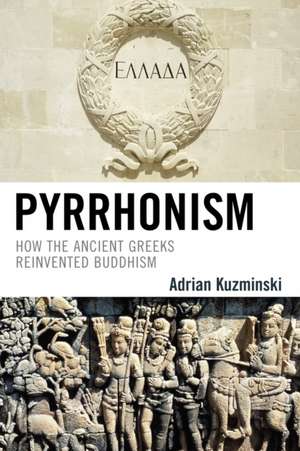
Pyrrhonism: How the Ancient Greeks Reinvented Buddhism: Studies in Comparative Philosophy and Religion
Autor Adrian Kuzminskien Limba Engleză Paperback – 10 mai 2010
Recomandăm Pyrrhonism ca o resursă academică esențială pentru studenții și cercetătorii înscriși în programe de filozofie comparată și istoria religiilor, fiind o lucrare de referință pentru înțelegerea rădăcinilor orientale ale gândirii elene. Adrian Kuzminski propune o reevaluare riguroasă a pironismului, argumentând că acesta nu este o simplă formă de scepticism, ci o practică menită să aline suferința umană prin suspendarea credințelor dogmatice. Această perspectivă poziționează volumul ca o alternativă la Greek Buddha pentru cursurile de filozofie antică, cu avantajul unei analize mai aplicate asupra modului în care pironismul a fost redescoperit în filozofia modernă, în special în opera lui Wittgenstein. Lucrarea este structurată în patru părți majore care facilitează o progresie logică de la clarificări conceptuale la aplicații istorice și contemporane. Primele capitole delimitează pironismul de scepticismul convențional și explorează similaritățile frapante cu budismul Madhyamaka, în timp ce secțiunile finale analizează distincția dintre „evident” și „non-evident”. Spre deosebire de alte lucrări ale autorului, precum The Ecology of Money sau The People’s Money, care explorează sistemele monetare și politice, Pyrrhonism revine la nucleul preocupărilor sale epistemologice, investigând modul în care structura credințelor noastre influențează experiența realității. Considerăm că rigoarea cu care Adrian Kuzminski tratează sursele istorice, de la Sextus Empiricus până la textele budiste timpurii, oferă cititorului un instrument critic valoros. Volumul nu se limitează la o expunere teoretică, ci prezintă pironismul ca pe un stil de viață, o metodă practică de a naviga într-o cultură contemporană saturată de certitudini dogmatice.
Din seria Studies in Comparative Philosophy and Religion
- 22%
 Preț: 332.98 lei
 - 35%
 Preț: 747.03 lei
 - 23%
 Preț: 323.68 lei
 - 22%
 Preț: 325.83 lei
 - 23%
 Preț: 312.23 lei
 - 34%
 Preț: 567.78 lei
 - 34%
 Preț: 633.31 lei
 - 23%
 Preț: 326.92 lei
 - 18%
 Preț: 692.10 lei
 - 34%
 Preț: 380.47 lei
 - 29%
 Preț: 345.71 lei
 - 26%
 Preț: 359.68 lei
 - 33%
 Preț: 549.46 lei
 - 27%
 Preț: 271.41 lei
 - 32%
 Preț: 585.45 lei
 - 30%
 Preț: 535.13 lei
 - 36%
 Preț: 525.10 lei
 - 33%
 Preț: 583.16 lei
 - 32%
 Preț: 563.27 lei
 - 26%
 Preț: 272.03 lei
 - 33%
 Preț: 517.62 lei
 - 32%
 Preț: 616.03 lei
 - 27%
 Preț: 284.48 lei
 - 36%
 Preț: 526.58 lei
 - 32%
 Preț: 566.51 lei
 - 33%
 Preț: 518.63 lei
 - 34%
 Preț: 631.23 lei
 - 35%
 Preț: 623.32 lei
 - 33%
 Preț: 578.43 lei
 - 32%
 Preț: 560.57 lei
 - 30%
 Preț: 537.80 lei
 - 32%
 Preț: 551.24 lei
 - nou
 Preț: 563.44 lei
Preț: 327.44 lei
Preț vechi: 425.36 lei
-23%
Carte tipărită la comandă
Livrare economică 27 noiembrie-11 decembrie
Specificații
ISBN-10: 0739125079
Pagini: 155
Dimensiuni: 148 x 228 x 16 mm
Greutate: 0.27 kg
Editura: Bloomsbury Publishing
Colecția Lexington Books
Seria Studies in Comparative Philosophy and Religion
Locul publicării:New York, United States
V-ar putea interesa
-
 On the Shortness of LifeLucius Annaeus Seneca-20%Preț: 44.96 lei56.45 lei
 -
 MeditationsMarcus Aurelius-20%Preț: 45.71 lei56.89 lei
 -
 Plato: A Very Short IntroductionJulia Annas-20%Preț: 56.77 lei70.88 lei
 -
 Classical PhilosophyTerence Irwin-21%Preț: 396.56 lei501.15 lei
 -
 PoeticsAristotle-29%Preț: 423.60 lei595.18 lei
 -
 Plato's Penal Code: Tradition, Controversy, and Reform in Greek PenologyTrevor J. Saunders-32%Preț: 624.90 lei923.13 lei
 -
 Alcinous: The Handbook of PlatonismAlcinous-29%Preț: 514.65 lei722.37 lei
 -
 Socratic Perplexity and the Nature of PhilosophyGareth B. Matthews-33%Preț: 657.95 lei979.87 lei
 -
 Aristotle on PerceptionStephen Everson-28%Preț: 404.75 lei565.66 lei
 -
 Plato's TheaetetusDavid Bostock-29%Preț: 463.41 lei648.89 lei
 -
 Aristotle's First PrinciplesTerence Irwin-27%Preț: 411.06 lei563.91 lei
 -
 -27%Preț: 354.00 lei484.71 lei
 -
 Love and Friendship in Plato and AristotleA. W. Price-29%Preț: 425.02 lei596.03 lei
 -
 Plato's 'Phaedo'David Bostock-29%Preț: 416.58 lei583.45 lei
 -
 Aristotle: Political PhilosophyRichard Kraut-27%Preț: 367.94 lei506.07 lei
 -
 -28%Preț: 382.05 lei530.62 lei
 -
 Determinism and Freedom in Stoic PhilosophySusanne Bobzien-28%Preț: 514.53 lei717.64 lei
 -
 Aristotle's Theory of Substance: The Categories and Metaphysics ZetaMichael V. Wedin-28%Preț: 542.04 lei754.71 lei
De ce să citești această carte
Recomandăm această carte cercetătorilor care doresc să exploreze punțile dintre filozofia greacă și cea indiană. Cititorul va câștiga o înțelegere profundă a pironismului ca metodă de eliberare de suferință, nu doar ca exercițiu intelectual. Este o lectură esențială pentru oricine studiază istoria ideilor și dorește să descopere cum contactele interculturale din antichitate au modelat fundamentele gândirii critice occidentale.
Descriere
Cuprins
Recenzii
In promoting cross-cultural understanding and the quest for linkages between Greek and Buddhist philosophies, the book has paved a radiant path reflecting the continuity of traditions since the third century BCE.
The connections between Greek Pyrrhonism and Indian Madhyamaka are too striking to ignore. Kuzminski provides welcome attention to the philosophical vision they share and to the arguments Pyrrhonists and madhyamikas deploy to advance that vision. The exposition is clear and accessible to the non-specialist.
Throughout this book, Kuzminski boldly challenges an intimidating array of scholars and philosophers in an attempt to show how Pyrrhonism has often been misunderstood. Considering the brevity of the work, Kuzminski is remarkably successful..Kuzminski's study is a welcome addition to the literature on this topic in that he show the benefit of a comparative analysis with Buddhism for a more nuanced understanding of the issues.
Kuzminski does a commendable job of pointing out the marked similarities or congruencies between Indian Buddhism and Pyrrhonism. Moreover, what I found particularly interesting and fruitful -something not often discussed in much detail in the Pyrrhonist literature- were the sections devoted to an examination of the sort of practical life adherence to Pyrrhonist (and Buddhist) attitudes yield. This, in particular, is sure to spark or encourage further enquiry.