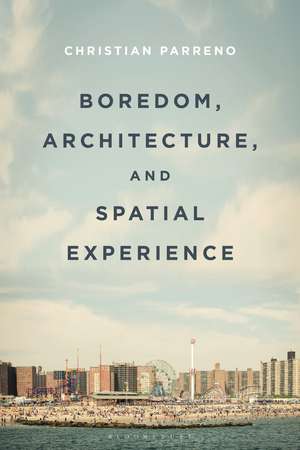
Boredom, Architecture, and Spatial Experience
Autor Christian Parrenoen Limba Engleză Paperback – 25 aug 2022
Boredom, Architecture, and Spatial Experience investigates that relationship, showing how an understanding of boredom affords us a new way of looking at and understanding the modern experience. It reconstructs a series of episodes in architectural history, from the 19th century to the present, to survey how boredom became a normalized component of the everyday, how it infiltrated into the production and reception of architecture, and how it serves to diagnose moments of crisis in the continuous transformations of the built environment.
Erudite and innovative, the work moves deftly from architectural theory and philosophy to literature and psychology to make its case. Combining archival material, scholarly sources, and illuminating excerpts from conversations with practitioners and thinkers-including Charles Jencks, Rem Koolhaas, Sylvia Lavin, and Jorge Silvetti-it reveals the complexity and importance of boredom in architecture.
Preț: 214.63 lei
Preț vechi: 307.51 lei
-30%
Puncte Express: 322
Carte tipărită la comandă
Livrare economică 01-15 decembrie
Livrare prin curier în România Termenul estimat este afișat lângă disponibilitate.
Transport gratuit de la 400.00 lei Plată online sau ramburs, în funcție de opțiunile comenzii.
Retur gratuit în 14 zile Comandă securizată și suport în română.
Specificații
ISBN-13: 9781350213647
ISBN-10: 1350213640
Pagini: 272
Ilustrații: 20 bw illus
Dimensiuni: 156 x 234 x 19 mm
Greutate: 0.39 kg
Editura: Bloomsbury Publishing
Colecția Bloomsbury Visual Arts
Locul publicării:London, United Kingdom
ISBN-10: 1350213640
Pagini: 272
Ilustrații: 20 bw illus
Dimensiuni: 156 x 234 x 19 mm
Greutate: 0.39 kg
Editura: Bloomsbury Publishing
Colecția Bloomsbury Visual Arts
Locul publicării:London, United Kingdom
V-ar putea interesa
-
 Preț: 467.35 lei
 -
 Architecture and Adaptation: From Cybernetics to Tangible ComputingSocrates Yiannoudes-18%Preț: 1608.10 lei1961.09 lei
 -
 Grace and Gravity: Architectures of the FigureLars Spuybroek-17%Preț: 255.23 lei305.83 lei
 -
 The Place of Silence: Architecture / Media / PhilosophyProfessor Mark Dorrian-34%Preț: 557.24 lei838.27 lei
 -
 Writing Architectures: Ficto-Critical ApproachesHélène Frichot-39%Preț: 650.12 lei1059.59 lei
 -
 Atmospheric Architectures: The Aesthetics of Felt SpacesProfessor Gernot Böhme-28%Preț: 202.84 lei281.25 lei
 -
 Building Time: Architecture, event, and experienceDr David Leatherbarrow-23%Preț: 192.32 lei248.74 lei
 -
 -16%Preț: 243.60 lei289.09 lei
 -
 -33%Preț: 605.73 lei906.60 lei
 -
 Visions of ArchitectureStephen Lees-47%Preț: 132.60 lei249.93 lei
 -
 -18%Preț: 1151.99 lei1404.87 lei
 -
 Coda: ArchitectureLana ZoetPreț: 93.67 lei
 -
 Journey to a Straw Bale HouseF. Harlan FlintPreț: 161.32 lei
 -
 Light in Architecture: The Intangible MaterialElisa Valero RamosPreț: 293.72 lei
Cuprins
List of Illustrations
Preface
Foreword by Iain Borden
Acknowledgements
Introduction: Boredom as Architecture
1. A Component of Modernity
Differential Distances
2. Fascination and Aversion
3. Søren Kierkegaard's Babylonian Tower
4. Catherine Gore and Charles Dickens: Idle Restlessness/Restless Idleness
5. Blunting and Jading
6. Coney Island, Misleading Structures
Circular Trajectories
7. A Unity of Disarray
8. Martin Heidegger's Urge to Be at Home
9. Oran, the Capital of Boredom
10. International Style Confusions: Sigfried Giedion
11. Los Angeles, Flat Enough
Extended Thresholds
12. Potential Architectures
13. Andrew Benjamin's Antithesis to Boredom
14. Boredom in Domus
15. Servitude and Liberalism: Russell Kirk
16. Charles Jencks, Rem Koolhaas, and the Generic
17. Jorge Silvetti and Sylvia Lavin: Unamused Muses and Lying Fallow
Epilogue: Architectures of Boredom
Bibliography
Index
Preface
Foreword by Iain Borden
Acknowledgements
Introduction: Boredom as Architecture
1. A Component of Modernity
Differential Distances
2. Fascination and Aversion
3. Søren Kierkegaard's Babylonian Tower
4. Catherine Gore and Charles Dickens: Idle Restlessness/Restless Idleness
5. Blunting and Jading
6. Coney Island, Misleading Structures
Circular Trajectories
7. A Unity of Disarray
8. Martin Heidegger's Urge to Be at Home
9. Oran, the Capital of Boredom
10. International Style Confusions: Sigfried Giedion
11. Los Angeles, Flat Enough
Extended Thresholds
12. Potential Architectures
13. Andrew Benjamin's Antithesis to Boredom
14. Boredom in Domus
15. Servitude and Liberalism: Russell Kirk
16. Charles Jencks, Rem Koolhaas, and the Generic
17. Jorge Silvetti and Sylvia Lavin: Unamused Muses and Lying Fallow
Epilogue: Architectures of Boredom
Bibliography
Index
Recenzii
What if architectural creativity is not only grounded in knowledge and skill but equally in a state of mind, a mood? Improbable though the suggestion may be, this original and marvelously well-studied book shows that from the 19th century onward boredom became a force that focused concentration and compelled experimentation.
A fascinating exploration of boredom that builds on 19th-century literary narratives to understand its contemporary spatial manifestations. Parreno meanders through a multitude of boredoms, from the domestic to the monumentally bureaucratic, and from the modern generic to endlessly varied imagery-revealing unexpectedly reassuring aspects of boredom in the process.
Parreno liberates scholars from the perils of straightforward interpretations and analysis ... [This book] has the potential to complicate architectural historians' works on use, the user, and the space. It urges architectural historians to historicize not only these categories but also emotions.
A fascinating exploration of boredom that builds on 19th-century literary narratives to understand its contemporary spatial manifestations. Parreno meanders through a multitude of boredoms, from the domestic to the monumentally bureaucratic, and from the modern generic to endlessly varied imagery-revealing unexpectedly reassuring aspects of boredom in the process.
Parreno liberates scholars from the perils of straightforward interpretations and analysis ... [This book] has the potential to complicate architectural historians' works on use, the user, and the space. It urges architectural historians to historicize not only these categories but also emotions.
Caracteristici
Includes extracts from interviews with a number of very famous architects and architectural theorists - including Charles Jencks and Rem Koolhas