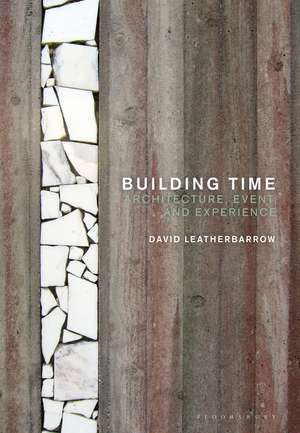
Building Time: Architecture, event, and experience
Autor Dr David Leatherbarrowen Limba Engleză Paperback – 26 noi 2020
All buildings exist in time. Even if designed for permanence, they change, slowly but inevitably. They change use, they accrue history and meaning, they decay - all of these processes are inscribed in time. So too is the path traced by the sun through a building, and the movements of the human body from room to room. Time, this book argues, is the framework for our spatial experience of architecture, and a key dimension of a building's structure and significance.
Building Time presents twelve close readings of buildings and artworks which explore this idea. Examining works by distinctive modern architects - from Eileen Gray to Álvaro Siza and Wang Shu - it takes the reader, in some cases literally step-by-step, through a built work, and provides insightful reflections on the importance of 'making space for time' in architectural design.
This is a book for both theorists and for architectural designers. Through it, theorists will find a way to rethink the fundamental premises and aims of design work, while designers will rediscover the order and ideas that shape the world around them-its buildings, interiors, and landscapes.
Preț: 192.32 lei
Preț vechi: 248.74 lei
-23%
Puncte Express: 288
Carte disponibilă
Livrare economică 13-27 noiembrie
Livrare express 30 octombrie-05 noiembrie pentru 103.37 lei
Livrare prin curier în România Termenul estimat este afișat lângă disponibilitate.
Transport gratuit de la 400.00 lei Plată online sau ramburs, în funcție de opțiunile comenzii.
Retur gratuit în 14 zile Comandă securizată și suport în română.
Specificații
ISBN-13: 9781350165182
ISBN-10: 1350165182
Pagini: 288
Ilustrații: 130 bw illus
Dimensiuni: 170 x 240 x 18 mm
Greutate: 0.74 kg
Editura: Bloomsbury Publishing
Colecția Bloomsbury Visual Arts
Locul publicării:London, United Kingdom
ISBN-10: 1350165182
Pagini: 288
Ilustrații: 130 bw illus
Dimensiuni: 170 x 240 x 18 mm
Greutate: 0.74 kg
Editura: Bloomsbury Publishing
Colecția Bloomsbury Visual Arts
Locul publicării:London, United Kingdom
Cuprins
Introduction
1: Making Space for Time
Part One: The Time of the World
2: Day Time
3: Well-Timed Openings
4: Tempered Terrain
5: World Rhythms
Part Two: The Time of the Body
6: Taking Steps
7: Pacing and Spacing
8: Wandering Sites
9: Pedestrian Rhythms
Part Three: The Time of the Project
10: Past and Present Possibilities
11: Proposing Precedents
12: Recalling Future Projects
13: Project Rhythms
Bibliography
Index
1: Making Space for Time
Part One: The Time of the World
2: Day Time
3: Well-Timed Openings
4: Tempered Terrain
5: World Rhythms
Part Two: The Time of the Body
6: Taking Steps
7: Pacing and Spacing
8: Wandering Sites
9: Pedestrian Rhythms
Part Three: The Time of the Project
10: Past and Present Possibilities
11: Proposing Precedents
12: Recalling Future Projects
13: Project Rhythms
Bibliography
Index
Recenzii
Building Time is based on the author's own physical and mental experience of the objects examined, as well as an almost intimate knowledge of the architect's work, the processes of creation, the craft, the spaces and the details. One senses that this is an architecture that occupies Leatherbarrow, in which he is deeply committed. And perhaps this is precisely one of the explanations why his descriptions and interpretations manage to hit so precisely.
Leatherbarrow focuses his meditative attention on lasting works of architecture and art. Discussing projects and paintings with particular sensitivity to light and material, he works like a clockmaker, patiently disassembling architectural mechanisms into their component parts, and explaining how buildings operate in time.
When Leatherbarrow writes about time he is also writing about the slow and then ever faster passage of our own lives. Even as we visit the Pantheon to watch time literally move before our eyes and we are reminded that it also measures the span of our own existence. This is a dense, lyrical, and heartbreaking book about our lives and our buildings.
Linger, return, and remember rhythm this meditation on the interactions of time, space and place for both author and reader. Not since the romantic writers of the early 19th century has the temporal dimension of architecture been viewed patiently from so many facets.
Building Time suggests that architecture matters partly because architecture weathers orienting and grounding us: by keeping its identity amidst contextual change, inevitable decay, and eventual renewal, as well as recording its own creation and survival. The world stage, the active body and the project script frame the close reading of chosen modern masterpieces in time and as time. Sound, serviceable, and delightful.
Building Time is a graceful, timely, and purposeful walk through a garden of architectural knowledge, offering an account-in all, a theory-not just of human spatial experience through time (first we go here, then we go there...), but of the world experiencing itself through the medium of buildings, especially buildings which, in having long-term ethical projects as well as complexities of their own, are works of architecture. With Proustian intimacy and often dizzying insight, Leatherbarrow enlarges the very language we use to understand architecture. Buildings are indifferent only apparently. In marking time, in accommodating the fleeting, in witnessing and in suffering, they bring up the future.
The range of examples that Leatherbarrow brings together in Building Time is rich, stimulating, and rooted in the tangible ... He is a patient, knowledgeable, and observant guide to particular buildings and places, and their particular times.
Leatherbarrow focuses his meditative attention on lasting works of architecture and art. Discussing projects and paintings with particular sensitivity to light and material, he works like a clockmaker, patiently disassembling architectural mechanisms into their component parts, and explaining how buildings operate in time.
When Leatherbarrow writes about time he is also writing about the slow and then ever faster passage of our own lives. Even as we visit the Pantheon to watch time literally move before our eyes and we are reminded that it also measures the span of our own existence. This is a dense, lyrical, and heartbreaking book about our lives and our buildings.
Linger, return, and remember rhythm this meditation on the interactions of time, space and place for both author and reader. Not since the romantic writers of the early 19th century has the temporal dimension of architecture been viewed patiently from so many facets.
Building Time suggests that architecture matters partly because architecture weathers orienting and grounding us: by keeping its identity amidst contextual change, inevitable decay, and eventual renewal, as well as recording its own creation and survival. The world stage, the active body and the project script frame the close reading of chosen modern masterpieces in time and as time. Sound, serviceable, and delightful.
Building Time is a graceful, timely, and purposeful walk through a garden of architectural knowledge, offering an account-in all, a theory-not just of human spatial experience through time (first we go here, then we go there...), but of the world experiencing itself through the medium of buildings, especially buildings which, in having long-term ethical projects as well as complexities of their own, are works of architecture. With Proustian intimacy and often dizzying insight, Leatherbarrow enlarges the very language we use to understand architecture. Buildings are indifferent only apparently. In marking time, in accommodating the fleeting, in witnessing and in suffering, they bring up the future.
The range of examples that Leatherbarrow brings together in Building Time is rich, stimulating, and rooted in the tangible ... He is a patient, knowledgeable, and observant guide to particular buildings and places, and their particular times.