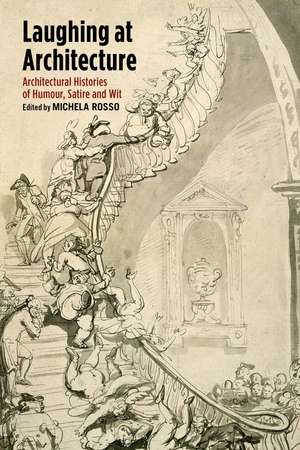
Laughing at Architecture: Architectural Histories of Humour, Satire and Wit
Editat de Michela Rossoen Limba Engleză Paperback – 25 iun 2020
In a novel contribution to the field of architectural history, this book outlines a survey of visual and textual humour as applied to architecture, its artefacts and leading professionals. Employing a wide variety of visual and literary sources (prints, the illustrated press, advertisements, theatrical representations, cinema and TV), thirteen essays explore an array of historical subjects concerning the critical reception of projects, buildings and cities through the means of caricature and parody. Subjects range from 1750 to the present, and from Europe and the USA to contemporary China. From William Hogarth and George Cruikshank to Osbert Lancaster, Adolf Loos' satire, and Saul Steinberg's celebrated cartoons of New York City, graphic and descriptive humour is shown to be an enormously fruitful, yet largely unexplored terrain of investigation for the architectural and urban historian.
Preț: 252.09 lei
Preț vechi: 293.97 lei
-14%
Puncte Express: 378
Carte tipărită la comandă
Livrare economică 08-22 decembrie
Livrare prin curier în România Termenul estimat este afișat lângă disponibilitate.
Transport gratuit de la 400.00 lei Plată online sau ramburs, în funcție de opțiunile comenzii.
Retur gratuit în 14 zile Comandă securizată și suport în română.
Specificații
ISBN-13: 9781350170490
ISBN-10: 1350170496
Pagini: 288
Ilustrații: 73 bw illus
Dimensiuni: 156 x 234 x 26 mm
Greutate: 0.41 kg
Editura: Bloomsbury Publishing
Colecția Bloomsbury Visual Arts
Locul publicării:London, United Kingdom
ISBN-10: 1350170496
Pagini: 288
Ilustrații: 73 bw illus
Dimensiuni: 156 x 234 x 26 mm
Greutate: 0.41 kg
Editura: Bloomsbury Publishing
Colecția Bloomsbury Visual Arts
Locul publicării:London, United Kingdom
Cuprins
List of Figures
List of Contributors
Introduction, Michela Rosso
1. Laughing at the Baroque: A Drawing and Some Texts Compared, Susanna Pasquali
2. From Reportage to Ridicule: Satirizing the Building Industry in the Eighteenth-century Irish Press, Conor Lucey
3. The Thorn of Scorn: John Nash and his All Souls Church for a Transformed Regency London, Daniela Roberts
4. 'A Joke that has Gone on Far too Long': Mocking the Completion of the New Hôtel des Postes de Paris (1886-1888), Guy Lambert
5. Deconstructing Gaudí: Intertwined Relationships between Satire and Architectural Criticism, Josep-Maria Garcia-Fuentes
6. Confronting Problems with a Sense of Humour: Adolf Loos's Architectural Polemics and Viennese
Journalism, Ruth Hanisch
7. Words and Images of Contempt: Il Selvaggio on Architecture (1926-1942), Michela Rosso
8. Osbert Lancaster: Architectural Humour in the Time of Functionalism, Alan Powers
9. Irrational Interiors: The Modern Domestic Landscape Seen in Caricatures, Gabriele Neri
10. From 'Little Russia' (Klein Rusland) to 'Planet of the Apes' (De Apenplaneet): Nicknaming Twentieth-century Mass Housing in Belgium, Evert Vandeweghe
11. Saul Steinberg's Graph Paper Architecture: Humorous Drawings and Diagrams as Instruments of Critique, Christoph Lueder
12. The Modern City Through the Mirror of Humour: A Different Portrait, Olivier Ratouis
13. Splendid?! Preposterous! Chinese Artists Mock the Architectural Spectacle, Angela Becher
Index
List of Contributors
Introduction, Michela Rosso
1. Laughing at the Baroque: A Drawing and Some Texts Compared, Susanna Pasquali
2. From Reportage to Ridicule: Satirizing the Building Industry in the Eighteenth-century Irish Press, Conor Lucey
3. The Thorn of Scorn: John Nash and his All Souls Church for a Transformed Regency London, Daniela Roberts
4. 'A Joke that has Gone on Far too Long': Mocking the Completion of the New Hôtel des Postes de Paris (1886-1888), Guy Lambert
5. Deconstructing Gaudí: Intertwined Relationships between Satire and Architectural Criticism, Josep-Maria Garcia-Fuentes
6. Confronting Problems with a Sense of Humour: Adolf Loos's Architectural Polemics and Viennese
Journalism, Ruth Hanisch
7. Words and Images of Contempt: Il Selvaggio on Architecture (1926-1942), Michela Rosso
8. Osbert Lancaster: Architectural Humour in the Time of Functionalism, Alan Powers
9. Irrational Interiors: The Modern Domestic Landscape Seen in Caricatures, Gabriele Neri
10. From 'Little Russia' (Klein Rusland) to 'Planet of the Apes' (De Apenplaneet): Nicknaming Twentieth-century Mass Housing in Belgium, Evert Vandeweghe
11. Saul Steinberg's Graph Paper Architecture: Humorous Drawings and Diagrams as Instruments of Critique, Christoph Lueder
12. The Modern City Through the Mirror of Humour: A Different Portrait, Olivier Ratouis
13. Splendid?! Preposterous! Chinese Artists Mock the Architectural Spectacle, Angela Becher
Index
Recenzii
Satire opens the mind even as it leaves the mouth gaping... and it turns out to have been an inherent ingredient in the symbiotic rise of public debate and modernization since the mid-18th century. That is one of the many conclusions of this anthology of ribald images and erudite analyses that place humour in its social ad political context. The collection is as delightful as it is insightful, the humor runs the full gamut from affectionate to wickedly biting.
Although architecture is usually regarded as too ponderous a matter to allow much space for humour, some of its sharpest and most memorable criticism has been in the form of wit and satire. The essays in Laughing at Architecture, both diverting and serious, range from Pugin to Loos, to Steinberg, and open up this important, but neglected, mode of architectural criticism.
This pathbreaking collection of essays brilliantly links architecture to social history and to the multiple cultural contexts and interpersonal exchanges implicit in acts of ridicule and satiric irony. The section by Rosso herself, on the irrepressible, often volcanic, pasquinade of the 1930s Italian architectural scene launched by Mino Maccari and Leo Longanesi in the journal Il Selvaggio, is a true gem. Edited with an incisive critical introduction and beautifully produced with copious illustrations, this book will be a scholarly reference for years to come.
Although architecture is usually regarded as too ponderous a matter to allow much space for humour, some of its sharpest and most memorable criticism has been in the form of wit and satire. The essays in Laughing at Architecture, both diverting and serious, range from Pugin to Loos, to Steinberg, and open up this important, but neglected, mode of architectural criticism.
This pathbreaking collection of essays brilliantly links architecture to social history and to the multiple cultural contexts and interpersonal exchanges implicit in acts of ridicule and satiric irony. The section by Rosso herself, on the irrepressible, often volcanic, pasquinade of the 1930s Italian architectural scene launched by Mino Maccari and Leo Longanesi in the journal Il Selvaggio, is a true gem. Edited with an incisive critical introduction and beautifully produced with copious illustrations, this book will be a scholarly reference for years to come.