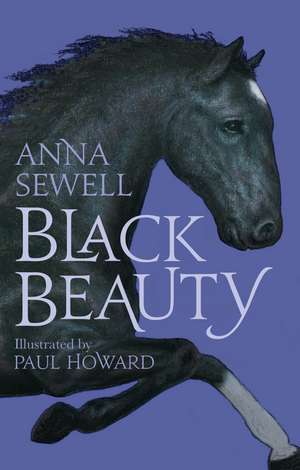
Black Beauty: Illustrated by Paul Howard: Alma Junior Classics
Autor Anna Sewell Ilustrat de Paul Howarden Limba Engleză Paperback – 2016 – vârsta până la 11 ani
Ritmul acestui roman clasic este unul așezat, asemenea pasului unui cal de trăsură care parcurge drumul lung al vieții, oferind cititorului timp pentru reflecție și empatie. Notăm cu interes cum Anna Sewell reușește să transforme o narațiune despre supraviețuire într-o pledoarie profundă pentru demnitate, folosind vocea unui narator necuvântător. Black Beauty nu este doar o poveste pentru copii, ci o cronică stratificată a epocii victoriene, unde soarta unui animal depindea în totalitate de capriciile și moralitatea oamenilor. Imaginați-vă tensiunea socială și morală din Ladybird Classics: Black Beauty, dar extinsă aici într-o formă integrală, neabreviată, care păstrează întreaga forță a mesajului original. Structura cărții urmărește traiectoria calului de la siguranța fermei natale până la realitatea dură a străzilor londoneze, fiind punctată de întâlniri memorabile cu alte personaje equine, precum impetuoasa Ginger sau înțeleptul Merrylegs. Merită menționat că această ediție de la WORDSWORTH EDITIONS LTD îmbogățește experiența lecturii prin includerea unor documente de epocă fascinante. Prezența textelor semnate de Charles Darwin sau Thomas Huxley în anexe plasează suferința și inteligența lui Beauty într-un context științific și filosofic veritabil, transformând lectura dintr-o simplă poveste emoționantă într-un studiu despre etica relației om-animal. Este singura lucrare publicată a autoarei, o moștenire literară care a definit genul „pony book” și a influențat decisiv legislația privind protecția animalelor.
Din seria Alma Junior Classics
-
 Preț: 51.65 lei
 -
 Preț: 57.73 lei
 -
 Preț: 52.46 lei
 -
 Preț: 51.47 lei
 -
 Preț: 52.00 lei
 -
 Preț: 46.99 lei
 -
 Preț: 52.70 lei
 - 6%
 Preț: 55.99 lei
 -
 Preț: 51.53 lei
 -
 Preț: 45.82 lei
 -
 Preț: 45.03 lei
 -
 Preț: 57.53 lei
 -
 Preț: 43.97 lei
 -
 Preț: 50.72 lei
 -
 Preț: 51.12 lei
 -
 Preț: 52.08 lei
 -
 Preț: 51.46 lei
 -
 Preț: 50.84 lei
 -
 Preț: 44.46 lei
 -
 Preț: 51.97 lei
 -
 Preț: 56.57 lei
 -
 Preț: 52.36 lei
 -
 Preț: 43.79 lei
 - 8%
 Preț: 53.55 lei
 -
 Preț: 45.32 lei
 -
 Preț: 51.40 lei
 -
 Preț: 58.70 lei
 -
 Preț: 44.57 lei
 -
 Preț: 50.59 lei
 -
 Preț: 44.52 lei
 -
 Preț: 43.35 lei
 -
 Preț: 50.82 lei
 -
 Preț: 50.46 lei
 -
 Preț: 51.03 lei
 -
 Preț: 46.07 lei
 -
 Preț: 50.29 lei
 -
 Preț: 50.49 lei
 -
 Preț: 64.20 lei
 -
 Preț: 52.08 lei
 - 7%
 Preț: 53.62 lei
 -
 Preț: 50.47 lei
 -
 Preț: 50.65 lei
 -
 Preț: 84.38 lei
 -
 Preț: 51.71 lei
 -
 Preț: 51.60 lei
 -
 Preț: 83.19 lei
Preț: 51.45 lei
Carte disponibilă
Livrare economică 11-25 noiembrie
Livrare express 28 octombrie-03 noiembrie pentru 21.95 lei
Specificații
ISBN-10: 1847495869
Pagini: 288
Ilustrații: b/w
Dimensiuni: 128 x 194 x 24 mm
Greutate: 0.26 kg
Editura: Alma Books COMMIS
Colecția Alma Classics
Seria Alma Junior Classics
Locul publicării:London, United Kingdom
V-ar putea interesa
-
 Chocolates for BreakfastPamela MoorePreț: 101.73 lei
 -
 Animal FarmGeorge Orwell-29%Preț: 49.05 lei69.28 lei
 -
 Bonjour Tristesse and A Certain SmileFrancoise SaganPreț: 71.69 lei
 -
 The War That Saved My LifeKimberly Brubaker BradleyPreț: 61.97 lei
 -
 Brown Girl DreamingJacqueline WoodsonPreț: 79.94 lei
 -
 A Wrinkle in TimeMadeleine L'EnglePreț: 48.52 lei
 -
 The Last WolfMichael Morpurgo-30%Preț: 39.60 lei56.49 lei
 -
 FrankensteinMary ShelleyPreț: 35.93 lei
 -
 The Orphan Master's SonAdam Johnson-10%Preț: 79.53 lei88.58 lei
 -
 Journey to the Center of the EarthJules VernePreț: 36.34 lei
 -
 Hope in a Ballet ShoeMichaela DePrincePreț: 65.29 lei
 -
 Holes: The iconic childhood-defining phenomenonLouis Sachar-33%Preț: 43.25 lei64.94 lei
 -
 The Misadventures of Max Crumbly 1: Locker HeroRachel Renee Russell-17%Preț: 48.43 lei58.46 lei
 -
 The Girl Who Speaks BearSophie AndersonPreț: 72.18 lei
 -
 Little Sticker Dolly Dressing KittensFiona WattPreț: 46.54 lei
 -
 Preț: 89.92 lei
 -
 Sticker Dolly Dressing ChristmasLeonie PrattPreț: 63.05 lei
 -
 Preț: 87.59 lei
 -
 The Mysterious IslandJules VernePreț: 39.02 lei
 -
 Preț: 38.38 lei
 -
 The Little PrinceAntoine De Saint-ExuperyPreț: 35.80 lei
 -
 Twenty Thousand Leagues Under the SeaJules VernePreț: 37.10 lei
 -
 The Red Badge of CourageStephen CranePreț: 28.01 lei
 -
 NostromoJoseph ConradPreț: 28.01 lei
 -
 Three Sea StoriesJoseph ConradPreț: 28.01 lei
Recenzii de la cititorii Books Express
Anonim a dat nota:
Black Beauty este una dintre cele mai sensibile povești cu animale pe care le-am citit. Fiind o autobiografie a unui cal, Black Beauty expune suferința cailor din cauza conduitei necugetate și crude a oamenilor și susține nevoia pentru bunăstarea lor generală. Se spune că ceea ce a inspirat-o pe Anna să scrie singura carte pe care a scris-o vreodată a fost să creeze conștientizarea socială a suferinței cailor și să-i inducă să fie tratați cu bunătate, compasiune și înțelegere. Deși povestea este axată pe cai, ea învață lumea în general nevoia de a fi amabil, grijuliu și empatic față de toate animalele. Am citit această poveste pentru prima dată când aveam vreo nouă ani. Îmi amintesc că am fost cu inima zdrobită și nefericită zile întregi, pentru că eram un copil foarte sensibil. Am auzit că unii spun că această carte nu este potrivită pentru copii, deoarece le tulbură mintea. Nu sunt psiholog și nu pot explica adevărul, dar cred că acest lucru ar trebui să fie citit de copii. Bunătatea, compasiunea și simpatia față de toate ființele sunt calități pe care trebuie să le cultivăm în mintea copiilor de la o vârstă fragedă. Cel mai bun mod de a insufla aceste calități copiilor este de a arăta cum suferă alte ființe în absența lor.
De ce să citești această carte
Recomandăm această carte celor care caută o lectură clasică, plină de noblețe și compasiune. Dincolo de frumusețea narațiunii, cititorul câștigă o perspectivă unică asupra empatiei, învățând că bunătatea față de animale reflectă, de fapt, caracterul uman. Este o piesă esențială pentru orice bibliotecă de beletristică, fiind la fel de relevantă astăzi pentru mesajul său despre respect și responsabilitate.
Despre autor
Anna Sewell (1820–1878) a fost o scriitoare engleză a cărei viață a fost marcată de o dizabilitate fizică suferită în tinerețe, fapt ce a făcut-o să depindă de trăsurile trase de cai pentru mobilitate. Această dependență i-a cultivat o observație fină și o dragoste profundă pentru aceste animale. Singurul său roman, Black Beauty, a fost scris într-o perioadă de declin al sănătății, fiind dictat mamei sale sau scris pe fragmente de hârtie. Deși a murit la doar cinci luni după publicarea cărții în 1877, Sewell a apucat să vadă succesul imediat al operei sale, care a devenit ulterior unul dintre cele mai bine vândute romane din toate timpurile.
Descriere
Unfortunately one day he is sold on to new owners, and a new chapter opens in his life, full of uncertainty, hardship and cruelty. Will Black Beauty ever make it back home, or reconnect with the people and horses that cared about him?
Recenzii
Notă biografică
Textul de pe ultima copertă
This large print rendition of this timeless classic will delight younger readers with illustrations by Van Gool.
Extras
The first place that I can well remember was a large pleasant meadow with a pond of clear water in it. Some shady trees leaned over it, and rushes and water lilies grew at the deep end. Over the hedge on one side we looked into a plowed field, and on the other we looked over a gate at our master's house, which stood by the roadside. At the top of the meadow was a plantation of fir trees, and at the bottom a running brook overhung by a steep bank.
While I was young I lived upon my mother's milk, as I could not eat grass. In the daytime I ran by her side, and at night I lay down close by her. When it was hot we used to stand by the pond in the shade of the trees, and when it was cold we had a nice warm shed near the plantation.
As soon as I was old enough to eat grass, my mother used to go out to work in the daytime and come back in the evening.
There were six young colts in the meadow besides me. They were older than I was; some were nearly as large as grown-up horses. I used to run with them, and had great fun; we used to gallop all together round and round the field, as hard as we could go. Sometimes we had rather rough play, for they would frequently bite and kick as well as gallop.
One day, when there was a good deal of kicking, my mother whinnied to me to come to her, and then she said:
"I wish you to pay attention to what I am going to say to you. The colts who live here are very good colts, but they are carthorse colts and, of course, they have not learned manners. You have been well bred and well born; your father has a great name in these parts, and your grandfather won the cup two years at the Newmarket races. Your grandmother had the sweetest temper of any horse I ever knew, and I think you have never seen me kick or bite. I hope you will grow up gentle and good, and never learn bad ways; do your work with a good will, lift your feet up well when you trot, and never bite or kick even in play."
I have never forgotten my mother's advice. I knew she was a wise old horse, and our master thought a great deal of her. Her name was Duchess, but he often called her Pet.
Our master was a good, kind man. He gave us good food, good lodging, and kind words; he spoke as kindly to us as he did to his little children. We were all fond of him, and my mother loved him very much. When she saw him at the gate, she would neigh with joy, and trot up to him. He would pat and stroke her and say, "Well, old Pet, and how is your little Darkie?" I was a dull black, so he called me Darkie, then he would give me a piece of bread, which was very good, and sometimes he brought a carrot for my mother. All the horses would come to him, but I think we were his favorites. My mother always took him to the town on a market day in a light gig.
There was a plowboy, Dick, who sometimes came into our field to pluck blackberries from the hedge. When he had eaten all he wanted, he would have what he called fun with the colts, throwing stones and sticks at them to make them gallop. We did not much mind him, for we could gallop off, but sometimes a stone would hit and hurt us.
One day he was at this game and did not know that the master was in the next field, but he was there, watching what was going on. Over the hedge he jumped in a snap, and catching Dick by the arm, he gave him such a box on the ear as made him roar with the pain and surprise. As soon as we saw the master, we trotted up nearer to see what went on.
"Bad boy!" he said. "Bad boy to chase the colts! This is not the first time, nor the second, but it shall be the last. There--take your money and go home. I shall not want you on my farm again." So we never saw Dick anymore. Old Daniel, the man who looked after the horses, was just as gentle as our master, so we were well off.
CHAPTER 2
The Hunt
I was two years old when a circumstance happened which I have never forgotten. It was early in the spring; there had been a little frost in the night, and a light mist still hung over the plantations and meadows. I and the other colts were feeding at the lower part of the field when we heard, quite in the distance, what sounded like the cry of dogs. The oldest of the colts raised his head, pricked his ears, and said, "There are the hounds!" and immediately cantered off, followed by the rest of us to the upper part of the field, where we could look over the hedge and see several fields beyond. My mother and an old riding horse of our master's were also standing near, and seemed to know all about it.
"They have found a hare," said my mother, "and if they come this way we shall see the hunt."
And soon the dogs were all tearing down the field of young wheat next to ours. I never heard such a noise as they made. They did not bark, nor howl, nor whine, but kept on a "yo! yo, o, o! yo! yo, o, o!" at the top of their voices. After them came a number of men on horseback, some of them in green coats, all galloping as fast as they could. The old horse snorted and looked eagerly after them, and we young colts wanted to be galloping with them, but they were soon away into the fields lower down. Here it seemed as if they had come to a stand; the dogs left off barking and ran about every way with their noses to the ground.