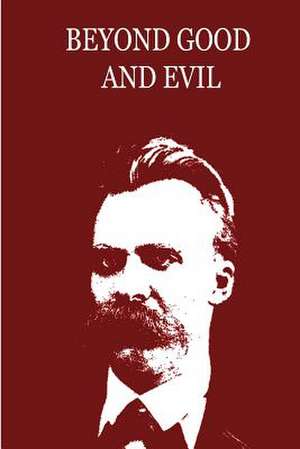
Beyond Good and Evil
Autor Friedrich Wilhelm Nietzscheen Limba Engleză Paperback
Preț: 68.76 lei
Puncte Express: 103
Cartea nu mai face parte din oferta noastră
Livrare prin curier în România Termenul estimat este afișat lângă disponibilitate.
Transport gratuit de la 400.00 lei Plată online sau ramburs, în funcție de opțiunile comenzii.
Retur gratuit în 14 zile Comandă securizată și suport în română.
Specificații
ISBN-13: 9781479230600
ISBN-10: 147923060X
Pagini: 146
Dimensiuni: 152 x 229 x 8 mm
Greutate: 0.2 kg
Editura: CREATESPACE
ISBN-10: 147923060X
Pagini: 146
Dimensiuni: 152 x 229 x 8 mm
Greutate: 0.2 kg
Editura: CREATESPACE
V-ar putea interesa
-
 A Nietzsche ReaderR J Hollingdale-37%Preț: 58.80 lei92.87 lei
 -
 Why I am So WiseFriedrich Nietzsche-21%Preț: 43.63 lei55.31 lei
 -
 Man Alone with HimselfFriedrich NietzschePreț: 55.34 lei
 -
 -20%Preț: 57.15 lei71.12 lei
 -
 The Birth of Tragedy and The Case of WagnerFriedrich NietzschePreț: 78.08 lei
 -
 Friedrich NietzscheLee SpinksPreț: 241.16 lei
 -
 Beyond Good and EvilFriedrich NietzschePreț: 40.66 lei
 -
 The Genealogy of MoralsFriedrich Nietzsche-19%Preț: 34.51 lei42.76 lei
 -
 The Will to PowerFriedrich NietzschePreț: 71.58 lei
 -
 Friedrich NietzscheTony Lee MoralPreț: 72.78 lei
 -
 World Classics Library: Friedrich NietzscheFrederich NietzschePreț: 152.34 lei
 -
 -4%Preț: 367.14 lei382.44 lei
 -
 Unpublished Fragments from the Period of Dawn (Winter 1879/80-Spring 1881)Friedrich NietzschePreț: 183.44 lei
 -
 Twilight of the IdolsFriedrich NietzschePreț: 38.11 lei
 -
 Beyond Good an EvilFriedrich NietzschePreț: 51.62 lei
 -
 Beyond Good And EvilFriedrich NietzschePreț: 46.16 lei
 -
 Beyond Good and EvilFrederich NietzschePreț: 56.30 lei
 -
 Human, All Too Human & Beyond Good and EvilFriedrich NietzschePreț: 53.85 lei
 -
 Reading Nietzsche: An Analysis of "Beyond Good and Evil"Douglas BurnhamPreț: 344.53 lei
 -
 Beyond Good & EvilFriedrich Wilhelm NietzschePreț: 72.68 lei
Notă biografică
Friedrich Wilhelm Nietzsche was a German philosopher, classical scholar, and cultural critic, known for his profound influence on modern thought. Born on October 15, 1844, in R cken, Germany, Nietzsche initially pursued a career as a classical philologist before transitioning to philosophy. His works challenged traditional beliefs, and his critiques of culture, religion, and morality made him one of the most influential philosophers of the 19th century. Nietzsche's writings explored complex concepts such as the "will to power," the " bermensch," and the idea of the eternal recurrence. His works, including "Thus Spoke Zarathustra" and "Beyond Good and Evil," questioned the foundations of Western philosophy and introduced ideas that would later shape existentialism and postmodernism. Nietzsche s intellectual journey was influenced by figures like Arthur Schopenhauer and Fyodor Dostoevsky. He faced personal struggles throughout his life, including mental illness, which led to his decline in health. He passed away on August 25, 1900, in Weimar, Germany, at the age of 55. Nietzsche s parents were Carl Ludwig Nietzsche and Franziska Oehler, and he had a brother, Ludwig Joseph Nietzsche, and a sister, Elisabeth F rster-Nietzsche. His groundbreaking ideas continue to resonate in contemporary philosophy and culture.
Descriere
Descriere de la o altă ediție sau format:
If ever there was a thinker who swam against the social and ethical tide of his day, it was Nietzsche. Nineteenth-century Europe was for him a moral wasteland filled with false altruism, duplicity, double standards, and, worst of all, moral complacency. Nietzsche shocked his readers by openly speaking their innermost thoughts: morality serves the social good, which for him meant fostering the best possible society--one that strives for excellence and abhors the herd mentality.
If ever there was a thinker who swam against the social and ethical tide of his day, it was Nietzsche. Nineteenth-century Europe was for him a moral wasteland filled with false altruism, duplicity, double standards, and, worst of all, moral complacency. Nietzsche shocked his readers by openly speaking their innermost thoughts: morality serves the social good, which for him meant fostering the best possible society--one that strives for excellence and abhors the herd mentality.