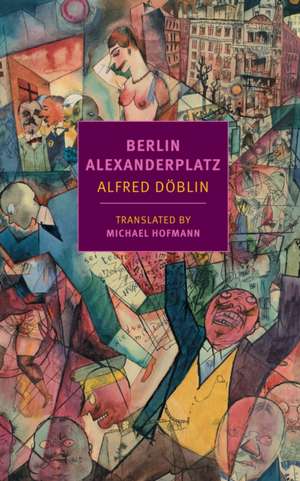
Berlin Alexanderplatz
Autor Alfred Döblin Traducere de Michael Hofmannen Limba Engleză Paperback – 6 feb 2018
Proza lui Alfred Döblin nu se mulțumește să descrie realitatea, ci o fragmentează și o reasamblează într-un ritm amețitor, specific metropolei moderne. Putem afirma că Berlin Alexanderplatz nu este doar un roman, ci un organism viu care pulsează prin intermediul unui colaj magistral: fragmente de știri, onomatopee stradale, predici biblice și cântece de tavernă se împletesc pentru a recrea Berlinul anilor 1920. Merită menționat că această nouă traducere semnată de Michael Hofmann reușește să captureze, poate pentru prima dată cu adevărat în limba engleză, asprimea și vitalitatea jargonului urban care definește opera lui Döblin. Cine a citit The Jungle de Upton Sinclair va recunoaște aici aceeași aplecare spre zonele obscure ale societății și lupta individului strivit de mecanismele economice, însă acolo unde Sinclair este naturalist și programatic, Döblin este modernist și experimental. Reținem destinul lui Franz Biberkopf, un om care, ieșit din închisoare, jură să rămână „cumsecade”, doar pentru a fi lovit repetat de o forță care seamănă izbitor cu fatalitatea. Spre deosebire de debutul său, Die drei Sprünge des Wang-lun, unde autorul explora spiritualitatea orientală, sau de ultimul său roman, Hamlet oder Die lange Nacht nimmt ein Ende, Berlin Alexanderplatz rămâne ancorat în betonul și noroiul Berlinului, transformând abatoarele și cârciumile în scene de o anvergură mitică. Simțim în fiecare pagină experiența de medic a autorului în cartierele muncitorești; privirea sa este clinică, dar nu lipsită de empatie. Este o lectură care cere atenție, dar care oferă în schimb o experiență senzorială totală a unei lumi aflate la granița dintre democrația fragilă și haosul ce avea să urmeze.
Preț: 133.84 lei
Carte disponibilă
Livrare economică 17 noiembrie-01 decembrie
Livrare express 31 octombrie-06 noiembrie pentru 37.21 lei
Specificații
ISBN-10: 1681371995
Pagini: 480
Dimensiuni: 128 x 203 x 27 mm
Greutate: 0.44 kg
Editura: Random House LLC US
Colecția NYRB Classics
V-ar putea interesa
-
 AmericanahChimamanda Ngozi AdichiePreț: 73.82 lei
 -
 Darkness at NoonArthur Koestler-19%Preț: 63.53 lei78.40 lei
 -
 The Time Traveler's WifeAudrey Niffenegger-23%Preț: 62.08 lei80.96 lei
 -
 A Gentleman in MoscowAmor Towles-23%Preț: 62.38 lei80.95 lei
 -
 The Secret HistoryDonna Tartt-22%Preț: 64.15 lei81.98 lei
 -
 Modern Classics Goodbye To All ThatRobert Graves-25%Preț: 59.19 lei79.27 lei
 -
 Selected StoriesKatherine Mansfield-16%Preț: 55.22 lei65.92 lei
 -
 Springtime in a Broken MirrorMario Benedetti-27%Preț: 57.45 lei78.26 lei
 -
 The Lost SpellsRobert MacFarlane-17%Preț: 90.72 lei109.34 lei
 -
 A Month in SienaHisham Matar-25%Preț: 64.81 lei85.98 lei
 -
 I Know Why the Caged Bird SingsMaya AngelouPreț: 56.64 lei
 -
 2001Arthur Charles ClarkePreț: 62.17 lei
 -
 Memoirs of an Infantry OfficerSiegfried SassoonPreț: 70.64 lei
 -
 Villa Air-BelRosemary Sullivan-26%Preț: 74.35 lei100.01 lei
 -
 Liquid ModernityZygmunt BaumanPreț: 142.59 lei
 -
 States and Social RevolutionsTheda SkocpolPreț: 143.21 lei
 -
 Preț: 60.84 lei
 -
 The Man Without QualitiesRobert Musil-41%Preț: 91.93 lei155.96 lei
 -
 -32%Preț: 54.07 lei79.45 lei
 -
 Berlin: Imagine a CityRory MacLean-25%Preț: 71.07 lei94.31 lei
 -
 -25%Preț: 219.46 lei292.61 lei
 -
 House of NutterLance Richardson-39%Preț: 66.54 lei108.20 lei
 -
 The Second SleepRobert Harris-17%Preț: 60.76 lei73.25 lei
 -
 Man's Search For MeaningViktor E. Frankl-19%Preț: 74.91 lei92.37 lei
 -
 Babylon BerlinVolker KutscherPreț: 81.03 lei
 -
 The JungleUpton SinclairPreț: 51.27 lei
De ce să citești această carte
Pentru cititorul care dorește să descopere vârful modernismului german, dincolo de Thomas Mann. Berlin Alexanderplatz oferă o incursiune fascinantă în psihologia marginalilor și în ritmul brutal al unui oraș care nu doarme niciodată. Veți câștiga o perspectivă unică asupra modului în care limbajul poate oglindi haosul unei epoci, totul într-o ediție Penguin Modern Classics care onorează complexitatea originalului.
Despre autor
Alfred Döblin (1878–1957) a fost un romancier, eseist și medic german, figură centrală a modernismului literar. Născut într-o familie de evrei asimilați, a profesat medicina în Berlin timp de aproape patru decenii, experiență care i-a oferit o cunoaștere intimă a mediilor defavorizate descrise în capodopera sa din 1929, Berlin Alexanderplatz. Opera sa vastă, ce cuprinde peste treizeci de volume, variază de la romane istorice la science-fiction și scrieri filozofice. Forțat să părăsească Germania în 1933, imediat după incendierea Reichstagului, Döblin a trăit în exil până în 1945, rămânând unul dintre cei mai inovatori experimentatori ai prozei europene.
Descriere scurtă
story begins, he has just been released from prison, where he did time for some stupid stuff; now he is back
in Berlin, determined to go straight. To begin with, he succeeds. But then, though doing all right for himself financially, he gets involved in a
set-to with an unpredictable external agency that looks an awful lot like fate. Three times the force attacks him and disrupts his scheme. The first time it comes at him with dishonesty and deception. Our man is able to get to his feet, he is still good to stand. Then it strikes him a low blow. He has trouble getting up from that, he is almost counted out. And finally it hits him with monstrous and extreme violence.
Notă biografică
Recenzii
Ace translator Michael Hofmann has delivered an exhilarating new version of Alfred Döblin's Berlin Alexanderplatz: that street-smart, slang-filled, richly allusive tale of crime, punishment and social crisis in the capital of Weimar Germany just before Hitler's rise to power. Hofmann's firecracker prose fizzes through this revolutionary trip into the lower depths of big-city life
The classic Weimar novel ... Long branded untranslatable, a fluent, pacy new translation by Michael Hofmann gainsays that assumption, opening up the book for English-speakers
Reading it was the most wonderful experience
Franz Biberkopf is one of the modern world's richest literary characters, as memorable as Woyzeck, Oblomov or Madame Bovary
Berlin Alexanderplatz is Europe's Moby-Dick ... both seriously significant and a great deal of fun
A flashing kaleidoscope of a novel ... Michael Hofmann's translation has a vivid immediacy
Brutal and prophetic ... a turning point in the history of the German novel
Berlin Alexanderplatz, which celebrates its 90th anniversary this year, still fascinates as a cautionary tale by shining light on the most obscure parts of the human soul.