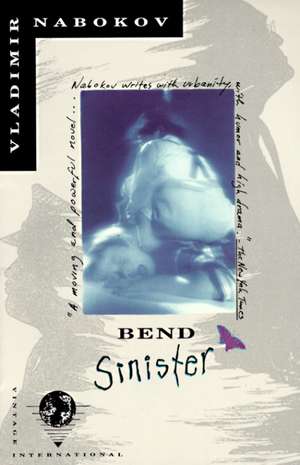
Bend Sinister
Autor Vladimir Nabokoven Limba Engleză Paperback – 14 apr 1990
Ce rămâne din integritatea unui gânditor atunci când mediocritatea devine lege de stat și violența devine limbaj administrativ? Subliniem faptul că Bend Sinister nu este doar un exercițiu de virtuozitate lingvistică, ci cea mai explicit politică lucrare a lui Vladimir Nabokov. Ne-a atras atenția modul în care autorul transformă coșmarul totalitar într-o farsă tragică, unde profesorul Adam Krug, cel mai respectat filozof al țării sale, încearcă să rămână o insulă de rațiune într-o mare de conformism brutal impus de dictatorul Paduk. Găsim în această carte o explorare dureroasă a vulnerabilității: statul nu îl atacă pe Krug doar prin idei, ci prin dragostea sa pentru fiul său, transformând cel mai pur sentiment uman într-o pârghie de șantaj. Ritmul narativ amintește de atmosfera sufocantă din The Palace Of Dreams de Ismail Kadare, dar structura este infuzată cu acel baroc verbal specific nabokovian, unde ironia tăioasă deconstruiește absurdul birocratic. Dacă în Lolita autorul explora obsesia privată, iar în Speak, Memory recupera trecutul prin nostalgia senzorială, aici Nabokov își folosește geniul pentru a demasca mecanismele prin care un regim „al omului obișnuit” strivește excepționalul. Este un roman despre coliziunea dintre o minte civilizată și forța brută a unei tiranii care nu suportă nuanțele.
Preț: 87.15 lei
Carte disponibilă
Livrare economică 28 mai-11 iunie
Specificații
ISBN-10: 0679727272
Pagini: 272
Dimensiuni: 132 x 202 x 15 mm
Greutate: 0.23 kg
Editura: Knopf Doubleday Publishing Group
V-ar putea interesa
-
 WeYevgeny Zamyatin-21%Preț: 54.16 lei68.20 lei
 -
 Ada or ArdorVladimir Nabokov-31%Preț: 64.65 lei93.14 lei
 -
 Collected StoriesVladimir Nabokov-18%Preț: 92.35 lei112.59 lei
 -
 The Annotated LolitaVladimir Nabokov-20%Preț: 84.03 lei104.67 lei
 -
 The Real Life of Sebastian KnightVladimir Nabokov-28%Preț: 53.97 lei74.69 lei
 -
 One Flew Over the Cuckoo's NestKen Kesey-27%Preț: 57.22 lei78.14 lei
 -
 AnthemAyn RandPreț: 52.17 lei
 -
 Nineteen Eighty-Four. Illustrated EditionGeorge OrwellPreț: 124.72 lei
 -
 LolitaVladimir NabokovPreț: 89.55 lei
 -
 Invitation to a BeheadingVladimir NabokovPreț: 87.38 lei
 -
 The Sound of WavesYukio Mishima-22%Preț: 74.21 lei94.68 lei
 -
 One Man's FreedomNicholas BuccolaPreț: 209.20 lei
 -
 Revenge of OdessaFrederick ForsythPreț: 109.40 lei
 -
 Lives of Bitter Rain: A Tyrant Philosophers NovellaAdrian Tchaikovsky-28%Preț: 83.61 lei116.05 lei
 -
 Pretenders to the Throne of GodAdrian Tchaikovsky-26%Preț: 88.83 lei119.97 lei
 -
 -26%Preț: 87.41 lei118.33 lei
 -
 The Little FriendDonna TarttPreț: 106.84 lei
 -
 The Secret HistoryDonna TarttPreț: 78.39 lei
 -
 All Souls' RisingMadison Smartt BellPreț: 100.02 lei
 -
 The Bonfire of the InsanitiesJohn CracePreț: 121.71 lei
 -
 Darkness at NoonArthur Koestler-20%Preț: 55.90 lei69.70 lei
 -
 A State of SiegeJanet FramePreț: 105.51 lei
 -
 The Wizard of the KremlinGiuliano Da EmpoliPreț: 78.47 lei
 -
 The Hour of the PredatorGiuliano Da EmpoliPreț: 84.22 lei
 -
 The Kremlin's NooseAmy KnightPreț: 78.18 lei
 -
 Nineteen Eighty-FourGeorge OrwellPreț: 36.81 lei
 -
 Eye of the MonkeyKrisztina Tóth-19%Preț: 83.99 lei103.97 lei
 -
 The Competent AuthorityIegor Gran-28%Preț: 108.10 lei150.14 lei
De ce să citești această carte
Recomandăm Bend Sinister cititorilor care caută o analiză profundă a totalitarismului, dincolo de clișeele distopice clasice. Veți descoperi o proză densă, în care limba engleză este modelată cu o precizie chirurgicală pentru a descrie absurdul. Este o lectură esențială pentru a înțelege cum autoritatea folosește frica și birocrația pentru a anihila individualitatea, oferind în schimb o reflecție amară, dar necesară, despre demnitate și pierdere.
Despre autor
Vladimir Nabokov (1899–1977) a fost un scriitor ruso-american de o complexitate rară, fiind deopotrivă romancier, poet, entomolog și compozitor de probleme de șah. După ce a scris primele sale nouă romane în limba rusă în perioada exilului berlinez, a uimit lumea literară prin măiestria cu care a adoptat limba engleză odată cu mutarea în Statele Unite. Recunoscut la nivel internațional pentru rafinamentul stilistic și structurile narative ingenioase, Nabokov rămâne o figură centrală a modernismului, capabil să îmbine observația științifică a naturii cu o explorare profundă a psihicului uman.
Notă biografică
The Nabokov household was trilingual, and as a child Nabokov was already reading Wells, Poe, Browning, Keats, Flaubert, Verlaine, Rimbaud, Tolstoy, and Chekhov, alongside the popular entertainments of Sir Arthur Conan Doyle and Jules Verne. As a young man, he studied Slavic and romance languages at Trinity College, Cambridge, taking his honors degree in 1922. For the next eighteen years he lived in Berlin and Paris, writing prolifically in Russian under the pseudonym Sirin and supporting himself through translations, lessons in English and tennis, and by composing the first crossword puzzles in Russian. In 1925 he married Vera Slonim, with whom he had one child, a son, Dmitri.
Having already fled Russia and Germany, Nabokov became a refugee once more in 1940, when he was forced to leave France for the United States. There he taught at Wellesley, Harvard, and Cornell. He also gave up writing in Russian and began composing fiction in English. In his afterword to Lolita he claimed: "My private tragedy, which cannot, and indeed should not, be anybody's concern, is that I had to abandon my natural idiom, my untrammeled, rich, and infinitely docile Russian tongue for a second-rate brand of English, devoid of any of those apparatuses--the baffling mirror, the black velvet backdrop, the implied associations and traditions--which the native illusionist, frac-tails flying, can magically use to transcend the heritage in his own way." [p. 317] Yet Nabokov's American period saw the creation of what are arguably his greatest works, Bend Sinister (1947), Lolita (1955), Pnin (1957), and Pale Fire (1962), as well as the translation of his earlier Russian novels into English. He also undertook English translations of works by Lermontov and Pushkin and wrote several books of criticism. Vladimir Nabokov died in Montreux, Switzerland, in 1977.
Descriere scurtă
Descriere
The state has been recently taken over and is being run by the tyrannical and philistine 'Average Man' party. Under the slogans of equality and happiness for all, it has done away with individualism and freedom of thought. Only John Krug, a brilliant philosopher, stands up to the regime.