Basic Concepts in Computational Physics
Autor Benjamin A. Stickler, Ewald Schachingeren Limba Engleză Paperback – 25 apr 2018
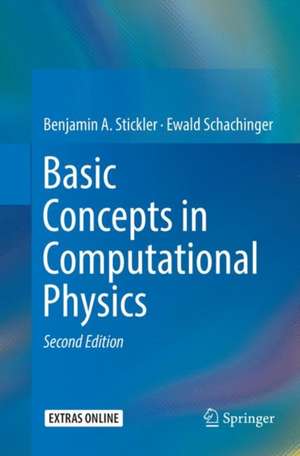
The book is divided into two main parts: Deterministic methods and stochastic methods in computational physics. Based on concrete problems, the first part discusses numerical differentiation and integration, as well as the treatment of ordinary differential equations. This is extended by a brief introduction to the numerics of partial differential equations. The second part deals with the generation of random numbers, summarizes the basics of stochastics, and subsequently introduces Monte-Carlo (MC) methods. Specific emphasis is on MARKOV chain MC algorithms. The final two chapters discuss data analysis and stochastic optimization. All this is again motivated and augmented by applications from physics. Inaddition, the book offers a number of appendices to provide the reader with information on topics not discussed in the main text.
Numerous problems with worked-out solutions, chapter introductions and summaries, together with a clear and application-oriented style support the reader. Ready to use C++ codes are provided online.
Preț: 432.49 lei
Puncte Express: 649
Carte tipărită la comandă
Livrare economică 04-18 decembrie
Livrare prin curier în România Termenul estimat este afișat lângă disponibilitate.
Transport gratuit pentru acest produs Plată online sau ramburs, în funcție de opțiunile comenzii.
Retur gratuit în 14 zile Comandă securizată și suport în română.
Specificații
ISBN-13: 9783319801032
ISBN-10: 3319801031
Pagini: 428
Ilustrații: XVI, 409 p.
Dimensiuni: 155 x 235 x 24 mm
Greutate: 0.59 kg
Ediția:Softcover reprint of the original 2nd edition 2016
Editura: Springer
Locul publicării:Cham, Switzerland
ISBN-10: 3319801031
Pagini: 428
Ilustrații: XVI, 409 p.
Dimensiuni: 155 x 235 x 24 mm
Greutate: 0.59 kg
Ediția:Softcover reprint of the original 2nd edition 2016
Editura: Springer
Locul publicării:Cham, Switzerland
V-ar putea interesa
-
 Information, Physics, and ComputationMarc Mézard-30%Preț: 676.71 lei970.50 lei
 -
 -20%Preț: 404.88 lei504.32 lei
 -
 Principia: The Authoritative TranslationIsaac NewtonPreț: 145.99 lei
 -
 Quantum GravityCarlo Rovelli-11%Preț: 689.32 lei774.51 lei
 -
 Star Maps for BeginnersTheodore LevittPreț: 89.02 lei
 -
 Groups, Representations and PhysicsH.F Jones-15%Preț: 632.97 lei744.67 lei
 -
 Geometry, Topology and PhysicsMikio Nakahara-18%Preț: 728.00 lei887.81 lei
 -
 Lectures on Quantum MechanicsSteven WeinbergPreț: 477.68 lei
 -
 A Student's Guide to Dimensional AnalysisDon S. LemonsPreț: 229.15 lei
 -
 Introduction to Mathematica® for PhysicistsAndrey GrozinPreț: 473.71 lei
 -
 Mathematical PhysicsSadri Hassani-17%Preț: 580.99 lei699.98 lei
 -
 Towards the Mathematics of Quantum Field TheoryFrédéric Paugam-18%Preț: 1165.29 lei1421.09 lei
 -
 Mathematical Tools for Physicists 2eM. Grinfeld-9%Preț: 1104.47 lei1213.71 lei
 -
 -33%Preț: 567.40 lei848.57 lei
 -
 A First Course in Mathematical PhysicsCT WhelanPreț: 342.58 lei
 -
 -15%Preț: 442.16 lei520.18 lei
Cuprins
Some Basic Remarks.- Part I Deterministic Methods.- Numerical Differentiation.- Numerical Integration.- The KEPLER Problem.- Ordinary Differential Equations – Initial Value Problems.- The Double Pendulum.- Molecular Dynamics.- Numerics of Ordinary Differential Equations - Boundary Value Problems.- The One-Dimensional Stationary Heat Equation.- The One-Dimensional Stationary SCHRÖDINGER Equation.- Partial Differential Equations.- Part II Stochastic Methods.- Pseudo Random Number Generators.- Random Sampling Methods.- A Brief Introduction to Monte-Carlo Methods.- The ISING Model.- Some Basics of Stochastic Processes.- The Random Walk and Diffusion Theory.- MARKOV-Chain Monte Carlo and the POTTS Model.- Data Analysis.- Stochastic Optimization.- Appendix: The Two-Body Problem.- Solving Non-Linear Equations. The NEWTON Method.- Numerical Solution of Systems of Equations.- Fast Fourier Transform.- Basics of Probability Theory.- Phase Transitions.- Fractional Integrals and Derivatives in1D.- Least Squares Fit.- Deterministic Optimization.
Notă biografică
Ewald Schachinger is a Professor in the Institute for Theoretical and Computational Physics in Graz University of Technology, Austria.
Benjamin A. Stickler is a Professor in the Institute of Theoretical Physics at the University of Duisburg-Essen, Germany.
Benjamin A. Stickler is a Professor in the Institute of Theoretical Physics at the University of Duisburg-Essen, Germany.
Textul de pe ultima copertă
This new edition is a concise introduction to the basic methods of computational physics. Readers will discover the benefits of numerical methods for solving complex mathematical problems and for the direct simulation of physical processes.
The book is divided into two main parts: Deterministic methods and stochastic methods in computational physics. Based on concrete problems, the first part discusses numerical differentiation and integration, as well as the treatment of ordinary differential equations. This is extended by a brief introduction to the numerics of partial differential equations. The second part deals with the generation of random numbers, summarizes the basics of stochastics, and subsequently introduces Monte-Carlo (MC) methods. Specific emphasis is on MARKOV chain MC algorithms. The final two chapters discuss data analysis and stochastic optimization. All this is again motivated and augmented by applications from physics. In addition, the book offers a number of appendices to provide the reader with information on topics not discussed in the main text.
Numerous problems with worked-out solutions, chapter introductions and summaries, together with a clear and application-oriented style support the reader. Ready to use C++ codes are provided online.
The book is divided into two main parts: Deterministic methods and stochastic methods in computational physics. Based on concrete problems, the first part discusses numerical differentiation and integration, as well as the treatment of ordinary differential equations. This is extended by a brief introduction to the numerics of partial differential equations. The second part deals with the generation of random numbers, summarizes the basics of stochastics, and subsequently introduces Monte-Carlo (MC) methods. Specific emphasis is on MARKOV chain MC algorithms. The final two chapters discuss data analysis and stochastic optimization. All this is again motivated and augmented by applications from physics. In addition, the book offers a number of appendices to provide the reader with information on topics not discussed in the main text.
Numerous problems with worked-out solutions, chapter introductions and summaries, together with a clear and application-oriented style support the reader. Ready to use C++ codes are provided online.
Caracteristici
Now with ready to use C++ program code available online Contains heavily expanded chapters on molecular dynamics, PDEs, random generators, Monte Carlo applications, data analysis and data optimization Presents deterministic methods are presented on a par with stochastic methods Mathematically precise, but driven by the needs of physicists Extensive appendices deepen the knowledge and present the mathematical basis