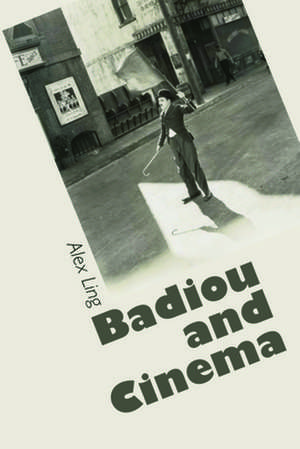
Badiou and Cinema
Autor Alex Lingen Limba Engleză Paperback – 10 mar 2013
John Mullarkey, Professor of Film and Television, Kingston University, London.
Alex Ling employs the philosophy of Alain Badiou to answer the question central to all serious film scholarship - namely, 'can cinema be thought?' Treating this question on three levels, the author first asks if we can really think what cinema is, at an ontological level. Second, he investigates whether cinema can actually think for itself; that is, whether or not it is truly 'artistic'. Finally he explores in what ways we can rethink the consequences of the fact that cinema thinks.
In answering these questions, the author uses well-known films ranging from Hiroshima mon amour to Vertigo to The Matrix to illustrate Badiou's philosophy as well as to consider the ways in which his work can be extended, critiqued and reframed with respect to the medium of cinema.
Alex Ling is Research Lecturer in Communication and Media Studies at the University of Western Sydney, Australia. He is the co-editor of Mathematics of the Transcendental: Onto-logy and Being-there, (Bloomsbury, 2013).
Preț: 191.09 lei
Preț vechi: 227.59 lei
-16%
Puncte Express: 287
Carte disponibilă
Livrare economică 09-23 noiembrie
Livrare prin curier în România Termenul estimat este afișat lângă disponibilitate.
Transport gratuit de la 400.00 lei Plată online sau ramburs, în funcție de opțiunile comenzii.
Retur gratuit în 14 zile Comandă securizată și suport în română.
Specificații
ISBN-13: 9780748677245
ISBN-10: 0748677240
Pagini: 224
Dimensiuni: 155 x 231 x 15 mm
Greutate: 0.36 kg
Editura: EDINBURGH UNIVERSITY PRESS
ISBN-10: 0748677240
Pagini: 224
Dimensiuni: 155 x 231 x 15 mm
Greutate: 0.36 kg
Editura: EDINBURGH UNIVERSITY PRESS
V-ar putea interesa
-
 Evolution, Literature, and Film – A ReaderBrian BoydPreț: 357.81 lei
 -
 Screening StrangersYosefa LoshitzkyPreț: 166.79 lei
 -
 Scotland: Global CinemaDavid Martin-Jones-16%Preț: 201.23 lei240.78 lei
 -
 Hong Kong EnglishJane Setter-17%Preț: 197.78 lei237.67 lei
 -
 Contemporary Action CinemaLisa Purse-17%Preț: 179.42 lei215.68 lei
 -
 Post-Classical HollywoodBarry Langford-15%Preț: 207.91 lei245.24 lei
 -
 -25%Preț: 628.53 lei833.61 lei
 -
 Roland PenroseJames King-21%Preț: 303.92 lei386.95 lei
 -
 -21%Preț: 136.74 lei173.18 lei
 -
 A Long Hard Look at 'Psycho'Raymond Durgnat-25%Preț: 180.63 lei242.04 lei
 -
 Writings, 1934-1947: Sergei Eisenstein Selected Works, Volume 3Sergei EisensteinPreț: 202.48 lei
 -
 Theorizing World CinemaProfessor Lúcia Nagib-19%Preț: 185.36 lei227.73 lei
 -
 Renegotiating the Body: Feminist Art in 1970s LondonKathy Battista-22%Preț: 197.08 lei251.76 lei
 -
 The Evil DeadKate EganPreț: 110.94 lei
Recenzii
As learned as it is exciting. Alex Ling has produced a textbook example of how to investigate Badiou's "Platonist Cinema" with utter rigor and fidelity. From "Hiroshima Mon Amour" to "The Matrix", he provides readings of films that mix his own ingenuity with Badiou's insights into the inessence of cinema. Yet "Badiou and Cinema" is more than simply an illustration of philosophical thought. It opens up the possibility of a truly thoughtful cinema, a cinema that thinks events in its own way, beyond the exigencies of both extant film theory and philosophy.--John Mullarkey, Kingston University
Cuprins
Introduction: Gorky's Maxim; 1. Presenting Alain Badiou; 2. Can Cinema Be Thought?; 3. In the Kingdom of Shadows; 4. An Aesthetic of Truth; 5. An Instant or an Eternity: Rethinking Cinema After Deleuze; 6. Alain Resnais and the Mise-en-Scene of Two; 7. The Castle of Impurity; Bibliography; Filmography; Index.