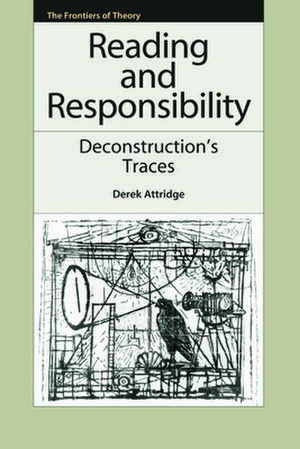
Reading and Responsibility
Autor Derek Attridgeen Limba Engleză Hardback – 27 mai 2010
Această culegere de studii semnată de Derek Attridge reprezintă o analiză riguroasă a intersecției dintre deconstrucție și etică, oferind o perspectivă proaspătă asupra modului în care lectura devine un act de responsabilitate. Suntem de părere că volumul reușește să demonstreze vitalitatea continuă a gândirii deconstructiviste, extrăgând-o din sfera pur teoretică pentru a o ancora în experiența estetică. Apreciem modul în care autorul nu caută în literatură pilde morale, ci investighează modul în care textul literar ne provoacă să răspundem în fața alterității. Descoperim aici o structură coerentă, organizată în unsprezece capitole care mapează influența lui Jacques Derrida asupra criticii literare contemporane. Reading and Responsibility începe cu o evaluare a deconstrucției în prezent, trece prin analize aplicate ale conceptelor de singularitate și „arche-jargon” și examinează contribuțiile unor figuri esențiale precum Roland Barthes sau Emmanuel Levinas. Comparabil cu Derrida: Ethics Under Erasure de Dr Nicole Anderson în rigurozitate, volumul lui Attridge se distinge prin focalizarea specifică pe actul lecturii ca practică etică, oferind un context aplicat pe texte literare concrete, inclusiv un capitol final dedicat operei lui J. M. Coetzee. Această preocupare pentru J. M. Coetzee continuă linia de cercetare începută de autor în lucrarea sa anterioară, J. M. Coetzee and the Ethics of Reading, consolidând argumentul că literatura solicită o formă unică de angajament intelectual și etic. Tonul este precis și academic, facilitând o înțelegere profundă a paradoxurilor etice fără a recurge la simplificări excesive.
Preț: 625.45 lei
Preț vechi: 833.61 lei
-25%
Carte tipărită la comandă
Livrare economică 25 august-08 septembrie
Specificații
ISBN-10: 0748640088
Pagini: 192
Ilustrații: 2 black & white illustrations
Dimensiuni: 163 x 234 x 18 mm
Greutate: 0.43 kg
Ediția:New.
Editura: EDINBURGH UNIVERSITY PRESS
Locul publicării:United Kingdom
V-ar putea interesa
-
 Moving Words: Forms of English PoetryDerek Attridge-14%Preț: 297.00 lei346.60 lei
 -
 -14%Preț: 601.96 lei699.95 lei
 -
 The Political Philosophy of Judith ButlerBirgit Schippers-18%Preț: 1197.62 lei1460.52 lei
 -
 Law's Trace: From Hegel to DerridaCatherine KelloggPreț: 437.14 lei
 -
 The Cambridge History of South African LiteratureDavid Attwell-23%Preț: 1443.83 lei1875.10 lei
 -
 Well-Weighed SyllablesD. AttridgePreț: 372.62 lei
 -
 Post-Structuralism and the Question of HistoryDerek Attridge-15%Preț: 281.46 lei331.02 lei
 -
 The Cambridge Companion to James JoyceDerek AttridgePreț: 276.88 lei
 -
 Semicolonial JoyceDerek AttridgePreț: 375.82 lei
 -
 Joyce EffectsDerek AttridgePreț: 372.41 lei
 -
 The Edinburgh Companion to PoststructuralismBenoît Dillet-23%Preț: 925.06 lei1195.47 lei
 -
 Not Half No EndGeoffrey Bennington-18%Preț: 176.72 lei215.38 lei
 -
 The Animal Question in DeconstructionLynn Turner-17%Preț: 205.11 lei247.23 lei
 -
 The Ethics of DeconstructionSimon Critchley-17%Preț: 174.87 lei210.73 lei
 -
 Jean Baudrillard: From Hyperreality to DisappearanceDavid B. Clarke-18%Preț: 171.02 lei208.27 lei
 -
 Relativism in the ArtsBetty Jean CraigePreț: 197.90 lei
 -
 The Critical Mythology of IronyJoseph A. DanePreț: 235.16 lei
 -
 Quantum AnthropologiesVicki KirbyPreț: 192.90 lei
 -
 For DerridaJ. Hillis MillerPreț: 355.48 lei
 -
 The Impossible Mourning of Jacques DerridaSean Gaston-42%Preț: 231.16 lei399.64 lei
 -
 Reading Derrida's Of GrammatologySean Gaston-29%Preț: 253.05 lei357.31 lei
 -
 Militant Democracy and Its CriticsAlexander Kirshner-17%Preț: 198.78 lei240.40 lei
 -
 The End(s) of CommunityJoshua Ben David NicholsPreț: 328.33 lei
 -
 Margins of DesireNiva AravPreț: 233.85 lei
 -
 The Concept of World from Kant to DerridaSean Gaston-36%Preț: 330.07 lei514.75 lei
 -
 The Transparency of EvilJean BaudrillardPreț: 133.94 lei
 -
 Derek Attridge in ConversationDerek AttridgePreț: 254.25 lei
De ce să citești această carte
Această lucrare se adresează studenților și cercetătorilor în teorie literară și filosofie care doresc să înțeleagă mizele etice ale deconstrucției. Cititorul câștigă o metodă de analiză critică ce depășește simpla interpretare de text, transformând lectura într-un exercițiu de responsabilitate intelectuală. Este un instrument esențial pentru oricine dorește să exploreze legătura dintre estetică și etică prin prisma gândirii lui Derrida.
Despre autor
Derek Attridge este profesor de literatură engleză la University of York și unul dintre cei mai respectați critici literari contemporani. Opera sa vastă cuprinde studii fundamentale despre modernism și poezie, precum James Joyce's Ulysses și Moving Words. În lucrările sale mai recente, precum The Work of Reading, Attridge s-a concentrat pe problemele sistemice ale disciplinelor umaniste în secolul XXI, pledând pentru o reevaluare a funcției criticii literare. Expertiza sa în literatura sud-africană și în teoria deconstrucției îl poziționează ca o voce autoritară în analiza raportului dintre formă și etică.