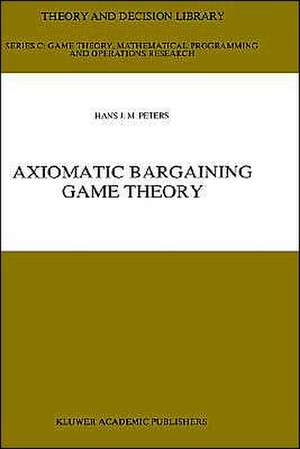
Axiomatic Bargaining Game Theory: Theory and Decision Library C, cartea 9
Autor H. J. Petersen Limba Engleză Hardback – 31 iul 1992
Axiomatic Bargaining Game Theory provides the reader with an up-to-date survey of cooperative, axiomatic models of bargaining, starting with Nash's seminal paper, The Bargaining Problem. It presents an overview of the main results in this area during the past four decades. Axiomatic Bargaining Game Theory provides a chapter on noncooperative models of bargaining, in particular on those models leading to bargaining solutions that also result from the axiomatic approach.
The main existing axiomatizations of solutions for coalitional bargaining games are included, as well as an auxiliary chapter on the relevant demands from utility theory.
Din seria Theory and Decision Library C
-
 Preț: 376.27 lei
 - 18%
 Preț: 915.43 lei
 - 15%
 Preț: 623.22 lei
 - 18%
 Preț: 1179.60 lei
 - 15%
 Preț: 618.19 lei
 - 15%
 Preț: 616.77 lei
 - 15%
 Preț: 616.15 lei
 - 15%
 Preț: 620.68 lei
 - 18%
 Preț: 914.83 lei
 - 15%
 Preț: 619.91 lei
 - 18%
 Preț: 915.89 lei
 - 18%
 Preț: 1331.40 lei
 - 18%
 Preț: 910.89 lei
 - 18%
 Preț: 1271.63 lei
 - 18%
 Preț: 1759.79 lei
 - 18%
 Preț: 909.98 lei
 - 18%
 Preț: 1174.61 lei
 - 15%
 Preț: 620.68 lei
 - 15%
 Preț: 622.09 lei
 - 15%
 Preț: 620.55 lei
 - 18%
 Preț: 919.37 lei
 - 18%
 Preț: 919.58 lei
 - 18%
 Preț: 915.43 lei
 - 15%
 Preț: 672.56 lei
 - 18%
 Preț: 915.64 lei
 - 18%
 Preț: 906.34 lei
 - 15%
 Preț: 619.61 lei
 - 15%
 Preț: 609.96 lei
 - 15%
 Preț: 620.38 lei
 - 15%
 Preț: 617.72 lei
Preț: 622.78 lei
Preț vechi: 732.68 lei
-15%
Puncte Express: 934
Carte tipărită la comandă
Livrare economică 06-20 iunie
Specificații
ISBN-13: 9780792318736
ISBN-10: 0792318730
Pagini: 256
Ilustrații: X, 242 p.
Dimensiuni: 160 x 241 x 20 mm
Greutate: 0.55 kg
Ediția:1992
Editura: Springer
Colecția Theory and Decision Library C
Seria Theory and Decision Library C
Locul publicării:Dordrecht, Netherlands
ISBN-10: 0792318730
Pagini: 256
Ilustrații: X, 242 p.
Dimensiuni: 160 x 241 x 20 mm
Greutate: 0.55 kg
Ediția:1992
Editura: Springer
Colecția Theory and Decision Library C
Seria Theory and Decision Library C
Locul publicării:Dordrecht, Netherlands
V-ar putea interesa
-
 Introduction to Game Theory: International EditionMartin J. Osborne-25%Preț: 1287.40 lei1722.95 lei
 -
 Before Sudoku: The World of Magic SquaresSeymour S Block-13%Preț: 130.37 lei150.02 lei
 -
 Strategic Learning and its LimitsH. Peyton Young-11%Preț: 428.44 lei481.40 lei
 -
 Preț: 109.60 lei
 -
 Goedel's Way: Exploits into an undecidable worldGregory Chaitin-15%Preț: 401.65 lei472.53 lei
 -
 The Moscow PuzzlesBoris Kordemsky-20%Preț: 79.43 lei99.66 lei
 -
 Game TheoryMorton D DavisPreț: 76.32 lei
 -
 Infinite Dimensional Optimization and Control TheoryHector O. Fattorini-14%Preț: 790.26 lei918.91 lei
 -
 -19%Preț: 429.45 lei530.18 lei
 -
 Algorithmic Game TheoryNoam Nisan-11%Preț: 508.02 lei570.82 lei
 -
 Games and Mathematics: Subtle ConnectionsDavid WellsPreț: 200.19 lei
 -
 Games, Puzzles, and ComputationRobert A. Hearn-18%Preț: 859.82 lei1048.56 lei
 -
 Formeln und Fakten im Grundkurs MathematikKlaus VettersPreț: 336.77 lei
 -
 Set-valued OptimizationAkhtar A. Khan-15%Preț: 643.68 lei757.26 lei
Public țintă
ResearchCuprins
Preliminaries.- Nash bargaining solutions.- Independence of irrelevant alternatives and revealed preferences.- Monotonicity properties.- Additivity properties.- Risk properties.- Bargaining with a variable number of players.- Alternative models and solution concepts.- Noncooperative models for bargaining solutions.- Solutions for coalitional bargaining games.- Elements from utility theory.