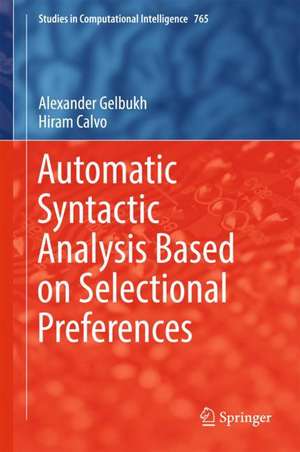
Automatic Syntactic Analysis Based on Selectional Preferences
Autor Alexander Gelbukh, Hiram Calvoen Limba Engleză Hardback – 9 mar 2018
Preț: 668.29 lei
Preț vechi: 835.35 lei
-20%
Puncte Express: 1002
Carte tipărită la comandă
Livrare economică 01-15 decembrie
Livrare prin curier în România Termenul estimat este afișat lângă disponibilitate.
Transport gratuit pentru acest produs Plată online sau ramburs, în funcție de opțiunile comenzii.
Retur gratuit în 14 zile Comandă securizată și suport în română.
Specificații
ISBN-13: 9783319740539
ISBN-10: 3319740539
Pagini: 176
Ilustrații: VIII, 165 p.
Dimensiuni: 160 x 241 x 16 mm
Greutate: 0.38 kg
Ediția:1st ed. 2018
Editura: Springer
Locul publicării:Cham, Switzerland
ISBN-10: 3319740539
Pagini: 176
Ilustrații: VIII, 165 p.
Dimensiuni: 160 x 241 x 16 mm
Greutate: 0.38 kg
Ediția:1st ed. 2018
Editura: Springer
Locul publicării:Cham, Switzerland
V-ar putea interesa
-
 -20%Preț: 1074.07 lei1342.59 lei
 -
 -20%Preț: 1079.16 lei1348.96 lei
 -
 Soft Computing Methods for Practical Environment SolutionsMarcos Gestal Pose-18%Preț: 1039.06 lei1267.14 lei
 -
 Affective Computing and InteractionDidem Gökçay-18%Preț: 1033.51 lei1260.38 lei
 -
 Intelligence and Security InformaticsHsinchun Chen-20%Preț: 662.81 lei828.52 lei
 -
 Formal Concept AnalysisSergei O. Kuznetsov-20%Preț: 337.36 lei421.70 lei
 -
 Adaptive and Natural Computing AlgorithmsBartlomiej Beliczynski-20%Preț: 653.58 lei816.97 lei
 -
 -20%Preț: 323.17 lei403.96 lei
 -
 Leveraging the Semantics of Topic MapsLutz Maicher-20%Preț: 335.36 lei419.20 lei
 -
 Computational Intelligence and SecurityYunping Wang-20%Preț: 996.27 lei1245.34 lei
 -
 MICAI 2007: Advances in Artificial IntelligenceAlexander Gelbukh-20%Preț: 775.57 lei969.46 lei
 -
 MICAI 2008: Advances in Artificial IntelligenceAlexander Gelbukh-20%Preț: 1031.92 lei1289.90 lei
 -
 -20%Preț: 321.17 lei401.46 lei
 -
 Transactions on Computational Collective Intelligence IINgoc Thanh Nguyen-20%Preț: 316.28 lei395.35 lei
 -
 -20%Preț: 657.90 lei822.37 lei
 -
 -20%Preț: 333.68 lei417.09 lei
 -
 -20%Preț: 316.28 lei395.35 lei
 -
 Logic for Programming, Artificial Intelligence, and ReasoningEdmund M. Clarke-20%Preț: 347.17 lei433.97 lei
 -
 -20%Preț: 314.86 lei393.57 lei
 -
 -20%Preț: 331.56 lei414.45 lei
 -
 Transactions on Rough Sets XIIIJames F. Peters-20%Preț: 320.55 lei400.68 lei
 -
 Transactions on Computational Collective Intelligence IIINgoc Thanh Nguyen-20%Preț: 317.85 lei397.31 lei
 -
 Advances in Soft Computing and Its ApplicationsFélix Castro-20%Preț: 348.87 lei436.10 lei
 -
 -20%Preț: 351.65 lei439.56 lei
 -
 Computational Linguistics and Intelligent Text ProcessingAlexander Gelbukh-20%Preț: 348.66 lei435.83 lei
Cuprins
Introduction.- First approach: sentence analysis using rewriting rules.- Second approach: constituent grammars.- Third approach: dependency trees.- Evaluation of the dependency parser.- Applications.- Prepositional phrase attachment disambiguation.- The unsupervised approach: grammar induction.- Multiple argument handling.- The need for full co-occurrence.
Textul de pe ultima copertă
This book describes effective methods for automatically analyzing a sentence, based on the syntactic and semantic characteristics of the elements that form it. To tackle ambiguities, the authors use selectional preferences (SP), which measure how well two words fit together semantically in a sentence. Today, many disciplines require automatic text analysis based on the syntactic and semantic characteristics of language and as such several techniques for parsing sentences have been proposed. Which is better? In this book the authors begin with simple heuristics before moving on to more complex methods that identify nouns and verbs and then aggregate modifiers, and lastly discuss methods that can handle complex subordinate and relative clauses. During this process, several ambiguities arise. SP are commonly determined on the basis of the association between a pair of words. However, in many cases, SP depend on more words. For example, something (such as grass) may be edible, depending on who is eating it (a cow?). Moreover, things such as popcorn are usually eaten at the movies, and not in a restaurant. The authors deal with these phenomena from different points of view.
Caracteristici
Describes recent methods for automatically analyzing a sentence, based on the syntactic and semantic characteristics of the elements that form it Presents a disambiguation algorithm based on linguistic and semantic knowledge Offers new contributions for automatic selectional preferences extraction and its multiple applications