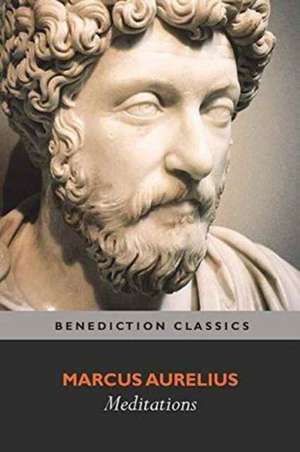
Aurelius, M: Meditations
en Limba Engleză Paperback – 15 oct 2016
Considerăm că forța rezilienței umane nu este nicăieri mai bine documentată decât în Meditations, opera lui Marcus Aurelius. Autorul nu scrie din postura unui teoretician care dorește să impună o doctrină, ci din cea a unui lider aflat la cârma Imperiului Roman între anii 161 și 180 d.Hr., care își folosește jurnalul personal ca pe un instrument de supraviețuire morală. Subliniem faptul că această lucrare nu a fost concepută pentru publicare, ceea ce îi conferă o onestitate brutală, transformând rigoarea stoică a lui Zeno sau Chrysippus într-o reflecție intimă despre datorie și toleranță. Structura volumului, împărțită în douăsprezece „Cărți”, urmărește progresia gândirii împăratului de la recunoștința față de mentori, în prima parte, până la acceptarea senină a finitudinii existenței în ultimele capitole. Ediția de față, publicată de Dover Publications, păstrează claritatea necesară unui text care extinde cadrul propus de Meditations - The Original Classic Edition prin concentrarea pe esența filosofică, fără a încărca aparatul critic. Reținem că, spre deosebire de alte lucrări incluse în Major Works of the Stoics 3-Book Boxed Set, acest volum se distinge prin caracterul său fragmentar și aforistic, fiind mai degrabă un exercițiu de igienă mentală decât un tratat sistematic. În analiza noastră, observăm o paralelă fascinantă între auto-analiza severă a lui Marcus Aurelius și idealul de autocontrol din literatura creștină timpurie. Totuși, acolo unde creștinismul propune smerenia în fața divinității, împăratul roman pledează pentru o încredere în sine modestă, bazată pe rațiune și pe „cetatea interioară”. Este o lectură esențială pentru înțelegerea modului în care disciplina intelectuală poate atenua povara responsabilităților publice și a zbuciumului cotidian.
Preț: 65.73 lei
Carte tipărită la comandă
Livrare economică 18 noiembrie-02 decembrie
Specificații
ISBN-10: 178139718X
Pagini: 140
Dimensiuni: 156 x 234 x 8 mm
Greutate: 0.23 kg
Editura: BENEDICTION BOOKS
V-ar putea interesa
-
 Discourses, Fragments, HandbookEpictetus-18%Preț: 65.12 lei79.69 lei
 -
 -8%Preț: 403.45 lei438.54 lei
 -
 Preț: 64.26 lei
 -
 The Brothers KaramazovFyodor DostoyevskyPreț: 53.75 lei
 -
 -26%Preț: 45.58 lei61.66 lei
 -
 MeditationsMarcus AureliusPreț: 63.23 lei
 -
 The Communist ManifestoFriedrich EngelsPreț: 11.26 lei
 -
 Meditations (The Concise Classic): Timeless Wisdom DistilledMarcus Aurelius-26%Preț: 69.39 lei93.91 lei
 -
 One MissionCharles Goodyear-35%Preț: 60.66 lei92.88 lei
 -
 1 CorinthiansJ. Ayodeji AdewuyaPreț: 239.59 lei
 -
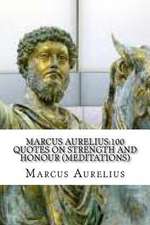 Marcus AureliusMarcus AureliusPreț: 38.49 lei
 -
 Preț: 100.79 lei
 -
 Meditations (Chump Change Edition)Marcus AureliusPreț: 53.42 lei
 -
 -19%Preț: 70.57 lei86.64 lei
 -
 -19%Preț: 63.79 lei78.95 lei
 -
 MeditationsEmperor Marcus AureliusPreț: 56.30 lei
 -
 Crime and PunishmentFyodor DostoevskyPreț: 38.99 lei
 -
 Meditations Gift SetChiltern PublishingPreț: 190.45 lei
 -
 The Illustrated MeditationsJames RommPreț: 109.02 lei
 -
 Warcraft: Legends Vol. 5Richard KnaakPreț: 76.06 lei
 -
 Preț: 73.96 lei
 -
 A Promise to Astrid - A True Story: Official Motion Picture EditionMichael K. TourvillePreț: 101.93 lei
 -
 Gândire rapidă, gândire lentăDaniel KahnemanPreț: 99.00 lei
 -
 Preț: 73.44 lei
 -
 InfernoLee JaerockPreț: 73.97 lei
 -
 Preț: 73.04 lei
 -
 HelvettiLee JaerockPreț: 81.27 lei
 -
 Select Classics: MeditationsMarcus AureliusPreț: 61.15 lei
De ce să citești această carte
Recomandăm această ediție pentru oricine caută un ghid practic de echilibru emoțional. Veți câștiga o perspectivă unică asupra modului în care gândirea rațională poate transforma adversitatea în oportunitate. Este o lectură fundamentală pentru studenții la filosofie și pentru cei care doresc să exploreze stoicismul direct de la sursă, într-un format compact și ușor de parcurs, care demonstrează că problemele umane fundamentale au rămas neschimbate de două milenii.
Despre autor
Marcus Aureliu a fost împărat al Imperiului Roman din dinastia Antoninilor (161–180 d.Hr.) și unul dintre cei mai importanți reprezentanți ai stoicismului târziu. Născut într-o familie nobilă și adoptat ulterior de Antoninus Pius, el a condus imperiul într-o perioadă marcată de războaie și pandemii, experiențe care i-au șlefuit viziunea asupra lumii. Opera sa, scrisă în limba greacă, a supraviețuit ca o mărturie a datoriei și a integrității. Lucrările sale sunt adesea grupate alături de cele ale lui Seneca și Epictet, formând nucleul gândirii stoice care continuă să influențeze etica modernă.
Descriere scurtă
"You have power over your mind - not outside events. Realize this, and you will find strength."
"When you arise in the morning, think of what a privilege it is to be alive, to think, to enjoy, to love ..."
"It is not death that a man should fear, but he should fear never beginning to live."
"Everything we hear is an opinion, not a fact. Everything we see is a perspective, not the truth."
The Meditations of Marcus Aurelius is a life-changing book. It contains the private meditations of the most powerful man in the Roman world, the Emperor Marcus Aurelius, as he wrestled with the complexities of his life using the wisdom of Stoic Philosophy. Meditations is written in lucid, accessible language and, interestingly, we see that the problems and perplexities of this philosopher-King are much like ours. Marcus Aurelius was impressively able to live out his philosophical ideals-such as the importance of gratitude, mindfulness, simplicity and life-long learning, of seizing the day, and of remembering the shortness of life-while administering the Roman Empire.
Marcus Aurelius (121-180 AD) was the last of the five "good Roman emperors". The Emperor Hadrian adopted Titus Aurelius Antoninus, thereby choosing him to succeed him, and arranged for Antonius to adopt Marcus, and thus, from a young age, Marcus was groomed for power. During this time, he devoted himself to philosophy with passion and diligence. At the age of forty he became Emperor and was known as Emperor Marcus Aurelius Antoninus Augustus. Remarkably in a culture of absolute power, he insisted that his adoptive brother and co-consul, Lucius, be elevated to co-emperor. The historian Herodian, a contemporary, wrote:
"he gave proof of his learning not by mere words or knowledge of philosophical doctrines but by his blameless character and temperate way of life."
Marcus Aurelius is now best remembered for Meditations, which is, perhaps, the greatest single work of Stoic philosophy.
Stoic philosophy is, above all, practical. It uses reason and the careful observation of human life to address the problems of daily life. It is also universal-the Emperor Marcus Aurelius and the freed slave Epictetus were both prominent Stoic philosophers. In recent years, Stoic philosophy has provided invaluable life lessons to people in many spheres of life including prisoners of war and Holocaust survivors, psychiatrists, and those in the business world. Indeed, modern Stoic thought "hold s] fascinating promise for business and government leaders tackling global problems in a turbulent, post-recession slump," (Forbes).
This edition is complete and unabridged and contains Introduction, Notes, Appendix containing correspondence with his tutor Fronto, and a Glossary.
Notă biografică
Descriere
Marcus Aurelius is considered to one of the great Emperors of Rome who was not only a skilled military leader but also a great philosopher in the Stoic tradition.He was born in 121 AD and both of his parents came from wealthy backgrounds. His father died when Marcus was 3 years old and by the time he was 6 he had gained the attention of the Emperor Hadrian who oversaw his education. Hadrian ensured that Marcus was taught by some of the greatest scholars in Rome who educated him in literature, drama, geometry, Greek oratory, Greek and Latin. Marcus later abandoned most of those subjects in favor of philosophy, with the work of the Greek philosopher Epictetus being a major influence on his thinking.Although Marcus spent almost all of his reign on campaigns in foreign territories, he managed to write down his thoughts and these became what are now considered a masterpiece of Roman philosophy, the discourses 'Meditations'. Marcus wrote 'Meditations' around 170 - 180, whilst on a campaign in central Europe, most probably in what is now Serbia, Hungary and Austria.The 12 books that make up 'Meditations' were not written as an exercise in explaining his philosophy but rather as a personal notebook for self-improvement and study.'Meditations' illustrates just how important Epictetus was to Marcus as he quotes the Greek philosopher's famed 'Discourses' on more than one occasion. Epictetus was a legendary figure in Greek philosophy and many claim he is the greatest of the Stoics; texts that remain in existence from the period suggest that in his native Greece, he was even more popular than Plato.As was previously mentioned, 'Meditations' was not written for public consumption but rather as an aid to personal development. Marcus wanted to change his way of living and thinking and to do this he embarked on a set of philosophical exercises. He would reflect on philosophical ideas and by writing them down and by repeating them he hoped to re-programme his mind and find his own philosophy to live by.One of the key exercises in the book discusses Marcus attempting to look at the world from 'the point of view of the cosmos' in a bid to try and look at life and the universe outside of the common and limited parameters of individual concerns."You have the power to strip away many superfluous troubles located wholly in your judgment, and to possess a large room for yourself embracing in thought the whole cosmos, to consider everlasting time, to think of the rapid change in the parts of each thing, of how short it is from birth until dissolution, and how the void before birth and that after dissolution are equally infinite."Marcus Aurelius died on March 17, 180, in the city of Vindobona which was situated where Vienna is today.History remembers him as the last of the 'Five Good Emperors' of theNervan-Antonian dynasty. Marcus' son Commodus replaced his father as Emperor and although he reigned over a relatively stable period in Roman history, in terms of war and peace, his personal behavior and antics were not in the spirit of those Emperors that came immediately before him. Commodus was eventually murdered in a plot that involved his mistress Marcia, thus bringing to an end the highly regarded Nervan-Antonian dynasty.