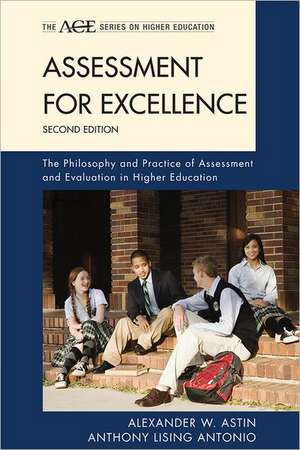
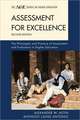
Assessment for Excellence: The Philosophy and Practice of Assessment and Evaluation in Higher Education: The ACE Series on Higher Education
Autor Alexander W. Astin, Anthony Lising Antonioen Limba Engleză Hardback – 13 iul 2012
Din seria The ACE Series on Higher Education
- 20%
 Preț: 266.19 lei
 - 26%
 Preț: 415.33 lei
 - 6%
 Preț: 230.71 lei
 - 17%
 Preț: 381.73 lei
 -
 Preț: 330.16 lei
 - 29%
 Preț: 486.86 lei
 - 21%
 Preț: 308.15 lei
 - 26%
 Preț: 340.93 lei
 - 23%
 Preț: 262.32 lei
 - 19%
 Preț: 337.85 lei
 - 15%
 Preț: 513.03 lei
 - 22%
 Preț: 302.19 lei
 - 25%
 Preț: 220.06 lei
 - 24%
 Preț: 268.64 lei
 - 24%
 Preț: 183.24 lei
 - 25%
 Preț: 346.74 lei
 - 32%
 Preț: 343.23 lei
 - 24%
 Preț: 267.67 lei
 - 16%
 Preț: 210.59 lei
 - nou
 Preț: 212.60 lei
 - nou
 Preț: 164.85 lei
Preț: 689.80 lei
Preț vechi: 1032.59 lei
-33%
Puncte Express: 1035
Carte tipărită la comandă
Livrare economică 08-22 decembrie
Livrare prin curier în România Termenul estimat este afișat lângă disponibilitate.
Transport gratuit pentru acest produs Plată online sau ramburs, în funcție de opțiunile comenzii.
Retur gratuit în 14 zile Comandă securizată și suport în română.
Specificații
ISBN-13: 9781442213616
ISBN-10: 1442213612
Pagini: 380
Dimensiuni: 160 x 226 x 30 mm
Greutate: 1.26 kg
Ediția:Revised.
Editura: Bloomsbury Publishing
Colecția Rowman & Littlefield
Seria The ACE Series on Higher Education
Locul publicării:New York, United States
ISBN-10: 1442213612
Pagini: 380
Dimensiuni: 160 x 226 x 30 mm
Greutate: 1.26 kg
Ediția:Revised.
Editura: Bloomsbury Publishing
Colecția Rowman & Littlefield
Seria The ACE Series on Higher Education
Locul publicării:New York, United States
Cuprins
Preface
Chapter 1: The Philosophy and Logic of Assessment
Chapter 2: A Conceptual Model for Assessment
Chapter 3: Assessing Outcomes
Chapter 4: Assessing Student Inputs
Chapter 5: Assessing the Environment
Chapter 6: Analyzing Assessment Data
Chapter 7: Use of Assessment Results
Chapter 8: Building a Database
Chapter 9: Assessment as Direct Feedback to the Learner
Chapter 10: Assessment and Equity
Chapter 11: Assessment and Public Policy
Chapter 12: The Future of Assessment
Appendix: Statistical Analysis of Longitudinal Data
References
Index
Chapter 1: The Philosophy and Logic of Assessment
Chapter 2: A Conceptual Model for Assessment
Chapter 3: Assessing Outcomes
Chapter 4: Assessing Student Inputs
Chapter 5: Assessing the Environment
Chapter 6: Analyzing Assessment Data
Chapter 7: Use of Assessment Results
Chapter 8: Building a Database
Chapter 9: Assessment as Direct Feedback to the Learner
Chapter 10: Assessment and Equity
Chapter 11: Assessment and Public Policy
Chapter 12: The Future of Assessment
Appendix: Statistical Analysis of Longitudinal Data
References
Index
Recenzii
Alexander W. Astin and anthony lising antonio have produced a most worthy successor to a genuine classic in our field: Assessment for Excellence. This second edition is a work of first-rank scholarship with a wide range of practical and policy implications. It is indispensable reading for anyone with a serious interest in assessment and evaluation in postsecondary education.
As with its predecessor, this volume is a timely tour de force of clarity in terms of explaining the philosophical, conceptual, and technical underpinnings of how assessment in postsecondary education should be conducted in order to serve students and society.
When it first came out in 1991, Assessment for Excellence was a breakthrough book, rendering the new field of assessment both broadly comprehensible and academically legitimate. This new second edition, updated with coauthor Anthony Antonio, retains the flavor of the original-personal, down to earth, and wise-while acknowledging and harnessing the best of the two decades of assessment scholarship that the original helped stimulate.
Grounded in a well-articulated philosophy of research, Astin and Antonio believe that assessment is not a set of techniques, but a way of thinking guided by humane and helping values. Where they encounter methodological questions, they do not gloss their difficulties but, as good teachers, sensibly take their readers through them step by step. Decades of experience have given them scores of good stories to illustrate these approaches and they use them well. The 'piano lesson' remains one of the best portrayals of learning with effective feedback ever put forward. This book is more than useful; it is a classic that has stood the test of time.
Astin's talent development concept and I-E-O model have informed research and practice in outcomes assessment for almost three decades. In this new edition, the authors deepen our understanding of the model and give us detailed advice about measuring student inputs, educational environments, and developmental outcomes. Graduate students and campus assessment leaders in particular will find this clear explanation of applied research aimed at improving college student learning both useful and helpful in guiding their thinking and their work.
This revised edition of Assessment for Excellence remains the leading authority on virtually all aspects of assessment in higher education. Grounded in sound theory and extensive practical experience, rigorous in conception and methods, savvy in its advice, comprehensive in coverage, and updated for this era, the volume provides important, accessible, and timely guidance for administrators, teaching faculty members, legislators and policy analysts, and higher education students and faculty members. More important, the coverage is as solid as it is broad, but handled in a fashion faithful to the book's goal of making assessment do-able, credible, and useful in practice.
As with its predecessor, this volume is a timely tour de force of clarity in terms of explaining the philosophical, conceptual, and technical underpinnings of how assessment in postsecondary education should be conducted in order to serve students and society.
When it first came out in 1991, Assessment for Excellence was a breakthrough book, rendering the new field of assessment both broadly comprehensible and academically legitimate. This new second edition, updated with coauthor Anthony Antonio, retains the flavor of the original-personal, down to earth, and wise-while acknowledging and harnessing the best of the two decades of assessment scholarship that the original helped stimulate.
Grounded in a well-articulated philosophy of research, Astin and Antonio believe that assessment is not a set of techniques, but a way of thinking guided by humane and helping values. Where they encounter methodological questions, they do not gloss their difficulties but, as good teachers, sensibly take their readers through them step by step. Decades of experience have given them scores of good stories to illustrate these approaches and they use them well. The 'piano lesson' remains one of the best portrayals of learning with effective feedback ever put forward. This book is more than useful; it is a classic that has stood the test of time.
Astin's talent development concept and I-E-O model have informed research and practice in outcomes assessment for almost three decades. In this new edition, the authors deepen our understanding of the model and give us detailed advice about measuring student inputs, educational environments, and developmental outcomes. Graduate students and campus assessment leaders in particular will find this clear explanation of applied research aimed at improving college student learning both useful and helpful in guiding their thinking and their work.
This revised edition of Assessment for Excellence remains the leading authority on virtually all aspects of assessment in higher education. Grounded in sound theory and extensive practical experience, rigorous in conception and methods, savvy in its advice, comprehensive in coverage, and updated for this era, the volume provides important, accessible, and timely guidance for administrators, teaching faculty members, legislators and policy analysts, and higher education students and faculty members. More important, the coverage is as solid as it is broad, but handled in a fashion faithful to the book's goal of making assessment do-able, credible, and useful in practice.