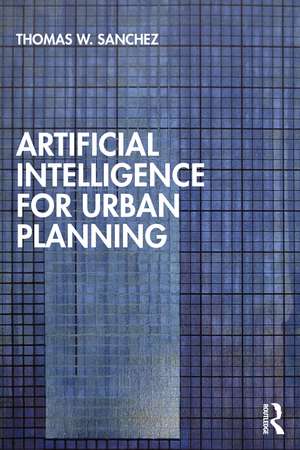
Artificial Intelligence for Urban Planning
Autor Thomas W. Sanchezen Limba Engleză Hardback – 22 sep 2025
Preț: 1152.21 lei
Preț vechi: 1405.14 lei
-18%
Puncte Express: 1728
Carte tipărită la comandă
Livrare economică 08-22 decembrie
Livrare prin curier în România Termenul estimat este afișat lângă disponibilitate.
Transport gratuit pentru acest produs Plată online sau ramburs, în funcție de opțiunile comenzii.
Retur gratuit în 14 zile Comandă securizată și suport în română.
Specificații
ISBN-13: 9781032760476
ISBN-10: 1032760478
Pagini: 254
Ilustrații: 64
Dimensiuni: 152 x 229 x 18 mm
Greutate: 0.5 kg
Ediția:1
Editura: Taylor & Francis
Colecția Routledge
Locul publicării:Oxford, United Kingdom
ISBN-10: 1032760478
Pagini: 254
Ilustrații: 64
Dimensiuni: 152 x 229 x 18 mm
Greutate: 0.5 kg
Ediția:1
Editura: Taylor & Francis
Colecția Routledge
Locul publicării:Oxford, United Kingdom
V-ar putea interesa
-
 Using Artificial Intelligence Absolute Beginner's GuideMichael Miller-20%Preț: 201.72 lei252.15 lei
 -
 How To Think About AI: A Guide For The PerplexedRichard Susskind-20%Preț: 66.94 lei83.68 lei
 -
 Preț: 95.87 leiRecomandat
 -
 The Image of the CityKevin LynchPreț: 277.67 lei
 -
 The Power of Design and Convergence of AITai Lee Siang-20%Preț: 419.95 lei524.93 lei
 -
 -20%Preț: 371.62 lei464.52 lei
 -
 Preț: 356.48 lei
 -
 Preț: 105.17 lei
 -
 -12%Preț: 142.29 lei161.47 lei
 -
 -14%Preț: 223.19 lei258.82 lei
 -
 Agentic AI For DummiesPam Baker-20%Preț: 146.02 lei182.53 lei
 -
 The Essential Book of AIAnne Rooney-20%Preț: 76.61 lei95.77 lei
 -
 -41%Preț: 58.51 lei99.01 lei
 -
 Mastering AIJeremy Kahn-20%Preț: 80.23 lei100.29 lei
 -
 The AI ConEmily M. BenderPreț: 151.99 lei
 -
 Preț: 321.18 lei
 -
 How to Make AI UsefulMagnus ReinerPreț: 94.13 lei
 -
 Artificial Intelligence for LibrariesBrady D. Lund-10%Preț: 345.14 lei385.57 lei
 -
 -16%Preț: 169.44 lei202.18 lei
Public țintă
Postgraduate, Professional Practice & Development, and Undergraduate AdvancedCuprins
Preface
Acknowledgements
1. Introduction
2. Machine Learning for Urban Planners
3. Neural Networks for Urban Planners
4. Natural Language Processing for Urban Planners
5. Computer Vision for Urban Planners
6. Generative AI for Urban Planners
7. Challenges to Adopting AI in Urban Planning
8. Moving towards the integration of AI in Urban Planning
Glossary
Acknowledgements
1. Introduction
2. Machine Learning for Urban Planners
3. Neural Networks for Urban Planners
4. Natural Language Processing for Urban Planners
5. Computer Vision for Urban Planners
6. Generative AI for Urban Planners
7. Challenges to Adopting AI in Urban Planning
8. Moving towards the integration of AI in Urban Planning
Glossary
Notă biografică
Thomas W. Sanchez, PhD, AICP, is a Professor in the Department of Landscape Architecture and Urban Planning at Texas A&M University. He earned his PhD in City Planning from Georgia Tech and a Master of City and Regional Planning from Cal Poly, San Luis Obispo. His research and teaching focus on cities, planning methods, transportation, and technology. His most recent books include Networks in the Knowledge Economy (with Denise Bedford) and Planning Knowledge and Research. Sanchez serves as the American Planning Association (APA) Education Committee Chair and as a member of APA’s Artificial Intelligence (AI) Foresight Community.
Recenzii
Thomas Sanchez offers a concise and well-informed introduction to the role of artificial intelligence in urban planning. The book outlines the main concepts, methodological approaches, and practical challenges that define this emerging field.
Carlos Nunes Silva, International Journal of E-Planning Research
Carlos Nunes Silva, International Journal of E-Planning Research
Descriere
This book introduces planners to AI, outlining essential concepts, terminologies, and methodologies. It shows how planners can effectively use AI in their daily practices, engage constructively with technical specialists, and critically assess the appropriateness of these technologies in different planning contexts.