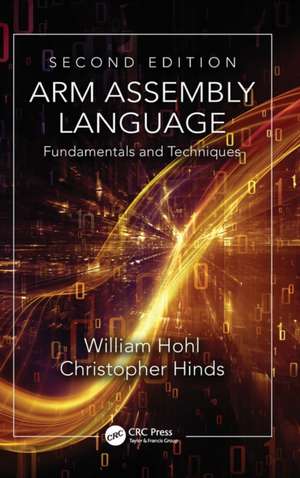
ARM Assembly Language: Fundamentals and Techniques, Second Edition
Autor William Hohl, Christopher Hindsen Limba Engleză Hardback – 20 oct 2014
În industria sistemelor embedded, arhitectura ARM reprezintă standardul de facto, iar înțelegerea modului în care hardware-ul interacționează cu software-ul la cel mai scăzut nivel este critică pentru optimizare. Observăm în ARM Assembly Language o abordare tehnică riguroasă, care nu se limitează la un singur model de procesor, ci extinde analiza de la clasicul ARM7 către generațiile moderne Cortex-A, Cortex-R și Cortex-M. Această a doua ediție, semnată de William Hohl și Christopher Hinds, este concepută pentru a ghida tranziția de la teoria arhitecturii la implementarea practică.
Descoperim aici o structură progresivă ce demarează cu modelul programatorului și regulile de asamblare, evoluând rapid spre operații complexe de logică întreagă, ramificații și bucle. Un element distinctiv față de alte manuale este atenția acordată aritmeticii în virgulă mobilă conform standardului IEEE 754, subiect tratat pe parcursul a trei capitole detaliate care explică transferul de date, rotunjirea și gestionarea excepțiilor. Complementar volumului Modern Assembly Language Programming with the ARM Processor de Larry D Pyeatt, care pune accent pe un stil tutorial și exemple bare-metal, lucrarea de față se concentrează pe utilizarea instrumentelor industriale precum Keil MDK-ARM și Code Composer Studio, oferind suport direct pentru platforme hardware populare de la STMicroelectronics sau NXP.
Reținem utilitatea capitolului dedicat mixării limbajului C cu Assembly, o competență esențială pentru inginerii care dezvoltă firmware performant. Cu 150 de ilustrații și 71 de tabele tehnice, textul servește drept referință profesională pentru programarea perifericelor mapate în memorie și gestionarea întreruperilor, asigurând o înțelegere profundă a modului în care seturile de instrucțiuni ARM, Thumb și Thumb-2 sunt executate la nivel de siliciu.
Preț: 778.27 lei
Preț vechi: 972.84 lei
-20%
Carte indisponibilă temporar
Specificații
ISBN-10: 1482229854
Pagini: 453
Ilustrații: 150 black & white illustrations, 71 black & white tables
Dimensiuni: 156 x 234 x 28 mm
Greutate: 1.8 kg
Ediția:Revised
Editura: CRC Press
Colecția CRC Press
Locul publicării:Boca Raton, United States
V-ar putea interesa
-
 -41%Preț: 457.81 lei769.47 lei
 -
 -40%Preț: 496.15 lei825.63 lei
 -
 -40%Preț: 493.92 lei823.98 lei
 -
 Embedded Systems: ARM Programming and OptimizationJason D. Bakos-34%Preț: 412.11 lei624.90 lei
 -
 High Performance Computing: Modern Systems and PracticesThomas Sterling-40%Preț: 437.18 lei729.97 lei
 -
 Principles of Computer HardwareAlan Clements-28%Preț: 623.58 lei861.14 lei
 -
 ARM System-on-Chip ArchitectureSteve Furber-18%Preț: 646.73 lei788.70 lei
 -
 -40%Preț: 458.81 lei768.90 lei
 -
 -30%Preț: 445.71 lei639.30 lei
 -
 Modern Assembly Language Programming with the ARM ProcessorLarry D Pyeatt-31%Preț: 467.79 lei675.11 lei
 -
 Computer Architecture: A Quantitative ApproachJohn L. Hennessy-39%Preț: 539.69 lei882.55 lei
 -
 -11%Preț: 494.15 lei555.22 lei
 -
 Blue Fox - Arm Assembly Internals and Reverse EngineeringMaria Markstedter-20%Preț: 235.08 lei293.84 lei
 -
 Computer Systems: A Programmer's Perspective, Global EditionRandal E. Bryant-20%Preț: 652.59 lei815.74 lei
 -
 Modern C, Third EditionJens Gustedt-20%Preț: 350.34 lei437.92 lei
 -
 Introduction to Computer Organization: ARM EditionRobert G. Plantz-35%Preț: 303.72 lei468.10 lei
 -
 The Art of ARM Assembly Volume 1Randall Hyde-35%Preț: 433.81 lei665.69 lei
 -
 -34%Preț: 245.07 lei372.06 lei
 -
 Heavy Wizardry 101: Shellcodes, Backdoors, Droppers and WormsDavid Martinez Oliveira-34%Preț: 291.18 lei443.89 lei
 -
 Understanding Computer OrganizationPatricio Buli¿-20%Preț: 387.55 lei484.44 lei
De ce să citești această carte
Recomandăm această carte inginerilor de sistem și studenților care doresc să stăpânească arhitectura ARM dincolo de abstracțiunile limbajelor de nivel înalt. Cititorul câștigă competențe practice în scrierea de cod Assembly optimizat și depanarea la nivel de registru, beneficiind de expertiza unor designeri de procesoare ARM. Este resursa ideală pentru cei care lucrează cu plăci de dezvoltare Tiva sau Discovery și au nevoie de o bază solidă în aritmetica IEEE 754.
Despre autor
William Hohl și Christopher Hinds sunt experți recunoscuți în designul microprocesoarelor, având o experiență vastă acumulată chiar în cadrul ecosistemului ARM. William Hohl a activat ca manager de mediul academic pentru ARM, fiind responsabil de educarea noilor generații de ingineri în utilizarea acestor arhitecturi. Christopher Hinds este un specialist de renume în arhitectura computerelor și un expert în standardele de aritmetică în virgulă mobilă, contribuind direct la dezvoltarea seturilor de instrucțiuni care definesc astăzi industria sistemelor embedded și mobile.
Descriere scurtă
Featuring three brand-new chapters, a new appendix, and expanded coverage of the ARM7™, this edition:
- Discusses IEEE 754 floating-point arithmetic and explains how to program with the IEEE standard notation
- Contains step-by-step directions for the use of Keil™ MDK-ARM and Texas Instruments (TI) Code Composer Studio™
- Provides a resource to be used alongside a variety of hardware evaluation modules, such as TI’s Tiva Launchpad, STMicroelectronics’ iNemo and Discovery, and NXP Semiconductors’ Xplorer boards
Cuprins
Notă biografică
Christopher Hinds has worked in the microprocessor design field for over 25 years, holding design positions at Motorola (now Freescale Semiconductor), AMD, and ARM. While at ARM, he was the primary author of the ARM VFP floating-point architecture and led the design of the ARM10 VFP, the first hardware implementation of the new architecture. He recently joined the Patents Group in ARM, identifying patentable inventions within the company and assisting in patent litigation. He holds BSEE and MSEE degrees from Texas A&M University and an M.Div from Oral Roberts University, where he worked to establish the School of Engineering, creating and teaching the first digital logic and microprocessor courses. He has numerous published papers and presentations on the floating-point architecture of ARM processors, and is a named inventor on over 30 US patents in the areas of floating-point implementation, instruction set design, and circuit design.
Recenzii
—Andrew Mason, Michigan State University, East Lansing, USA
"The authors are obviously authorities on the subject, and this shows clearly. The text is clearly written and easy to follow, with examples and analogies used to make understanding easier. Using Keil and the Tiva Launchpad should make it pretty easy to get the examples up and running on an actual Cortex-M as well as using a simulator."
—Craig A. Evans, University of Leeds, UK
"This book fills a void in the computer science literature."
—Don Evans, Southern Methodist University, Dallas, Texas, USA
"This text retains the ease of using the ARM7TDMI while moving the student [or reader] into the more capable Cortex-M4. …The addition of the Cortex-M4 makes this a much stronger text."
—Ralph Tanner, Western Michigan University, Kalamazoo, USA
"Assembly language programming is still the best way to learn about the internals of processors and this is one of a very few books that teaches that skill for ARM processors. It covers the necessary material in a well-organized manner. Updated for newer versions of ARM processors, it adds good material on floating-point arithmetic that was missing from the first edition."
—Ronald W. Mehler, California State University, Northridge, USA
"In general, this book contains most of the content that I generally cover in my introduction to computer organization course. It contains very nice exercises at the end of each chapter, and that is a plus when generating questions to help students grasp the concepts. …I look forward to a second edition, because I plan to continue using this book."
—Rose M. Lowe, Clemson University, South Carolina, USA