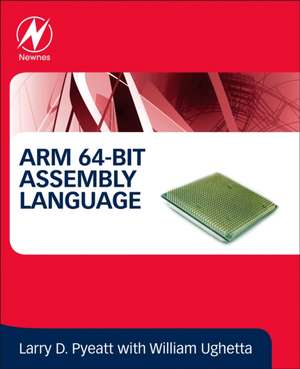
ARM 64-Bit Assembly Language
Autor Larry D Pyeatt, William Ughettaen Limba Engleză Paperback – 15 noi 2019
Ne-a atras atenția ARM 64-Bit Assembly Language deoarece reprezintă unul dintre primele manuale tehnice dedicate integral arhitecturii ARM pe 64 de biți, un standard esențial în dezvoltarea sistemelor embedded moderne. Considerăm că valoarea principală a lucrării rezidă în tranziția controlată de la sintaxa de bază GNU assembly către programarea complexă pe sisteme bare-metal, oferind inginerilor control total asupra hardware-ului fără interpunerea unui sistem de operare.
Structura volumului este riguros organizată pentru a facilita progresia tehnică. După stabilirea fundamentelor în capitolele dedicate seturilor de instrucțiuni Load/Store și procesării datelor, autorii Larry D Pyeatt și William Ughetta introduc concepte avansate de programare structurată și tipuri de date abstracte. Un punct forte îl reprezintă capitolele 8-10, care detaliază matematica non-integrală și utilizarea extensiilor ARM NEON pentru instrucțiuni SIMD (Single Instruction, Multiple Data), vitale în optimizarea performanței.
Pe linia practică a lucrării Modern Assembly Language Programming with the ARM Processor, scrisă tot de Larry D Pyeatt, acest nou volum face trecerea necesară către registrul de 64 de biți, păstrând însă rigoarea didactică. Spre deosebire de Programming with 64-Bit ARM Assembly Language de Stephen Smith, care se axează pe platforme specifice precum Raspberry Pi sau Nvidia Jetson sub Linux, lucrarea de față pune un accent mai mare pe arhitectura internă a procesorului și pe execuția codului în medii fără sistem de operare (Chapter 12). Utilizarea exclusivă a uneltelor open-source face ca această resursă să fie extrem de accesibilă pentru mediul universitar și pentru prototiparea rapidă.
Preț: 402.60 lei
Preț vechi: 513.87 lei
-22%
Carte tipărită la comandă
Livrare economică 30 noiembrie-14 decembrie
Specificații
ISBN-10: 0128192216
Pagini: 506
Ilustrații: Approx. 100 illustrations
Dimensiuni: 191 x 235 x 36 mm
Greutate: 0.86 kg
Editura: ELSEVIER SCIENCE
V-ar putea interesa
-
 -41%Preț: 457.81 lei769.47 lei
 -
 -40%Preț: 496.15 lei825.63 lei
 -
 -40%Preț: 493.92 lei823.98 lei
 -
 Embedded Systems: ARM Programming and OptimizationJason D. Bakos-34%Preț: 412.11 lei624.90 lei
 -
 Principles of Computer HardwareAlan Clements-28%Preț: 623.58 lei861.14 lei
 -
 ARM System-on-Chip ArchitectureSteve Furber-18%Preț: 646.73 lei788.70 lei
 -
 Hacker's DelightHenry Warren-20%Preț: 338.46 lei423.08 lei
 -
 -30%Preț: 445.71 lei639.30 lei
 -
 Modern Assembly Language Programming with the ARM ProcessorLarry D Pyeatt-31%Preț: 467.79 lei675.11 lei
 -
 Computer Architecture: A Quantitative ApproachJohn L. Hennessy-39%Preț: 539.69 lei882.55 lei
 -
 -39%Preț: 622.57 lei1028.93 lei
 -
 Blue Fox - Arm Assembly Internals and Reverse EngineeringMaria Markstedter-20%Preț: 235.08 lei293.84 lei
 -
 Computer Systems: A Programmer's Perspective, Global EditionRandal E. Bryant-20%Preț: 652.59 lei815.74 lei
 -
 x64 Assembly Language Step-by-StepJeff Duntemann-20%Preț: 429.61 lei537.02 lei
 -
 -34%Preț: 410.94 lei624.64 lei
 -
 Introduction to Computer Organization: ARM EditionRobert G. Plantz-35%Preț: 303.72 lei468.10 lei
 -
 The Art of ARM Assembly Volume 1Randall Hyde-35%Preț: 433.81 lei665.69 lei
 -
 -34%Preț: 245.07 lei372.06 lei
 -
 Heavy Wizardry 101: Shellcodes, Backdoors, Droppers and WormsDavid Martinez Oliveira-34%Preț: 291.18 lei443.89 lei
 -
 Assembly X64 in Easy StepsMike McgrathPreț: 108.69 lei
De ce să citești această carte
Recomandăm această carte studenților la calculatoare și inginerilor care doresc să stăpânească arhitectura ARMv8-A. Cititorul câștigă o înțelegere profundă a modului în care procesorul manipulează datele la nivel de registru, învățând să scrie cod optimizat pentru dispozitive mobile și sisteme industriale. Este o resursă esențială pentru cei care vor să treacă de la programarea de nivel înalt la controlul direct al hardware-ului prin asamblare pe 64 de biți.
Descriere scurtă
This resource provides an ideal introduction to the principles of 64-bit ARM assembly programming for both the professional engineer and computer engineering student, as well as the dedicated hobbyist with a 64-bit ARM-based computer.
- Represents the first true 64-bit ARM textbook
- Covers advanced topics such as fixed and floating point mathematics, optimization and ARM NEON
- Uses standard, free open-source tools rather than expensive proprietary tools
- Provides concepts that are illustrated and reinforced with a large number of tested and debugged assembly and C source listings
Cuprins
Chapter 2: GNU assembly syntax
Chapter 3: Load/store and branch instructions
Chapter 4: Data processing and other instructions
Chapter 5: Structured programming
Chapter 6: Abstract data types
Chapter 7: Integer mathematics
Chapter 8: Non-integral mathematics
Chapter 9: Floating point
Chapter 10: Advanced SIMD instructions
Chapter 11: Devices
Chapter 12: Running without an operating system