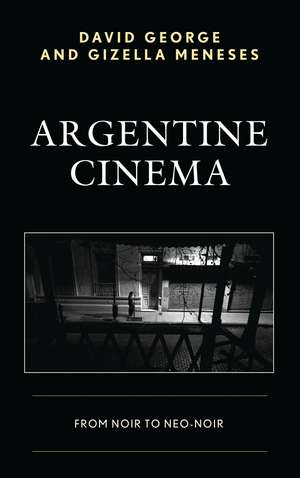
Argentine Cinema: From Noir to Neo-Noir
Autor David George, Gizella Menesesen Limba Engleză Paperback – 3 mar 2020
Preț: 254.72 lei
Preț vechi: 349.49 lei
-27%
Puncte Express: 382
Carte tipărită la comandă
Livrare economică 02-16 decembrie
Livrare prin curier în România Termenul estimat este afișat lângă disponibilitate.
Transport gratuit de la 400.00 lei Plată online sau ramburs, în funcție de opțiunile comenzii.
Retur gratuit în 14 zile Comandă securizată și suport în română.
Specificații
ISBN-13: 9781498511889
ISBN-10: 1498511880
Pagini: 192
Ilustrații: 16 b/w photos
Dimensiuni: 148 x 230 x 12 mm
Greutate: 0.26 kg
Editura: Bloomsbury Publishing
Colecția Lexington Books
Locul publicării:New York, United States
ISBN-10: 1498511880
Pagini: 192
Ilustrații: 16 b/w photos
Dimensiuni: 148 x 230 x 12 mm
Greutate: 0.26 kg
Editura: Bloomsbury Publishing
Colecția Lexington Books
Locul publicării:New York, United States
V-ar putea interesa
-
 Fifty Key British FilmsSarah Barrow-18%Preț: 919.50 lei1121.34 lei
 -
 Preț: 286.00 lei
 -
 Preț: 294.55 lei
 -
 Preț: 271.98 lei
 -
 Preț: 247.52 lei
 -
 -34%Preț: 552.85 lei835.85 lei
 -
 Movie Medievalism: The Imaginary Middle AgesNickolas HaydockPreț: 226.02 lei
 -
 An Introduction to World CinemaAristides GazetasPreț: 310.77 lei
 -
 Rungs on a Ladder: Hammer Films Seen Through a Soft GauzeChristopher Neame-34%Preț: 410.23 lei625.02 lei
 -
 Gillo Pontecorvo: From Resistance to TerrorismCarlo Celli-34%Preț: 409.05 lei624.24 lei
 -
 -33%Preț: 403.93 lei599.82 lei
 -
 Preț: 394.15 lei
 -
 The Challenge of the Able ChildDavid George-18%Preț: 1003.26 lei1223.49 lei
 -
 Preț: 470.92 lei
 -
 Superhero Synergies: Comic Book Characters Go DigitalJames N. Gilmore-33%Preț: 640.08 lei958.73 lei
 -
 Two Friends... Chase a Balloon.Furry EggPreț: 59.04 lei
 -
 -29%Preț: 343.67 lei482.99 lei
 -
 The Culture and Philosophy of Ridley ScottAdam Barkman-19%Preț: 367.22 lei452.25 lei
 -
 Alfie & EffieDavid GeorgePreț: 79.08 lei
Cuprins
Contents
Acknowledgments
Chapter 1: The Noir Phenomenon
Chapter 2: The Naked Angel (1946)
Chapter 3: Kiss of the Spider Woman (1984)
Chapter 4: The Aura (2005)
Chapter 5: The Signal (2007)
Chapter 6: The Secret in Their Eyes (2009)
Chapter 7: The German Doctor (2013)
Conclusion
Bibliography
Acknowledgments
Chapter 1: The Noir Phenomenon
Chapter 2: The Naked Angel (1946)
Chapter 3: Kiss of the Spider Woman (1984)
Chapter 4: The Aura (2005)
Chapter 5: The Signal (2007)
Chapter 6: The Secret in Their Eyes (2009)
Chapter 7: The German Doctor (2013)
Conclusion
Bibliography
Recenzii
Argentine Cinema: From Noir to Neo-Noir is an informative read that is both enlightening and interesting. As a reader you are well convinced by the book's conclusion that noir isn't a phenomenon unique to just Hollywood, but is an international phenomenon due to the authors' well presented argument.
Theorist-filmmaker Paul Schrader's influential claim that the film noir phenomenon is unique to Hollywood and reflects a specific period in US history-mid-1940s to late 1950s-provides the point of departure for this volume. Via close readings, George and Meneses (both, Lake Forest College) seek to prove that selected Argentine features are best considered full-fledged noirs or neo-noirs. Their aim, as they write in the conclusion, is to "demonstrate the cultural cross-fertilization in noir through intertextual perspectives, stylistic schema, and narrative and cinematic tropes." The authors generally succeed. Examining features covering a chronological ranging from 1946 (The Naked Angel) to 2013 (The German Doctor), George and Meneses offer detailed, perceptive readings of individual shots and sequences; they are particularly astute in their analyses of specific elements of craft, such as cinematography and production design. They also provide all-important sociohistorical contextualization to help readers better understand the themes of the films. The research is wide ranging and up-to-date, and influences and sources are indicated. The volume is clearly structured. . . This study is an important addition to understanding the international dimensions of film noir.
Summing Up: Recommended. Upper-division undergraduates through faculty.
This book provides a useful introduction to noir and neo-noir filmmaking in the Argentine context. It will be extremely valuable for college students seeking a concise and well-focused survey of the field. A real strength is its incisive analyses of individual shots and sequences, brought together with a strong sense of the enduring relevance and adaptability of noir themes and aesthetics. The clarity and coherence of this study would also make it very suitable for a general reader interested in noir film or Argentine cinema.
Argentine Cinema: From Noir to Neo-noir is the first serious exploration of Argentine film noir as it fits within the broader framework of international noir studies. An easily readable yet thorough analysis of key neo and retro noir films richly illustrated by classic examples, Argentine Cinema:From Noir to Neo-noir is a valuable resource for scholars, students, and fans of film noir and Argentine culture.
Theorist-filmmaker Paul Schrader's influential claim that the film noir phenomenon is unique to Hollywood and reflects a specific period in US history-mid-1940s to late 1950s-provides the point of departure for this volume. Via close readings, George and Meneses (both, Lake Forest College) seek to prove that selected Argentine features are best considered full-fledged noirs or neo-noirs. Their aim, as they write in the conclusion, is to "demonstrate the cultural cross-fertilization in noir through intertextual perspectives, stylistic schema, and narrative and cinematic tropes." The authors generally succeed. Examining features covering a chronological ranging from 1946 (The Naked Angel) to 2013 (The German Doctor), George and Meneses offer detailed, perceptive readings of individual shots and sequences; they are particularly astute in their analyses of specific elements of craft, such as cinematography and production design. They also provide all-important sociohistorical contextualization to help readers better understand the themes of the films. The research is wide ranging and up-to-date, and influences and sources are indicated. The volume is clearly structured. . . This study is an important addition to understanding the international dimensions of film noir.
Summing Up: Recommended. Upper-division undergraduates through faculty.
This book provides a useful introduction to noir and neo-noir filmmaking in the Argentine context. It will be extremely valuable for college students seeking a concise and well-focused survey of the field. A real strength is its incisive analyses of individual shots and sequences, brought together with a strong sense of the enduring relevance and adaptability of noir themes and aesthetics. The clarity and coherence of this study would also make it very suitable for a general reader interested in noir film or Argentine cinema.
Argentine Cinema: From Noir to Neo-noir is the first serious exploration of Argentine film noir as it fits within the broader framework of international noir studies. An easily readable yet thorough analysis of key neo and retro noir films richly illustrated by classic examples, Argentine Cinema:From Noir to Neo-noir is a valuable resource for scholars, students, and fans of film noir and Argentine culture.
Notă biografică
David George is professor emeritus of Spanish, Portuguese, and Latin American studies at Lake Forest College. Gizella Meneses is associate professor of Spanish at Lake Forest College.