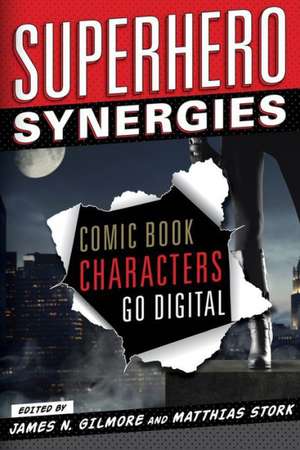
Superhero Synergies: Comic Book Characters Go Digital
Editat de James N. Gilmore, Matthias Storken Limba Engleză Hardback – 6 mar 2014
Superhero Synergies: Comic Book Characters Go Digital explores this developing relationship between superheroes and various forms of media, examining how the superhero genre, which was once limited primarily to a single medium, has been developed into so many more. Essays in this volume engage with several of the most iconic heroes-including Batman, Hulk, and Iron Man-through a variety of academic disciplines such as industry studies, gender studies, and aesthetic analysis to develop an expansive view of the genre's potency. The contributors to this volume engage cinema, comics, video games, and even live stage shows to instill readers with new ways of looking at, thinking about, and experiencing some of contemporary media's most popular texts.
This unique approach to the examination of digital media and superhero studies provides new and valuable readings of well-known texts and practices. Intended for both academics and fans of the superhero genre, this anthology introduces the innovative and growing synergy between traditional comic books and digital media.
Preț: 613.42 lei
Preț vechi: 929.37 lei
-34%
Puncte Express: 920
Carte tipărită la comandă
Livrare economică 08-22 iunie
Specificații
ISBN-13: 9781442232112
ISBN-10: 1442232110
Pagini: 252
Ilustrații: 17 b/w photos;
Dimensiuni: 160 x 232 x 22 mm
Greutate: 0.54 kg
Editura: Bloomsbury Publishing
Colecția Rowman & Littlefield
Locul publicării:New York, United States
ISBN-10: 1442232110
Pagini: 252
Ilustrații: 17 b/w photos;
Dimensiuni: 160 x 232 x 22 mm
Greutate: 0.54 kg
Editura: Bloomsbury Publishing
Colecția Rowman & Littlefield
Locul publicării:New York, United States
V-ar putea interesa
-
 Irish Dramatic MovementM. FitzgeraldPreț: 441.29 lei
 -
 Preț: 268.26 lei
 -
 Bunuel & Mexico – The Crisis of National CinemaErnesto R Acevedo–munoz-23%Preț: 538.36 lei699.17 lei
 -
 Preț: 261.26 lei
 -
 Preț: 216.69 lei
 -
 Film Stories: Volume 3Michael Roemer-25%Preț: 351.67 lei469.82 lei
 -
 Preț: 224.51 lei
 -
 Preț: 303.19 lei
 -
 Preț: 224.35 lei
 -
 Screening the TextKlinePreț: 254.79 lei
 -
 Rungs on a Ladder: Hammer Films Seen Through a Soft GauzeChristopher Neame-35%Preț: 391.01 lei605.80 lei
 -
 Historical Dictionary of Spanish CinemaDr Alberto Mira-22%Preț: 945.19 lei1206.37 lei
 -
 -33%Preț: 388.40 lei580.34 lei
 -
 What Is Neorealism?Bert Cardullo-19%Preț: 449.17 lei554.53 lei
 -
 Jean-Pierre Melville: An American in ParisGinette Vincendeau-27%Preț: 240.73 lei331.39 lei
 -
 My Favorite FilmsCyrus Ghani-9%Preț: 148.87 lei163.26 lei
 -
 -23%Preț: 183.43 lei239.77 lei
 -
 Practical DreamersMike HoolboomPreț: 183.36 lei
 -
 -31%Preț: 27.08 lei39.32 lei
 -
 -19%Preț: 500.22 lei617.56 lei
Cuprins
Foreword: The Industrial and Economic History of the Superhero Blockbuster, Drew Morton
Introduction: Heroes, Converge!, James N. Gilmore and Matthias Stork
Chapter 1: Will You Like Me When I'm Angry? Discourse of the Digital in Hulk and The Incredible Hulk, James N. Gilmore
Chapter 2: Secret Origins: Melodrama and the Digital in Hulk, Matt Yockey
Chapter 3: Fantastic Views: Superheroes, Visual Perception, and Digital Perspective, Lisa Gotto
Chapter 4: From Motion Line to Motion Blur: The Integration of Digital Coloring in the Superhero Comic Book. M.J. Clarke
Chapter 5: Assembling the Avengers: Re-Framing the Superhero Movie through Marvel's Cinematic Universe, Matthias Stork
Chapter 6: From Scientific Romance to Disney Superhero: Genre Fluidity and the Marketing of John Carter, Andrew Myers
Chapter 7: The Cult of Comic-Con and the Spectacle of Superhero Marketing, Kevin McDonald
Chapter 8: The Dark Knight Levels Up: Batman: Arkham Asylum and the Convergent Superhero Franchise, Justin Mack
Cha
Introduction: Heroes, Converge!, James N. Gilmore and Matthias Stork
Chapter 1: Will You Like Me When I'm Angry? Discourse of the Digital in Hulk and The Incredible Hulk, James N. Gilmore
Chapter 2: Secret Origins: Melodrama and the Digital in Hulk, Matt Yockey
Chapter 3: Fantastic Views: Superheroes, Visual Perception, and Digital Perspective, Lisa Gotto
Chapter 4: From Motion Line to Motion Blur: The Integration of Digital Coloring in the Superhero Comic Book. M.J. Clarke
Chapter 5: Assembling the Avengers: Re-Framing the Superhero Movie through Marvel's Cinematic Universe, Matthias Stork
Chapter 6: From Scientific Romance to Disney Superhero: Genre Fluidity and the Marketing of John Carter, Andrew Myers
Chapter 7: The Cult of Comic-Con and the Spectacle of Superhero Marketing, Kevin McDonald
Chapter 8: The Dark Knight Levels Up: Batman: Arkham Asylum and the Convergent Superhero Franchise, Justin Mack
Cha
Recenzii
Stork's clarity lays bare his extensive research, which digs not just into the financial logic of revised aesthetic approaches for maximal capital gains, but also film theorist Rick Altman's definition of 're-genrification,' which finally makes clear that Marvel's strategies are not new as much as reinterpreted-'a new presentational model of crossover synergy.' Stork's work here is a must-read for anyone who wants to understand precisely how corporate control yields pop-culture product. I'll be sending his essay to my inquisitive colleague shortly-along with the rest of Superhero Synergies.
Undisputably, Superhero Synergies is a strong and relevant contribution to patterns of digital media production. Offering a wide range of material and perspectives, it helps to elucidate the cultural productivity of present-day superhero(in)es, and points out blind spots of hero research through its focus on market imperatives, boundaries of the genre and affective immersion.... [T]his present volume is a viable contribution to studies of hero production and consumption, paving the way for future research into cultural practices of heroisation and the cultural processing of the heroic in the 'digital age'.
Fearlessly leapfrogging media from cinema and comics to gaming and theater, this fresh, smart collection follows the superhero's storied trajectory across formats, franchises, and fandoms, mapping our evolving entertainment universe through innovative, risk-taking scholarship. Whether or not you're into Batman or the Avengers, DC or Marvel, look no further for a shining exemplar of the emerging field of transmedia studies.
Agile and witty as Spider-Man, brilliantly persuasive as Batman, these essays offer a series of new perspectives on the figure of the superhero across media platforms. The contributors are expert in both traditional scholarship and comic-book canon: Eisenstein's theory of shot-collisions meets 'Hulk smash,' and Bazin's view of the cinema screen as a 'mask' illuminates the interior of Tony Stark's helmet. This is an inspiring assembly of exciting essays.
An insightful and provocative set of case studies, bound to unsettle the 'bad object' status that film studies and critics frequently reserve for the superhero genre, even as the book challenges the techno-centric ethos of new media theory to more convincingly account for the complexities of genre and inter-media content. Together, the original essays collected here provide a useful interdisciplinary roadmap and productive critical framework that should spur other scholars to more fully engage a wider range of complexities-involving gender, genre, aesthetics, identity, labor, and industrial practice-that define intermedial superhero genre production and consumption today.
Undisputably, Superhero Synergies is a strong and relevant contribution to patterns of digital media production. Offering a wide range of material and perspectives, it helps to elucidate the cultural productivity of present-day superhero(in)es, and points out blind spots of hero research through its focus on market imperatives, boundaries of the genre and affective immersion.... [T]his present volume is a viable contribution to studies of hero production and consumption, paving the way for future research into cultural practices of heroisation and the cultural processing of the heroic in the 'digital age'.
Fearlessly leapfrogging media from cinema and comics to gaming and theater, this fresh, smart collection follows the superhero's storied trajectory across formats, franchises, and fandoms, mapping our evolving entertainment universe through innovative, risk-taking scholarship. Whether or not you're into Batman or the Avengers, DC or Marvel, look no further for a shining exemplar of the emerging field of transmedia studies.
Agile and witty as Spider-Man, brilliantly persuasive as Batman, these essays offer a series of new perspectives on the figure of the superhero across media platforms. The contributors are expert in both traditional scholarship and comic-book canon: Eisenstein's theory of shot-collisions meets 'Hulk smash,' and Bazin's view of the cinema screen as a 'mask' illuminates the interior of Tony Stark's helmet. This is an inspiring assembly of exciting essays.
An insightful and provocative set of case studies, bound to unsettle the 'bad object' status that film studies and critics frequently reserve for the superhero genre, even as the book challenges the techno-centric ethos of new media theory to more convincingly account for the complexities of genre and inter-media content. Together, the original essays collected here provide a useful interdisciplinary roadmap and productive critical framework that should spur other scholars to more fully engage a wider range of complexities-involving gender, genre, aesthetics, identity, labor, and industrial practice-that define intermedial superhero genre production and consumption today.