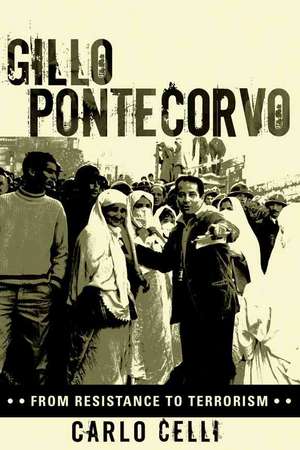
Gillo Pontecorvo: From Resistance to Terrorism
Autor Carlo Cellien Limba Engleză Paperback – 20 oct 2005
Preț: 409.05 lei
Preț vechi: 624.24 lei
-34%
Puncte Express: 614
Carte tipărită la comandă
Livrare economică 02-16 decembrie
Livrare prin curier în România Termenul estimat este afișat lângă disponibilitate.
Transport gratuit pentru acest produs Plată online sau ramburs, în funcție de opțiunile comenzii.
Retur gratuit în 14 zile Comandă securizată și suport în română.
Specificații
ISBN-13: 9780810854406
ISBN-10: 0810854406
Pagini: 139
Dimensiuni: 195 x 226 x 11 mm
Greutate: 0.27 kg
Editura: Bloomsbury Publishing
Colecția Scarecrow Press
Locul publicării:New York, United States
ISBN-10: 0810854406
Pagini: 139
Dimensiuni: 195 x 226 x 11 mm
Greutate: 0.27 kg
Editura: Bloomsbury Publishing
Colecția Scarecrow Press
Locul publicării:New York, United States
Cuprins
Part 1 Preface
Part 2 Acknowledgments
Part 3 Introduction
Chapter 4 1. Pontecorvo and Aldo Vergano's Il sole sorge ancora/Outcry (1946)
Chapter 5 2. The Neorealist Tradition and Pontecorvo's Early Documentaries, 1953-1956
Chapter 6 3. First Features: Giovanna (1956) and La grande strada azzurra/The Wide Blue Road (1957)
Chapter 7 4. Kapò (1960) and the Pitfalls of Holocaust Re-creation
Chapter 8 5. The Two Endings of La battaglia di Algeri/The Battle of Algiers (1966)
Chapter 9 6. The Colonial, Postcolonial Parable of Queimada!/Burn! (1969)
Chapter 10 7. The "Guilty Conscience" of Ogro (1979)
Chapter 11 8. Pontecorvo's Retreat: Ritorno ad Algeri/Return to Algiers (1992) and Nostalgia di protezione/Protection Nostalgia (1997)
Part 12 Filmography
Part 13 Bibliography
Part 14 Index
Part 15 About the Author
Part 2 Acknowledgments
Part 3 Introduction
Chapter 4 1. Pontecorvo and Aldo Vergano's Il sole sorge ancora/Outcry (1946)
Chapter 5 2. The Neorealist Tradition and Pontecorvo's Early Documentaries, 1953-1956
Chapter 6 3. First Features: Giovanna (1956) and La grande strada azzurra/The Wide Blue Road (1957)
Chapter 7 4. Kapò (1960) and the Pitfalls of Holocaust Re-creation
Chapter 8 5. The Two Endings of La battaglia di Algeri/The Battle of Algiers (1966)
Chapter 9 6. The Colonial, Postcolonial Parable of Queimada!/Burn! (1969)
Chapter 10 7. The "Guilty Conscience" of Ogro (1979)
Chapter 11 8. Pontecorvo's Retreat: Ritorno ad Algeri/Return to Algiers (1992) and Nostalgia di protezione/Protection Nostalgia (1997)
Part 12 Filmography
Part 13 Bibliography
Part 14 Index
Part 15 About the Author
Recenzii
...a detailed biography and filmography of Gillo Pontecorvo and his work....highly informative....
The name of Italian filmmaker Gillo Pontecorvo recently made the newspapers as it was revealed that his most famous work, 1966's The Battle of Algiers-depicting the doomed French colonial anti-insurgency campaign against the Algerian National Liberation Front, whose brutal but effective tactics would be denounced as "terrorism" by the French-was being afforded a special showing at the Pentagon, newly interested in the film's themes for the obvious reasons. In this work, Celli (Bowling Green State U.) surveys the entire career of the filmmaker, providing readings of Pontecorvo's early and late documentaries, as well as fictional major works such as The Battle of Algiers, Kapó, Burn!, and Ogro. While traditional concerns of film studies occasionally make their appearance in his treatment, Celli's main concern, as it was with Pontecorvo, are political themes, especially Pontecorvo's unresolved themes of justification of violence and terrorism for reasons of national liberation.
The name of Italian filmmaker Gillo Pontecorvo recently made the newspapers as it was revealed that his most famous work, 1966's The Battle of Algiers-depicting the doomed French colonial anti-insurgency campaign against the Algerian National Liberation Front, whose brutal but effective tactics would be denounced as "terrorism" by the French-was being afforded a special showing at the Pentagon, newly interested in the film's themes for the obvious reasons. In this work, Celli (Bowling Green State U.) surveys the entire career of the filmmaker, providing readings of Pontecorvo's early and late documentaries, as well as fictional major works such as The Battle of Algiers, Kapó, Burn!, and Ogro. While traditional concerns of film studies occasionally make their appearance in his treatment, Celli's main concern, as it was with Pontecorvo, are political themes, especially Pontecorvo's unresolved themes of justification of violence and terrorism for reasons of national liberation.