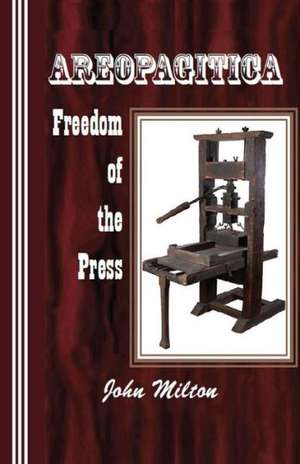
Areopagitica: Freedom of the Press: Little Humanist Classics, cartea 5
Autor John Milton Editat de A. S. Ashen Limba Engleză Paperback – 31 iul 2011
Milton, a child prodigy, aimed to be the best Latin poet in Europe. He made many friends on a trip to Italy, but he was warned by Galileo himself, then under house arrest, not to let censorship happen in England as it had in Italy. This may have led Milton, on his return, to turn his pamphleteering skills from the Divorce question to the issue then before the Long Parliament - government licensing of all printed materials. Shortly after Areopagitica was published, Oliver Cromwell appointed Milton his Latin secretary. Teachers- a Supplement Edition: Areopagitica filled with background information is available in print format at http: //www.createspace.com/3674947. This provides the same text, with the same page numbering, as the student edition, with a wealth of information organized around typical student questions, plus a glossary. Here are the questions:
Preface for Teachers
Why is Areopagitica important?
Who was John Milton?
Who was in Milton's family?
What was his childhood like?
What happened during Milton's college career?
How did Milton prepare himself after college?
What happened on Milton's trip to Italy?
Did Milton change on returning to England?
Did Milton marry?
What was he writing at this time?
Why did Milton use this title?
Why did he write Areopagitica?
What was the public reaction to Areopagitica?
What did the early critics say about Milton?
Why was England in a turmoil in the 1640s?
What did King Charles expect to achieve?
What was the Long Parliament?
How did Cromwell rise to prominence?
How had the press been restricted?
What points does Milton make?
Who states the other side of the argument?
What is special about printing?
How many people could read?
Is freedom of the press the same as freedom of speech?
Is freedom of the press a dead issue?
What books were in Milton's library?
Is Milton's style important?
What do modern critics say?
Was Milton borne out by history?
What was the printing history of Areopagitica?
What happened in Milton's later life?
Bibiography
Notes to the text
Glossary

Preț: 42.77 lei
Puncte Express: 64
Carte disponibilă
Livrare economică 11-25 noiembrie
Livrare prin curier în România Termenul estimat este afișat lângă disponibilitate.
Transport gratuit de la 400.00 lei Plată online sau ramburs, în funcție de opțiunile comenzii.
Retur gratuit în 14 zile Comandă securizată și suport în română.
Specificații
ISBN-13: 9780942208047
ISBN-10: 0942208048
Pagini: 44
Dimensiuni: 142 x 215 x 4 mm
Greutate: 0.07 kg
Editura: Humanist Classics
Seria Little Humanist Classics
ISBN-10: 0942208048
Pagini: 44
Dimensiuni: 142 x 215 x 4 mm
Greutate: 0.07 kg
Editura: Humanist Classics
Seria Little Humanist Classics
V-ar putea interesa
-
 You Can't Read This BookNick CohenPreț: 78.30 lei
-
 Free Speech after 9/11Katharine Gelber-31%Preț: 676.33 lei982.99 lei
-
 Speech and Harm: Controversies Over Free SpeechIshani Maitra-16%Preț: 172.84 lei206.46 lei
-
 Changing Media, Changing ChinaSusan L. Shirk-16%Preț: 193.96 lei231.77 lei
-
 Who′s Afraid of Academic Freedom?Akeel Bilgrami-27%Preț: 850.90 lei1165.62 lei
-
 The Fourth EnemyJames CanePreț: 316.24 lei
-
 Preț: 461.15 lei
-
 Secret Science and the Secret Space ProgramHerbert G Dorsey IIIPreț: 124.41 lei
-
 Dissent, Injustice, and the Meanings of AmericaSteven H. ShiffrinPreț: 463.92 lei
-
 Presidential Secrecy and the LawRobert M. PallittoPreț: 405.98 lei
-
 Transparency in Global ChangeBurkart HolznerPreț: 461.93 lei
-
 Protecting Intellectual Freedom in Your Public LibraryAmerican Library AssociationPreț: 369.25 lei
-
 ComusJohn MiltonPreț: 220.12 lei
-
 Preț: 322.41 lei
-
 The Tenure of Kings and MagistratesJohn MiltonPreț: 64.44 lei
-
 Le Paradis PerduJohn MiltonPreț: 96.93 lei
-
 Forbidden FruitSarah McnicolPreț: 166.44 lei
-
 Paradise Lost & Paradise RegainedJohn MiltonPreț: 136.40 lei
-
 A Right to OffendBrian Winston-14%Preț: 292.73 lei342.06 lei
-
 A Right to OffendBrian Winston-24%Preț: 903.98 lei1193.26 lei
-
 SJWs Always LieVox DayPreț: 132.62 lei
Notă biografică
John Milton (9 December 1608 - 8 November 1674) was an English poet and intellectual, who served as a civil servant for the Commonwealth of England under its Council of State and later under Oliver Cromwell. He wrote at a time of religious flux and political upheaval, and is best known for his epic poem Paradise Lost (1667). Writing in English, Latin, Greek, and Italian, he achieved international renown within his lifetime, and his celebrated Areopagitica (1644), written in condemnation of pre-publication censorship, is among history's most influential and impassioned defences of freedom of speech and freedom of the press. His desire for freedom extended into his style: he introduced new words (coined from Latin) to the English language, and was the first modern writer to employ non-rhymed verse outside of the theatre or translations. William Hayley's 1796 biography called him the greatest English author, and he remains generally regarded as one of the preeminent writers in the English language, though critical reception has oscillated in the centuries since his death (often on account of his republicanism). Samuel Johnson praised Paradise Lost as "a poem which...with respect to design may claim the first place, and with respect to performance, the second, among the productions of the human mind," though he (a Tory and recipient of royal patronage) described Milton's politics as those of an "acrimonious and surly republican." Poets such as William Blake, William Wordsworth and Thomas Hardy revered him.