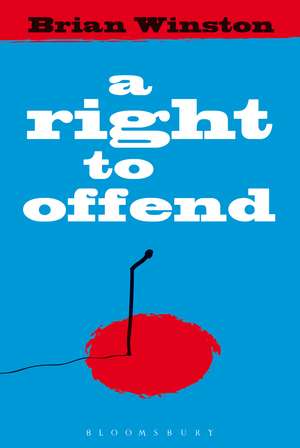
A Right to Offend
Autor Brian Winstonen Limba Engleză Paperback – 13 sep 2012
In this new book, Winston provides an account of the current state of freedom of expression in the western world. He analyses all the most pertinent cases of conflict during the last two decades - including the fatwa against Salman Rushdie, the incident of the Danish cartoons and offended celebrities - examining cultural, legal and journalistic aspects of each case.
A Right to Offend offers us a deeper understanding of the increasingly threatening environment in which free speech operates and is defended, as well as how it informs and is central to journalism practice and media freedom more generally. It is important reading for all those interested in freedom of expression in the twenty-first century.
Preț: 292.73 lei
Preț vechi: 342.06 lei
-14%
Puncte Express: 439
Carte tipărită la comandă
Livrare economică 03-17 decembrie
Livrare prin curier în România Termenul estimat este afișat lângă disponibilitate.
Transport gratuit de la 400.00 lei Plată online sau ramburs, în funcție de opțiunile comenzii.
Retur gratuit în 14 zile Comandă securizată și suport în română.
Specificații
ISBN-13: 9781849660037
ISBN-10: 1849660034
Pagini: 432
Ilustrații: None
Dimensiuni: 156 x 234 x 33 mm
Greutate: 0.7 kg
Editura: Bloomsbury Publishing
Colecția Bloomsbury Academic
Locul publicării:London, United Kingdom
ISBN-10: 1849660034
Pagini: 432
Ilustrații: None
Dimensiuni: 156 x 234 x 33 mm
Greutate: 0.7 kg
Editura: Bloomsbury Publishing
Colecția Bloomsbury Academic
Locul publicării:London, United Kingdom
V-ar putea interesa
-
 You Can't Read This BookNick CohenPreț: 78.30 lei
 -
 How to Defeat the Far RightNICK LOWLESPreț: 167.32 lei
 -
 Joseph AntonSalman Rushdie-16%Preț: 80.50 lei96.16 lei
 -
 Free Speech: A Very Short IntroductionNigel Warburton-21%Preț: 54.82 lei69.38 lei
 -
 Journalism: A Very Short IntroductionIan Hargreaves-19%Preț: 57.65 lei71.42 lei
 -
 That Book Is Dangerous!Adam SzetelaPreț: 198.52 lei
 -
 The Collapse of Freedom of ExpressionJordi PujolPreț: 308.36 lei
 -
 Preț: 95.03 lei
 -
 Summer of Our Discontent: The Age of Certainty and the Demise of DiscourseThomas Chatterton Williams-32%Preț: 130.88 lei191.08 lei
 -
 The Life and Death of Freedom of ExpressionRichard MoonPreț: 288.69 lei
 -
 Offended Freedom - The Rise of Libertarian AuthoritarianismCarolin AmlingerPreț: 169.54 lei
 -
 Preț: 79.42 lei
 -
 Is Free Speech Under Threat?Charlotte Lydia RileyPreț: 78.13 lei
 -
 -20%Preț: 105.37 lei132.40 lei
 -
 MiddlelandRory StewartPreț: 159.93 lei
 -
 The New CensorshipAyala PanievskyPreț: 141.53 lei
 -
 Is Free Speech Under Threat?Charlotte Lydia RileyPreț: 121.87 lei
 -
 Free SpeechTimothy Garton (Author) AshPreț: 122.26 lei
 -
 -43%Preț: 67.91 lei119.66 lei
 -
 Free Speech and Neoliberalism: Art, Culture, EducationDr. Asbjørn Skarsvåg Grønstad-32%Preț: 596.75 lei879.04 lei
Cuprins
Introduction: The Argument
Part One: The Challenge
Foreword: A Lesson to the Circumspect A Story to Pass the Waking Hours of the Night A More Remarkable StoryGive Me More of these Examples
Afterword: Perceive the Dawn of the Day
Part Two: The Brief (1)Foreword: Actus Reus Supresso VeriActionesConsensuAfterword: Ceteris Paribus
Part Three: The Brief (2)
Foreword: Non SequiturCustos MorumEx ConcessisConsensus ad IdemSugestio FalsiAfterword: Contra Ius Commune
Part Four: The Defence Foreword: Accedas ad CuriamMens ReaObita DictaStare DecisisAfterword: Post Mortem
Part One: The Challenge
Foreword: A Lesson to the Circumspect A Story to Pass the Waking Hours of the Night A More Remarkable StoryGive Me More of these Examples
Afterword: Perceive the Dawn of the Day
Part Two: The Brief (1)Foreword: Actus Reus Supresso VeriActionesConsensuAfterword: Ceteris Paribus
Part Three: The Brief (2)
Foreword: Non SequiturCustos MorumEx ConcessisConsensus ad IdemSugestio FalsiAfterword: Contra Ius Commune
Part Four: The Defence Foreword: Accedas ad CuriamMens ReaObita DictaStare DecisisAfterword: Post Mortem
Recenzii
Every generation needs to be reminded, in George Orwell's words, that "Freedom is the right to tell people what they do not want to hear". This message is even more important in our globalized and networked world, in which nearly everyone, it seems, can speak and be heard. As usual, Brian Winston is an ideal guide to the past as well as the present and even the future challenges faced by those who are devoted to preserving this most basic human right.
Brian Winston's A Right to Offend provides two important contributions to this fraught and often under-researched debate. He brings a welcome international scope of his inquiry, guiding the reader through the differing legal systems of, say, France and the U.S. But it is his frequent recourse to history that is most instructive...A highly readable and informative compendium on freedom of expression.
The book is no slim polemic, either, but a meticulously researched 400-page demolition of arguments for the closing down of speech, not only in the press, but also online and, thankfully, in wider society, too. Winston does a sterling job of placing Hackgate and Leveson in a sound historical and philosophical context that includes John Milton, Salman Rushdie, the internet and everything in between.
Winston's views here are more than mere academic ruminations
This encyclopedic account of 'the long, and often bloody, history of the struggle' for free speech aims to dispel 'the shadow of the fatwa' that spread from Salman Rushdie, and all those involved in the publication of The Satanic Verses, until it covered every writer and academic.
Brian Winston's A Right to Offend provides two important contributions to this fraught and often under-researched debate. He brings a welcome international scope of his inquiry, guiding the reader through the differing legal systems of, say, France and the U.S. But it is his frequent recourse to history that is most instructive...A highly readable and informative compendium on freedom of expression.
The book is no slim polemic, either, but a meticulously researched 400-page demolition of arguments for the closing down of speech, not only in the press, but also online and, thankfully, in wider society, too. Winston does a sterling job of placing Hackgate and Leveson in a sound historical and philosophical context that includes John Milton, Salman Rushdie, the internet and everything in between.
Winston's views here are more than mere academic ruminations
This encyclopedic account of 'the long, and often bloody, history of the struggle' for free speech aims to dispel 'the shadow of the fatwa' that spread from Salman Rushdie, and all those involved in the publication of The Satanic Verses, until it covered every writer and academic.