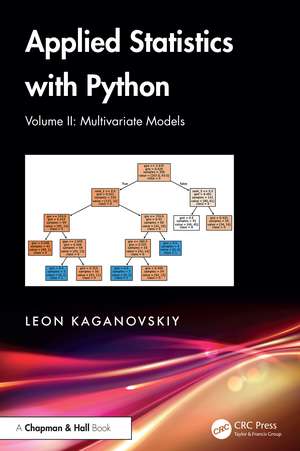
Applied Statistics with Python: Volume II: Multivariate Models
Autor Leon Kaganovskiyen Limba Engleză Hardback – 28 dec 2025
As in Volume I, the Python programming language is used throughout due to its flexibility and widespread adoption in data science and machine learning. The book relies heavily on tools from the standard sklearn package, which are integrated directly into the discussion. Unlike many other resources, Python is not treated as an add-on, but as an organic part of the learning process.
This book is based on the author’s 15 years of experience teaching statistics and is designed for undergraduate and first-year graduate students in fields such as business, economics, biology, social sciences, and natural sciences. However, more advanced students and professionals might also find it valuable. While some familiarity with basic statistics is helpful, it is not required - core concepts are introduced and explained along the way, making the material accessible to a wide range of learners.
Key Features:
- Employs Python as an organic part of the learning process.
- Removes the tedium of hand/calculator computations.
- Weaves code into the text at every step in a clear and accessible way.
- Covers advanced machine-learning topics.
- Uses tools from Standardized sklearn Python package.
Preț: 808.70 lei
Preț vechi: 888.69 lei
-9%
Puncte Express: 1213
Carte disponibilă
Livrare economică 16-30 octombrie
Livrare express 01-07 octombrie pentru 40.83 lei
Livrare prin curier în România Termenul estimat este afișat lângă disponibilitate.
Transport gratuit pentru acest produs Plată online sau ramburs, în funcție de opțiunile comenzii.
Retur gratuit în 14 zile Comandă securizată și suport în română.
Specificații
ISBN-13: 9781041006251
ISBN-10: 104100625X
Pagini: 310
Ilustrații: 350
Dimensiuni: 156 x 234 mm
Greutate: 0.66 kg
Ediția:1
Editura: CRC Press
Colecția Chapman and Hall/CRC
ISBN-10: 104100625X
Pagini: 310
Ilustrații: 350
Dimensiuni: 156 x 234 mm
Greutate: 0.66 kg
Ediția:1
Editura: CRC Press
Colecția Chapman and Hall/CRC
V-ar putea interesa
-
 Preț: 211.28 lei
 -
 Just Enough Data Science and Machine LearningMark LevenePreț: 340.78 lei
 -
 The Elements of Statistical LearningJerome Friedman-20%Preț: 539.05 lei673.81 lei
 -
 Preț: 403.96 lei
 -
 Applied Statistics for the Social and Health SciencesRachel A. GordonPreț: 438.07 lei
 -
 An Introduction to Applied Statistics: With Step-By-Step SPSS InstructionsJr. Edward T. Vieira-9%Preț: 658.02 lei723.10 lei
 -
 R-ticulateMartin Bader-23%Preț: 643.92 lei836.26 lei
 -
 -4%Preț: 383.51 lei399.49 lei
 -
 Statistical Analysis with R For DummiesJoseph Schmuller-20%Preț: 140.79 lei175.99 lei
 -
 Statistical Analysis with Python For DummiesJoseph SchmullerPreț: 193.97 lei
 -
 -26%Preț: 652.72 lei882.06 lei
 -
 The Book of RTilman M. Davies-36%Preț: 299.90 lei466.11 lei
 -
 PythonMartin Czygan-23%Preț: 644.95 lei837.61 lei
 -
 Python for Probability, Statistics, and Machine LearningJosé UnpingcoPreț: 505.29 lei
 -
 An Introduction to Statistical LearningGareth James-15%Preț: 522.30 lei614.47 lei
 -
 Preț: 433.14 lei
 -
 Materials Data ScienceStefan Sandfeld-15%Preț: 591.20 lei695.53 lei
 -
 Statistics for ScientistsUmberto Michelucci-20%Preț: 275.88 lei344.84 lei
 -
 Multivariate Analysis and Machine Learning TechniquesSrikrishnan Sundararajan-20%Preț: 534.82 lei668.53 lei
Public țintă
Undergraduate Advanced and Undergraduate CoreCuprins
Preface 1 Analysis of Variance (ANOVA) 2 Multivariate Data Models 3 Nonlinear Models 4 Tree-Based Methods 5 Unsupervised Models (Principal Values and Clusters) Bibliography Index
Notă biografică
Leon Kaganovskiy is an Associate Professor at the Mathematics Department of Touro College. He received a M.S. in Theoretical Physics from Kharkov State University, and M.S. and PhD in Applied Mathematics from the University of Michigan. His most recent interest is in a broad field of Applied Statistics, and he has developed new courses in Bio-Statistics with R, Statistics for Actuaries with R, and Business Analytics with R. He teaches Statistics research courses at the Graduate Program in Speech-Language Pathology at Touro College.
Descriere
This book focuses on ANOVA, multivariate models such as multiple regression, model selection, and reduction techniques, regularization methods like lasso and ridge, logistic regression, K-nearest neighbors (KNN), support vector classifiers, nonlinear models, tree-based methods,clustering, and principal component analysis.
Recenzii
"In conclusion, Applied Statistics with Python: Volume I represents a timely and well-executed contribution to the modernization
of statistics education. Its computation-first approach, integration of Python throughout the narrative, and focus on interpretation and model-based reasoning provide students with a solid foundation in both statistical thinking and computational literacy. While the book is not intended as a comprehensive theoretical reference, it fills a crucial niche for applied programs seeking to introduce statistics in a practical, codeoriented context. By blending readable style, intuitive guidance, and contextualized examples, the text empowers students to engage confidently with data and prepares them for advanced study or professional work in data-driven fields."
- Maria Iannario in The American Statistician, March 2026
"Overall, the author has done an excellent job presenting foundational statistical concepts for students in an introductory college-level course. The consistent use of Python is a notable strength, and the intuitive, concept-driven approach makes the material accessible to students who are not mathematics or statistics majors but are comfortable with programming. [...] In summary, this is a strong textbook for an introductory statistics course, particularly for the right audience."
- Pradipta Sarkar in Technometrics, April 2026
of statistics education. Its computation-first approach, integration of Python throughout the narrative, and focus on interpretation and model-based reasoning provide students with a solid foundation in both statistical thinking and computational literacy. While the book is not intended as a comprehensive theoretical reference, it fills a crucial niche for applied programs seeking to introduce statistics in a practical, codeoriented context. By blending readable style, intuitive guidance, and contextualized examples, the text empowers students to engage confidently with data and prepares them for advanced study or professional work in data-driven fields."
- Maria Iannario in The American Statistician, March 2026
"Overall, the author has done an excellent job presenting foundational statistical concepts for students in an introductory college-level course. The consistent use of Python is a notable strength, and the intuitive, concept-driven approach makes the material accessible to students who are not mathematics or statistics majors but are comfortable with programming. [...] In summary, this is a strong textbook for an introductory statistics course, particularly for the right audience."
- Pradipta Sarkar in Technometrics, April 2026