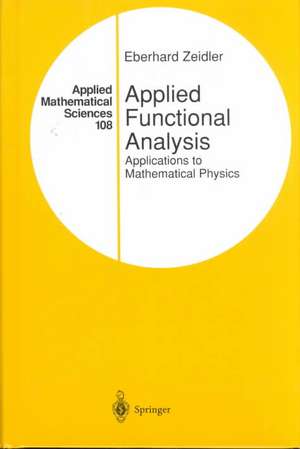
Applied Functional Analysis: Applied Mathematical Sciences, cartea 108
Autor Eberhard Zeidleren Limba Engleză Hardback – 23 iun 1995
Recomandăm Applied Functional Analysis studenților și cercetătorilor din științele exacte care caută o înțelegere pragmatică a modului în care analiza funcțională rezolvă probleme reale. Eberhard Zeidler propune o abordare didactică ce prioritizează întrebarea „Care sunt cele mai importante aplicații?”, evitând digresiunile teoretice care nu servesc direct rezolvării unor probleme concrete din istoria matematicii sau fizicii. Remarcăm modul în care autorul reușește să prezinte concepte riguroase, precum spațiile Banach și operatorii liniari, ca instrumente esențiale, nu doar ca abstracțiuni matematice. Structura volumului reflectă această filozofie: primele capitole introduc rapid noțiunile de normă, convergență și spații metrice, trecând imediat la Teorema de punct fix a lui Banach și iterația utilizată în ecuații integrale. Progresia este logică și orientată spre rezultat, incluzând teoremele de punct fix Brouwer și Schauder, precum și principiul Leray-Schauder pentru estimări a priori. Această ediție extinde cadrul propus de Applications of Functional Analysis and Operator Theory de V. Hutson, oferind o selecție de material calibrată special pentru nevoile fizicii matematice moderne. În contextul operei sale, acest volum se aliniază cu viziunea din Quantum Field Theory I: Basics in Mathematics and Physics, unde Zeidler subliniază că marii matematicieni au combinat întotdeauna teoria cu practica. Față de lucrările sale enciclopedice, precum Oxford Users' Guide to Mathematics, volumul de față este un curs aplicat, o „cale principală” ce oferă soluții elegante pentru fenomenele lumii fizice, fără a sacrifica rigoarea necesară nivelului de cercetare.
Din seria Applied Mathematical Sciences
-
 Preț: 554.93 lei
 -
 Preț: 550.88 lei
 -
 Preț: 560.75 lei
 - 18%
 Preț: 824.50 lei
 - 18%
 Preț: 1178.63 lei
 -
 Preț: 419.28 lei
 - 56%
 Preț: 495.89 lei
 - 24%
 Preț: 775.61 lei
 - 18%
 Preț: 904.98 lei
 - 18%
 Preț: 2186.79 lei
 - 24%
 Preț: 1034.80 lei
 - 15%
 Preț: 600.85 lei
 -
 Preț: 191.86 lei
 -
 Preț: 394.46 lei
 - 18%
 Preț: 1002.14 lei
 - 15%
 Preț: 666.97 lei
 - 15%
 Preț: 543.81 lei
 -
 Preț: 398.57 lei
 - 18%
 Preț: 758.64 lei
 - 18%
 Preț: 1054.89 lei
 -
 Preț: 387.82 lei
 - 18%
 Preț: 1426.76 lei
 - 18%
 Preț: 1166.94 lei
 - 18%
 Preț: 1183.90 lei
 - 15%
 Preț: 677.91 lei
 -
 Preț: 398.68 lei
 - 15%
 Preț: 670.35 lei
 - 15%
 Preț: 662.95 lei
 -
 Preț: 372.15 lei
 - 18%
 Preț: 824.93 lei
 - 24%
 Preț: 857.73 lei
Preț: 819.08 lei
Preț vechi: 998.88 lei
-18%
Carte tipărită la comandă
Livrare economică 07-21 decembrie
Specificații
ISBN-10: 0387944427
Pagini: 516
Ilustrații: XXIX, 481 p.
Dimensiuni: 160 x 241 x 34 mm
Greutate: 0.82 kg
Ediția:1995
Editura: Springer
Colecția Applied Mathematical Sciences
Seria Applied Mathematical Sciences
Locul publicării:New York, NY, United States
V-ar putea interesa
-
 Principles of Mathematical Analysis (Int'l Ed)Walter Rudin-27%Preț: 375.61 lei516.26 lei
 -
 Quasiconformal Maps and Teichmüller TheoryAlastair Fletcher-30%Preț: 817.83 lei1170.42 lei
 -
 Oxford Users' Guide to MathematicsEberhard Zeidler-28%Preț: 507.17 lei700.87 lei
 -
 An Introduction to Infinite-Dimensional Linear Systems TheoryRuth F. Curtain-15%Preț: 683.78 lei804.45 lei
 -
 Matrix AnalysisRajendra Bhatia-15%Preț: 495.63 lei583.09 lei
 -
 A Course in Functional AnalysisJohn B. Conway-15%Preț: 498.70 lei586.70 lei
 -
 An Introduction to Banach Space TheoryRobert E. Megginson-15%Preț: 687.58 lei808.91 lei
 -
 Lectures on the HyperrealsRobert Goldblatt-15%Preț: 661.87 lei778.67 lei
 -
 Problems and Solutions for Complex AnalysisRami Shakarchi-15%Preț: 471.95 lei555.23 lei
 -
 Real AnalysisN. L. Carothers-19%Preț: 460.04 lei567.95 lei
 -
 First Course Mathematical AnalysisDavid Alexander Brannan-19%Preț: 517.37 lei638.73 lei
 -
 CalculusKen Binmore-19%Preț: 520.86 lei643.03 lei
 -
 The Mathematica GuideBook for ProgrammingMichael TrottPreț: 555.02 lei
 -
 More Calculus of a Single VariablePeter R. MercerPreț: 174.85 lei
 -
 An Introduction to Teichmüller SpacesYoichi Imayoshi-15%Preț: 638.90 lei751.66 lei
Public țintă
ResearchDe ce să citești această carte
Această carte se adresează studenților și practicienilor care au nevoie de instrumentele analizei funcționale pentru a soluționa ecuații diferențiale și integrale în fizică și inginerie. Cititorul câștigă o perspectivă aplicată asupra spațiilor Banach și a teoremelor de punct fix, învățând să utilizeze teoria ca un suport direct pentru modelarea matematică, nu doar ca un exercițiu intelectual abstract.
Despre autor
Eberhard Zeidler este un matematician de renume mondial, recunoscut pentru contribuțiile sale vaste în analiza neliniară și fizica matematică. Lucrările sale, printre care se numără tratate de referință despre teoria cuantică a câmpului și ghiduri matematice fundamentale precum Oxford Users' Guide to Mathematics, demonstrează o capacitate rară de a sintetiza ramuri diverse ale matematicii. De-a lungul carierei, Zeidler a promovat ideea că intuiția și conceptele teoretice trebuie să colaboreze pentru a înțelege legile naturii, viziune ce fundamentează întreaga sa activitate editorială la editura Springer.