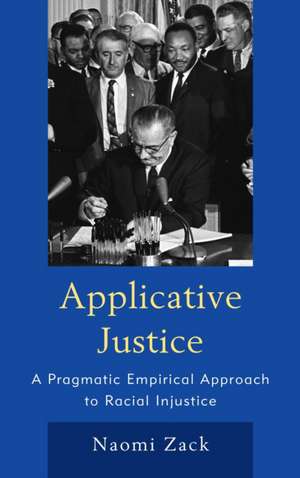
Applicative Justice: A Pragmatic Empirical Approach to Racial Injustice: Rowman & Littlefield Publishers
Autor Naomi Zacken Limba Engleză Hardback – 2 mar 2016
Din seria Rowman & Littlefield Publishers
-
 Preț: 113.89 lei
 - 13%
 Preț: 155.38 lei
 -
 Preț: 109.93 lei
 - 20%
 Preț: 370.93 lei
 - 19%
 Preț: 323.76 lei
 - 26%
 Preț: 223.03 lei
 - 19%
 Preț: 321.01 lei
 - 21%
 Preț: 307.35 lei
 - 20%
 Preț: 190.98 lei
 - 24%
 Preț: 255.02 lei
 - 16%
 Preț: 109.26 lei
 - 31%
 Preț: 351.69 lei
 - 15%
 Preț: 127.13 lei
 - 22%
 Preț: 328.37 lei
 - 19%
 Preț: 324.21 lei
 - 30%
 Preț: 355.24 lei
 - 23%
 Preț: 258.39 lei
 -
 Preț: 402.96 lei
 - 23%
 Preț: 275.97 lei
 - 24%
 Preț: 275.28 lei
 - 31%
 Preț: 351.50 lei
 - 22%
 Preț: 323.28 lei
 - 32%
 Preț: 373.39 lei
 - 34%
 Preț: 842.33 lei
 - 19%
 Preț: 314.30 lei
 - 23%
 Preț: 354.68 lei
 - 21%
 Preț: 128.84 lei
 - 30%
 Preț: 774.75 lei
 - 23%
 Preț: 278.65 lei
 - 23%
 Preț: 259.97 lei
 - 19%
 Preț: 344.02 lei
 - 32%
 Preț: 594.45 lei
 - 31%
 Preț: 566.85 lei
 - 22%
 Preț: 358.54 lei
 - 19%
 Preț: 322.03 lei
 - 16%
 Preț: 148.06 lei
 - 22%
 Preț: 360.79 lei
 - 19%
 Preț: 323.37 lei
 - 31%
 Preț: 414.61 lei
 - 25%
 Preț: 344.18 lei
 - 30%
 Preț: 703.64 lei
 - 14%
 Preț: 152.49 lei
 - 30%
 Preț: 827.47 lei
 - 19%
 Preț: 316.66 lei
 - 23%
 Preț: 276.77 lei
 - 29%
 Preț: 709.89 lei
 - 23%
 Preț: 262.16 lei
 - 19%
 Preț: 335.82 lei
Preț: 585.00 lei
Preț vechi: 865.03 lei
-32%
Puncte Express: 878
Carte tipărită la comandă
Livrare economică 27 noiembrie-11 decembrie
Livrare prin curier în România Termenul estimat este afișat lângă disponibilitate.
Transport gratuit pentru acest produs Plată online sau ramburs, în funcție de opțiunile comenzii.
Retur gratuit în 14 zile Comandă securizată și suport în română.
Specificații
ISBN-13: 9781442260009
ISBN-10: 1442260009
Pagini: 250
Dimensiuni: 158 x 239 x 24 mm
Greutate: 0.61 kg
Editura: Bloomsbury Publishing
Colecția Rowman & Littlefield
Seria Rowman & Littlefield Publishers
Locul publicării:New York, United States
ISBN-10: 1442260009
Pagini: 250
Dimensiuni: 158 x 239 x 24 mm
Greutate: 0.61 kg
Editura: Bloomsbury Publishing
Colecția Rowman & Littlefield
Seria Rowman & Littlefield Publishers
Locul publicării:New York, United States
V-ar putea interesa
-
 An AnthologySimone WeilPreț: 93.37 lei
 -
 Kierkegaard: A Very Short IntroductionPatrick Gardiner-20%Preț: 57.15 lei71.12 lei
 -
 Russell: A Very Short IntroductionA. C. Grayling-19%Preț: 57.55 lei71.35 lei
 -
 Schopenhauer: A Very Short IntroductionChristopher Janaway-20%Preț: 57.15 lei71.12 lei
 -
 Needs, Values, Truth: Essays in the Philosophy of ValueDavid Wiggins-28%Preț: 377.10 lei520.65 lei
 -
 Truth, Language, and History: Philosophical Essays Volume 5Donald Davidson-11%Preț: 352.91 lei397.76 lei
 -
 Stanley Cavell: Philosophy's Recounting of the OrdinaryStephen Mulhall-28%Preț: 426.18 lei594.52 lei
 -
 The Ontology of Mind: Events, Processes, and StatesHelen Steward-28%Preț: 410.98 lei574.72 lei
 -
 -28%Preț: 450.86 lei625.25 lei
 -
 -29%Preț: 477.51 lei668.03 lei
 -
 Rules, Reasons, and NormsPhilip Pettit-19%Preț: 379.30 lei466.53 lei
 -
 The Essential DavidsonDonald Davidson-12%Preț: 311.32 lei353.61 lei
 -
 An Introduction to Philosophical AnalysisJohn HospersPreț: 381.63 lei
 -
 Preț: 343.86 lei
 -
 Preț: 266.67 lei
 -
 Cities of WordsStanley CavellPreț: 239.39 lei
 -
 Philosophy the Day after TomorrowStanley CavellPreț: 235.33 lei
 -
 The Essential KierkegaardSøren KierkegaardPreț: 244.80 lei
 -
 Star Wars and PhilosophyKevin S DeckerPreț: 113.70 lei
Cuprins
Preface
Introduction: Key Ideas and Chapter Scopes
1. Ideal Theory, Nonideal Theory, and Empirical Political Theory
2. Limits of Law and Government
3. Ideal Equality and Real Inequality
4. The Distribution of Procedural Justice
5. Discourse, Prophecy, and Atmosphere
6. The Discourse of Political Activism
7. Postscript: An Invitation to the Reader
Notes
Select Bibliography
Index
About the Author
Introduction: Key Ideas and Chapter Scopes
1. Ideal Theory, Nonideal Theory, and Empirical Political Theory
2. Limits of Law and Government
3. Ideal Equality and Real Inequality
4. The Distribution of Procedural Justice
5. Discourse, Prophecy, and Atmosphere
6. The Discourse of Political Activism
7. Postscript: An Invitation to the Reader
Notes
Select Bibliography
Index
About the Author
Recenzii
Zack draws on empirical pragmatism to define applicative justice, because 'Rawlsian ideal theorizing has nothing to offer for correcting real life injustice.' The approach is based on Arthur Bentley's claims in The Process of Government (1908) that just law can coexist with unjust practices, and that institutions and rules are nothing more than the actual realizations associated with them. A central example is the United Nations' Declaration of Human Rights promotion of a 'general equality principle,' which has not been a serious interest to world leaders. Applicative justice is the 'extension of received functions of ordinary justice under ordinary law, to those who have been denied them in modern democratic societies.' A barrier to achieving this is facing the delusion of the power of academic speech to change reality, and that social construction of race 'may require the kind of faith found in activists within the black prophetic tradition.'. . .An excellent supplemental text for any course on justice.
Summing Up:Recommended. Lower-division undergraduates through faculty.
I found Applicative Justice to be a thought-provoking, engaging work that provokes the reader not only to rethink past approaches to mitigating injustice, but also one that challenges the reader to see the gaps in how we frame our understanding of racial injustice. Zack is always a clear, crisp writer. Her work is replete with examples that make her arguments more persuasive and illuminating. But what really hit me about her book was the utter applicability of applicative justice.. Thank you to Zack for providing the language that so keenly homes in on this and other racial injustices.
Applicative Justice shows how philosophical theories of ideal justice are unable to imagine or perceive the background conditions and mechanisms by which actual cases of injustice emerge. With a focus on racial injustice, Zack explores the works of both neglected and celebrated political theorists in order to locate better tools for normative investigations of injustice. Using these tools to understand the racial injustices we see today, as well as discourses about them, Zack guides us toward more adequate responses to them.
Injustice impacting African Americans and the poor exemplify the demand for a pragmatic approach to what it means to think about justice in the here and now. This highly important book probes cases of injustice to propose what Naomi Zack conceives of as an "applicative theory of justice." Her original and provocative argument lays out the grounds for correcting injustice as it is experienced from the perspective of the vulnerable and oppressed. Developing further Amartya Sen's post-Rawlsian insights she emphasizes ideals of justice that are thoroughly empirical and realizable. At last, justice theory is deeply relevant for addressing the urgencies of political life.
Naomi Zack's newest book is a real tour de force. It does to ideal notions of distributive justice what Charles Mills's The Racial Contract did to ideal notions of the social contract. How does one fight for justice when the philosophical theories of justice are themselves unjust to Black people and people of color in general? Zack's notion of applicative justice, as well as her bold invitation to the reader to not just THINK about justice but DO justice, offers us an enlightened way to directly deal with the (white) elephant in the room that goes unnoticed due to an alleged (white) veil of ignorance.
Many theorists of justice describe an ideal and bracket the challenge of realizing it; others worry about how best to achieve improvements in our nonideal circumstances. Zack explores whether appeals to ideals are necessary for framing social and political improvements in the context of widespread and persistent injustice. She stresses that we must start with where we are now. She astutely points to tensions in descriptive and explanatory frameworks but argues that concrete improvements are possible without appealing to ideals that offer reasons only for imagined persons in ahistoric fantasylands. Her theory of applicative justice is firmly grounded in history, attentive to political and economic realities, and informed by critical reflections on common narratives in the law, culture, and media. Zack concludes on an uplifting hopeful note by observing signs of a path forward. She consistently challenges the reader to reconsider dominant methodologies for social and political theorizing.
Summing Up:Recommended. Lower-division undergraduates through faculty.
I found Applicative Justice to be a thought-provoking, engaging work that provokes the reader not only to rethink past approaches to mitigating injustice, but also one that challenges the reader to see the gaps in how we frame our understanding of racial injustice. Zack is always a clear, crisp writer. Her work is replete with examples that make her arguments more persuasive and illuminating. But what really hit me about her book was the utter applicability of applicative justice.. Thank you to Zack for providing the language that so keenly homes in on this and other racial injustices.
Applicative Justice shows how philosophical theories of ideal justice are unable to imagine or perceive the background conditions and mechanisms by which actual cases of injustice emerge. With a focus on racial injustice, Zack explores the works of both neglected and celebrated political theorists in order to locate better tools for normative investigations of injustice. Using these tools to understand the racial injustices we see today, as well as discourses about them, Zack guides us toward more adequate responses to them.
Injustice impacting African Americans and the poor exemplify the demand for a pragmatic approach to what it means to think about justice in the here and now. This highly important book probes cases of injustice to propose what Naomi Zack conceives of as an "applicative theory of justice." Her original and provocative argument lays out the grounds for correcting injustice as it is experienced from the perspective of the vulnerable and oppressed. Developing further Amartya Sen's post-Rawlsian insights she emphasizes ideals of justice that are thoroughly empirical and realizable. At last, justice theory is deeply relevant for addressing the urgencies of political life.
Naomi Zack's newest book is a real tour de force. It does to ideal notions of distributive justice what Charles Mills's The Racial Contract did to ideal notions of the social contract. How does one fight for justice when the philosophical theories of justice are themselves unjust to Black people and people of color in general? Zack's notion of applicative justice, as well as her bold invitation to the reader to not just THINK about justice but DO justice, offers us an enlightened way to directly deal with the (white) elephant in the room that goes unnoticed due to an alleged (white) veil of ignorance.
Many theorists of justice describe an ideal and bracket the challenge of realizing it; others worry about how best to achieve improvements in our nonideal circumstances. Zack explores whether appeals to ideals are necessary for framing social and political improvements in the context of widespread and persistent injustice. She stresses that we must start with where we are now. She astutely points to tensions in descriptive and explanatory frameworks but argues that concrete improvements are possible without appealing to ideals that offer reasons only for imagined persons in ahistoric fantasylands. Her theory of applicative justice is firmly grounded in history, attentive to political and economic realities, and informed by critical reflections on common narratives in the law, culture, and media. Zack concludes on an uplifting hopeful note by observing signs of a path forward. She consistently challenges the reader to reconsider dominant methodologies for social and political theorizing.